16_estilos_de_arte
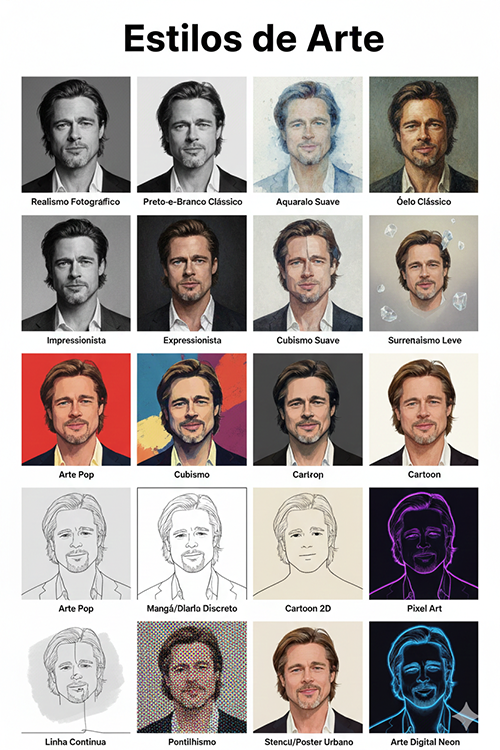
Aqui está a versão ajustada, trocando as 16 variações de efeito por 16 estilos de arte diferentes, sempre mantendo 100% da identidade, cabelo e gênero da foto enviada.
Prompt – Poster 16 Estilos de Arte (IDENTIDADE TRAVADA)
Use the uploaded photo as the ONLY and EXCLUSIVE identity reference. The young person shown in every square must be the exact same real person from the uploaded image, not a generic model or a different face.
IDENTITY LOCK – 100% FACE, HAIR, GENDER
Preserve 100% of the real appearance of the person in the reference photo: same facial structure and proportions, skull shape, jawline, chin, cheekbones, nose, lips, eyes, eyebrows, ears, skin tone, age and gender, including all unique details such as asymmetries, freckles, spots, scars, wrinkles, beard texture and hair density. Keep exactly the same hairstyle family: same haircut type, hairline, length, direction of strands, volume and overall silhouette; do NOT change hairstyle type or gender expression, only allow very small grooming adjustments if needed, as long as it is clearly the same haircut.
GLOBAL SCENE – POSTER DESCRIPTION
Create a high‑resolution poster titled “Estilos de Arte”, designed as a 4×4 visual grid showing the SAME face rendered in 16 different art styles. Clean, minimalist layout: pure white background, each square containing one stylized portrait, sharp typography, no extra decorative elements.
LAYOUT AND TYPOGRAPHY
At the top of the poster, place a large bold sans‑serif title in black that reads exactly: “Estilos de Arte”, centered horizontally on the white background.
Below the title, create a perfect 4×4 grid of square portrait images, with equal spacing and margins, forming a rigid grid with consistent distances between all squares.
CHARACTER AND FRAMING IN EVERY SQUARE
Each of the 16 squares must show the same person from the uploaded photo, with identical facial identity, hairstyle family, gender, age and ethnicity.
Use the same base framing in all squares: head and upper shoulders, frontal camera, same focal length and crop. The pose and neutral / lightly pleasant expression stay similar in all 16 portraits so that the main variation is the art style, not face shape or pose.
16 ART STYLES (ONE PER SQUARE)
Apply a different art style to each square while keeping the face perfectly recognizable. Under every square, write the corresponding style name in Portuguese, centered in a simple sans‑serif font, black text on white. Use each style exactly once:
Realismo Fotográfico – ultra‑realistic, DSLR‑level portrait, natural colors and lighting.
Preto‑e‑Branco Clássico – high‑contrast black‑and‑white studio portrait, elegant grayscale.
Aquarela Suave – watercolor painting with soft edges, light wash textures and gentle color bleeding.
Óleo Clássico – traditional oil painting style, visible brushstrokes, rich warm colors, museum‑like look.
Impressionista – loose brushstrokes, broken color, soft edges, inspired by impressionist painting (sem citar artistas vivos).
Expressionista – bold colors and stronger contrast, slightly exaggerated shapes to enhance emotion, still clearly the same face.
Cubismo Suave – geometric planes and subtle fragmentation of shapes, multiple angles suggested, but identity still very readable.
Surrealismo Leve – slightly dreamlike atmosphere and background, maybe floating shapes or unexpected elements, while the face remains anatomically correct.
Arte Pop – flat, strong colors, poster‑like look, thick outlines or graphic shading, reminiscent of pop‑art posters.
Mangá/Anime Discreto – clean line art, cell‑shading and simplified features in manga/anime style, but preserving the same hairstyle silhouette and overall face proportions.
Cartoon 2D – stylized 2D cartoon illustration, smooth lines and simple shading, identity and hairstyle clearly maintained.
Pixel Art – portrait rendered in retro pixel‑art style, visible square pixels, with enough resolution to still recognize the person.
Linha Contínua – minimalist one‑line drawing look, single continuous line forming the face, supported by subtle tone or background so the identity remains readable.
Pontilhismo – pointillism style with tiny dots forming the image, clear structure at normal viewing distance.
Stencil/Poster Urbano – high‑contrast stencil look, solid black shapes on light background, graphic street‑art vibe.
Arte Digital Neon – modern digital illustration with glowing neon accents around the character or background, but without distorting the face.
All 16 portraits must still show the same anatomical face, same haircut silhouette and same gender expression; styles change color, line and rendering, not the identity.
TEXT CAPTIONS UNDER EACH PORTRAIT
Below each square, write its style label exactly as:
“Realismo Fotográfico”, “Preto‑e‑Branco Clássico”, “Aquarela Suave”, “Óleo Clássico”, “Impressionista”, “Expressionista”, “Cubismo Suave”, “Surrealismo Leve”, “Arte Pop”, “Mangá/Anime Discreto”, “Cartoon 2D”, “Pixel Art”, “Linha Contínua”, “Pontilhismo”, “Stencil/Poster Urbano”, “Arte Digital Neon”.
Use identical sans‑serif font, size and weight for all labels, aligned neatly with the 4×4 grid.
MOOD, QUALITY AND RESTRICTIONS
Mood: playful, educational and visually striking, like a professional poster demonstrating how different art styles reinterpret the same face. The design must stay clean and minimal, with strong grid structure and typography hierarchy, no emojis or extra icons.
Generate in ultra‑high resolution with very clear facial details, crisp edges and consistent framing. No extra logos, watermarks, UI elements or text besides the title and the 16 style names.
Do NOT change the person’s identity, ethnicity, age or gender. Do NOT change the haircut family. No horror or gore, no extreme surreal distortions that break facial anatomy, no low‑poly 3D or plastic toy renders (unless very subtly implied within the listed styles). Identity, hair and gender must remain 100% consistent across all 16 art styles.
Prompt – Poster 16 Estilos de Arte (IDENTIDADE TRAVADA)
Use the uploaded photo as the ONLY and EXCLUSIVE identity reference. The young person shown in every square must be the exact same real person from the uploaded image, not a generic model or a different face.
IDENTITY LOCK – 100% FACE, HAIR, GENDER
Preserve 100% of the real appearance of the person in the reference photo: same facial structure and proportions, skull shape, jawline, chin, cheekbones, nose, lips, eyes, eyebrows, ears, skin tone, age and gender, including all unique details such as asymmetries, freckles, spots, scars, wrinkles, beard texture and hair density. Keep exactly the same hairstyle family: same haircut type, hairline, length, direction of strands, volume and overall silhouette; do NOT change hairstyle type or gender expression, only allow very small grooming adjustments if needed, as long as it is clearly the same haircut.
GLOBAL SCENE – POSTER DESCRIPTION
Create a high‑resolution poster titled “Estilos de Arte”, designed as a 4×4 visual grid showing the SAME face rendered in 16 different art styles. Clean, minimalist layout: pure white background, each square containing one stylized portrait, sharp typography, no extra decorative elements.
LAYOUT AND TYPOGRAPHY
At the top of the poster, place a large bold sans‑serif title in black that reads exactly: “Estilos de Arte”, centered horizontally on the white background.
Below the title, create a perfect 4×4 grid of square portrait images, with equal spacing and margins, forming a rigid grid with consistent distances between all squares.
CHARACTER AND FRAMING IN EVERY SQUARE
Each of the 16 squares must show the same person from the uploaded photo, with identical facial identity, hairstyle family, gender, age and ethnicity.
Use the same base framing in all squares: head and upper shoulders, frontal camera, same focal length and crop. The pose and neutral / lightly pleasant expression stay similar in all 16 portraits so that the main variation is the art style, not face shape or pose.
16 ART STYLES (ONE PER SQUARE)
Apply a different art style to each square while keeping the face perfectly recognizable. Under every square, write the corresponding style name in Portuguese, centered in a simple sans‑serif font, black text on white. Use each style exactly once:
Realismo Fotográfico – ultra‑realistic, DSLR‑level portrait, natural colors and lighting.
Preto‑e‑Branco Clássico – high‑contrast black‑and‑white studio portrait, elegant grayscale.
Aquarela Suave – watercolor painting with soft edges, light wash textures and gentle color bleeding.
Óleo Clássico – traditional oil painting style, visible brushstrokes, rich warm colors, museum‑like look.
Impressionista – loose brushstrokes, broken color, soft edges, inspired by impressionist painting (sem citar artistas vivos).
Expressionista – bold colors and stronger contrast, slightly exaggerated shapes to enhance emotion, still clearly the same face.
Cubismo Suave – geometric planes and subtle fragmentation of shapes, multiple angles suggested, but identity still very readable.
Surrealismo Leve – slightly dreamlike atmosphere and background, maybe floating shapes or unexpected elements, while the face remains anatomically correct.
Arte Pop – flat, strong colors, poster‑like look, thick outlines or graphic shading, reminiscent of pop‑art posters.
Mangá/Anime Discreto – clean line art, cell‑shading and simplified features in manga/anime style, but preserving the same hairstyle silhouette and overall face proportions.
Cartoon 2D – stylized 2D cartoon illustration, smooth lines and simple shading, identity and hairstyle clearly maintained.
Pixel Art – portrait rendered in retro pixel‑art style, visible square pixels, with enough resolution to still recognize the person.
Linha Contínua – minimalist one‑line drawing look, single continuous line forming the face, supported by subtle tone or background so the identity remains readable.
Pontilhismo – pointillism style with tiny dots forming the image, clear structure at normal viewing distance.
Stencil/Poster Urbano – high‑contrast stencil look, solid black shapes on light background, graphic street‑art vibe.
Arte Digital Neon – modern digital illustration with glowing neon accents around the character or background, but without distorting the face.
All 16 portraits must still show the same anatomical face, same haircut silhouette and same gender expression; styles change color, line and rendering, not the identity.
TEXT CAPTIONS UNDER EACH PORTRAIT
Below each square, write its style label exactly as:
“Realismo Fotográfico”, “Preto‑e‑Branco Clássico”, “Aquarela Suave”, “Óleo Clássico”, “Impressionista”, “Expressionista”, “Cubismo Suave”, “Surrealismo Leve”, “Arte Pop”, “Mangá/Anime Discreto”, “Cartoon 2D”, “Pixel Art”, “Linha Contínua”, “Pontilhismo”, “Stencil/Poster Urbano”, “Arte Digital Neon”.
Use identical sans‑serif font, size and weight for all labels, aligned neatly with the 4×4 grid.
MOOD, QUALITY AND RESTRICTIONS
Mood: playful, educational and visually striking, like a professional poster demonstrating how different art styles reinterpret the same face. The design must stay clean and minimal, with strong grid structure and typography hierarchy, no emojis or extra icons.
Generate in ultra‑high resolution with very clear facial details, crisp edges and consistent framing. No extra logos, watermarks, UI elements or text besides the title and the 16 style names.
Do NOT change the person’s identity, ethnicity, age or gender. Do NOT change the haircut family. No horror or gore, no extreme surreal distortions that break facial anatomy, no low‑poly 3D or plastic toy renders (unless very subtly implied within the listed styles). Identity, hair and gender must remain 100% consistent across all 16 art styles.