2564ceec2ba0acc95a31f0bd4a7679d3
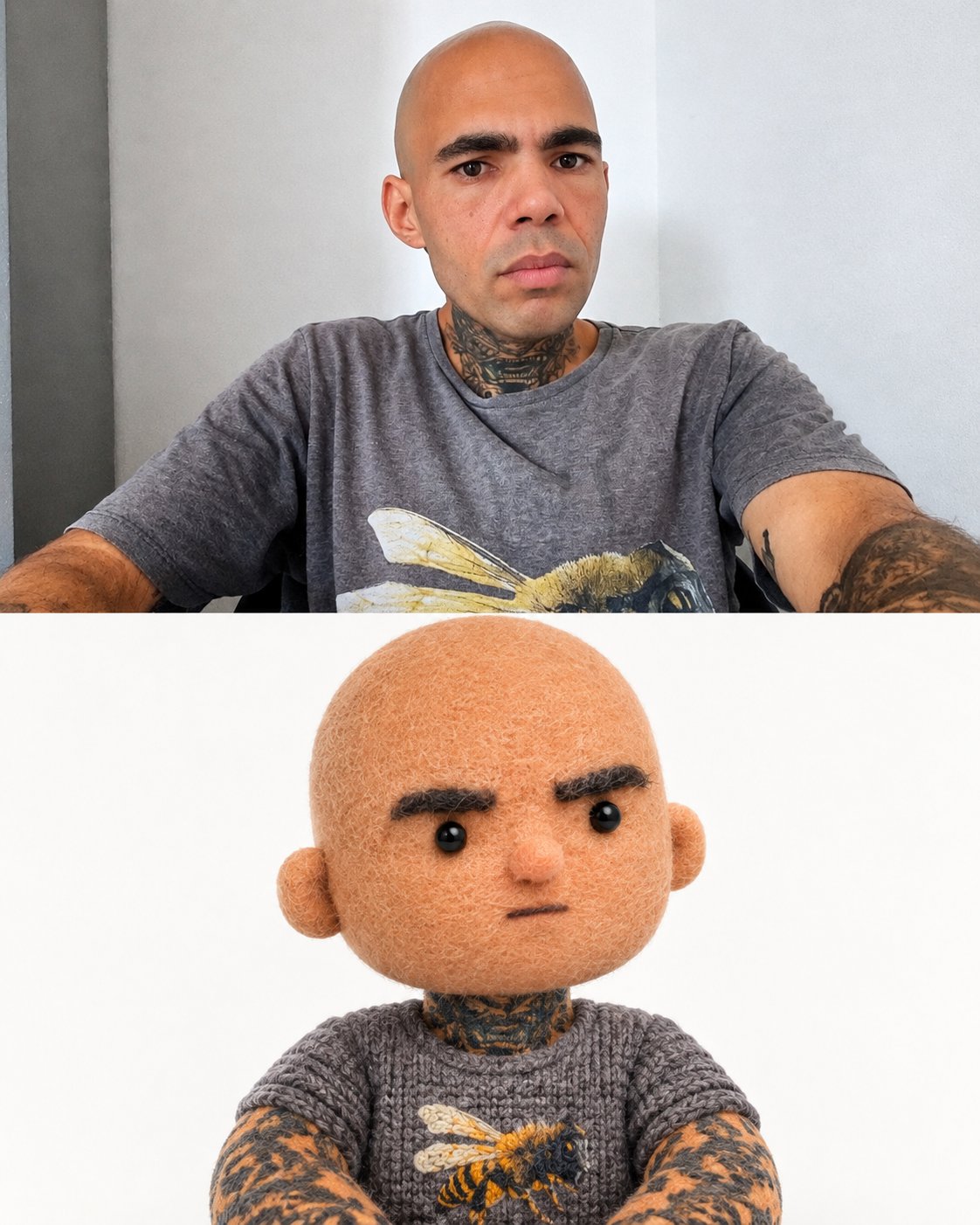
[OUTPUT] One single unified image in 4:5 vertical, not a collage. Split into two panels of exactly equal height, each occupying 50% of the frame, stacked and divided by one clean straight horizontal edge.
[CRITICAL] The two panels are two separate images of the same subject, not one picture with its lower half stylised. Nothing runs continuously across the dividing edge — no shared background, no element sliced in half. The top panel is the photograph; the bottom panel is a complete, self-contained doll portrait with its own white backdrop.
[TOP PANEL — BEFORE] The attached real photograph exactly as provided: same subject, same pose, same background, same colours and lighting, unedited apart from a subtle refined grade. Crop intelligently to fill the landscape panel edge to edge without distorting the subject. Full bleed, no margins, no border.
[BOTTOM PANEL — AFTER] A 3D textile-art doll bust of the same person.
Identify the inputs by content: the real photograph is the IDENTITY SOURCE, the minimalist doll on a white background is the STYLE REFERENCE. Preserve identity, expression, pose and object relationships, and reconstruct them as an exaggerated, humorous designer toy. Do not simply apply a plush-texture filter.
REFERENCE — take ONLY these qualities from the style image: a wide, rounded, oversized head; tiny tightly-clustered facial features with generous empty space on the face; sculptural knit forms and yarn clusters; slight asymmetry; the contrast between fine-grain flocking and coarse knitwear; a primary/secondary colour structure; white-background studio lighting.
Do NOT inherit the reference character's body, pose, hairstyle, hat, glasses, clothing, props or colours.
SUBJECT — the real photograph is a strict content whitelist. Render only the body parts, hairstyle, clothing, accessories, objects, pose and points of contact actually visible in it. Never add anything beyond the frame.
Extract 2–5 identity anchors; exaggerate 1–2 of them and simplify the rest.
The face is a wide, thick, rounded cube or short cylinder. The eyes are tiny black beads or capsules. The nose is a small rounded block. The mouth becomes a short line or small opening, following the original expression. The hair becomes large yarn loops or clusters.
Hand count must match exactly: no hands visible means no hands drawn; one hand means one hand only — keeping its direction, its cuff, and whatever it is touching. Any text or logo becomes unreadable woven texture.
COMPOSITION — a tight head-and-shoulders bust centred in the landscape panel. The head occupies roughly 70–85% of the PANEL HEIGHT, with clean empty white space to the left and right of the figure. The body is compressed, keeping only the necessary gesture or object. Cropping at the edges is allowed; never add body that was outside the original frame.
STYLE — stylized 3D textile art toy, oversized head and tiny features, sculptural knit forms, micro-flocked surface. Abstraction and exaggeration take priority over realism, while remaining recognisable through silhouette, pose and objects.
COLOUR — build a palette of 3–5 colours automatically: a primary colour, an accent with clear warm/cool or value contrast, a supporting colour, and a neutral. Non-identity areas may be recoloured. Avoid near-monochrome, all-neutral, evenly distributed rainbow, and mechanical stripes.
MATERIAL AND LIGHTING — face, hands and small parts use short dense flocking or fine felt. Hair, hats and clothing use coarse knit or crochet, yarn loops and clusters. A slightly warm white seamless background, soft bright studio lighting, and short light shadows.
[RESTRICTIONS] Do not retain realistic eyeballs, nostrils, lips, skin or individual hair strands. Do not copy the style reference's character. Do not add any body, gesture, accessory or prop that is not in the photograph. No ordinary 3D cartoon look, plastic, polymer clay, wax figure, long-pile plush, readable text or logos, rooms or complex backgrounds.
The identity source decides WHAT to render; the style image only decides HOW to render it.
[AVOID] The lower panel continuing the upper photo, one scene split across both panels, a subject sliced across the dividing edge, unequal panel heights, a visible gap or border between panels, side-by-side layout, a photographic subject in the lower panel, a realistic background in the lower panel, mismatched subjects between panels, a doll that is not recognisably the same person, text, watermark.