44be4582f0c9f75ea8e501a18fe0113c
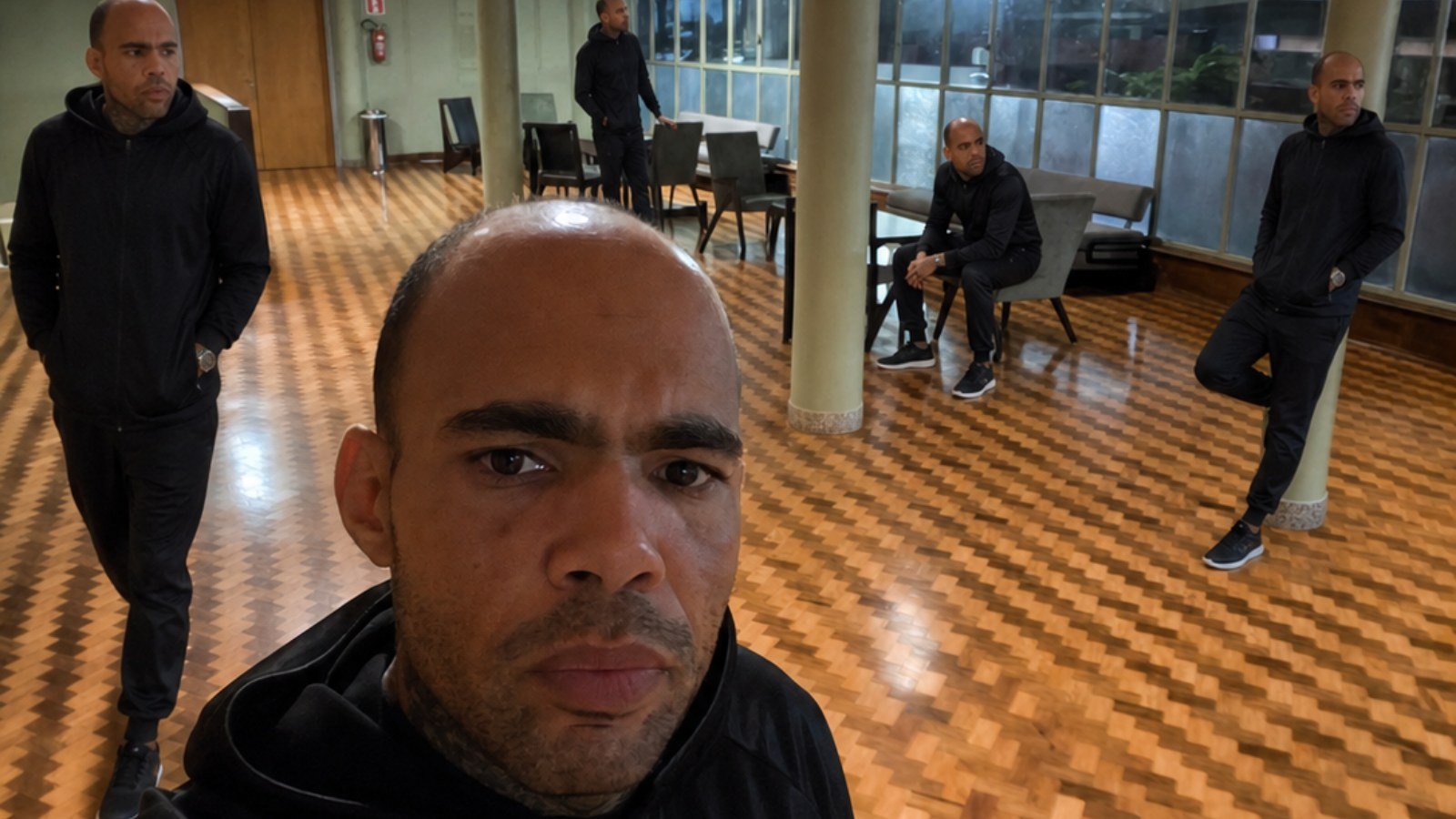
@image1 = the source photo
Add four photorealistic duplicates of the person in this photograph, placed naturally around the scene, so it reads as one real photo of the same individual standing in several places at once.
THE ORIGINAL PERSON — unchanged
Keep them exactly as photographed: same face, pose, clothing, accessories, position in frame and sharpness. Do not move, resize, re-pose, retouch or partially cover them. They remain fully visible and the clear focal point.
THE DUPLICATES — identical person
Each duplicate is unmistakably the same individual: the same face and bone structure, the same hairstyle and hair colour, the same facial hair, the same skin tone, the same height and build, and the exact same outfit down to the garment colours, patterns, footwear, bag, watch, jewellery and eyewear. Nothing varies between them but the pose.
THE POSES — invent them from THIS location
Do not use a stock set of poses. Read the actual environment in @image1 and invent poses that genuinely belong in that specific place, using what is physically there.
Look at what the scene offers — steps, a kerb, a low wall, a railing, a doorway, a bench, sand, a lamppost, a car bonnet, a shop front — and have each duplicate interact with a different one of those features in a way a real person would while waiting around there.
Every pose must be DIFFERENT from the others in body shape and energy: vary standing, sitting, leaning, crouching, mid-stride, turning, reaching, resting. Vary the direction each one faces and the height each one occupies, so the figures create a varied rhythm across the frame rather than a row of similar silhouettes.
Make the poses look good. Relaxed, natural and quietly stylish — the kind of posture a person falls into when they are comfortable and not performing. Confident body language, clean lines, nothing stiff, nothing awkward, nothing theatrical.
None of them looks at the camera. None looks at or interacts with another. None mirrors another's pose.
Generate a genuinely different set of poses every time this prompt is run — never repeat the same combination across images.
PLACEMENT AND DEPTH — the thing that makes it believable
Spread them across clearly different distances from the camera: one close to the foreground, one at mid-distance, two further back. Distribute them left and right across the frame rather than clustering on one side, and leave clean space between every figure so no two bodies overlap or touch.
Scale each one correctly for its distance. A duplicate further away is proportionally smaller and sits higher in the frame, with its feet on the correct point of the receding ground plane. Their heads should roughly follow the scene's horizon line, as real people at different depths do.
GROUNDING
Every duplicate stands, sits or crouches with real contact against the actual surface — the same pavement, floor, step, grass or sand — never floating, never sinking.
Each casts its own shadow, falling in the same direction, at the same angle and with the same softness as the shadows already in the photograph, anchored where the body meets the ground.
LIGHT AND CAMERA MATCHING
Light every duplicate with the scene's existing key light — same direction, same hardness, same colour temperature, same ambient fill. Highlights fall on the same sides of the body; shaded sides sit at the same depth as everything else in frame.
Match the camera. Distant duplicates are slightly softer if the original has shallow depth of field, and pick up the same atmospheric haze as objects at that distance. Every duplicate carries the same grain, noise, sharpness, lens character and colour grade as the original photograph.
THE SCENE
Keep the background, architecture, objects, other people, framing, crop and aspect ratio exactly as they are. Only add figures into the space that already exists.
The finished image must read as a single real photograph, not a composite.
Avoid: repeating the same poses across different images, a crouching figure tying a shoelace, every duplicate standing upright, duplicates in similar or mirrored postures, poses that ignore the surroundings, stiff or awkward posture, overlapping or touching figures, duplicates clustered at one distance, duplicates all the same size, wrong scale for depth, feet floating or sunk, a missing shadow, a shadow falling the wrong way, a duplicate lit differently from the scene, blurry low-detail duplicates, a changed face, inconsistent faces between duplicates, a different hairstyle or outfit on any duplicate, duplicates looking at the camera, duplicates interacting, a cut-out or pasted-on look, a collage, a changed background or crop, text, watermark.
Run at moderate edit strength (0.5-0.65). Change the seed between runs.