Apresentacao_de_produto
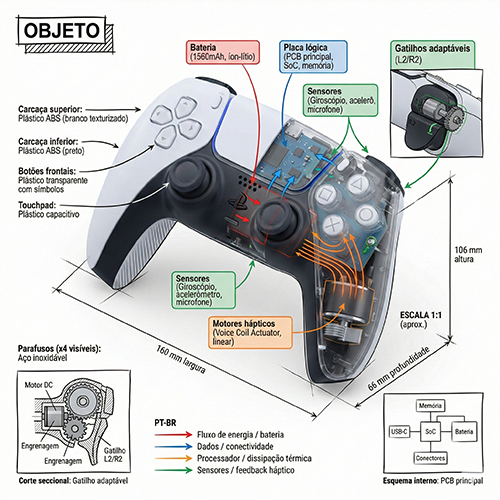
Create a technical infographic of [PRODUCT] in a 45‑degree isometric 3D perspective, with the device slightly tilted to clearly reveal depth, volume, and internal architecture. The object is rendered as a clean, realistic photoreal 3D model, floating on a pure white background, surrounded by black ink technical annotations like an engineering teardown sheet. All labels, callouts, measurements, and descriptive text on the infographic must be written in Brazilian Portuguese (pt‑BR).
Show internal components through transparent and cutaway sections wherever useful, revealing key subsystems inside the [PRODUCT]. Add clear, readable key component labels with color‑coded callout boxes, using PT‑BR terms such as “Bateria”, “Placa lógica”, “Sensores”, “Carcaça”, “Conectores”, “Motores hápticos”. Include measurements, dimensions, and precise scale markers with metric units and PT‑BR notation, for example “160 mm largura”, “66 mm profundidade”, “106 mm altura”.
Add material callouts and quantities in PT‑BR, such as “Plástico ABS”, “Alumínio escovado”, “Parafusos (x4)”, “Borracha texturizada”. Use color‑coded arrows with PT‑BR legends to explain function and flow: RED for power/battery (“Fluxo de energia / bateria”), BLUE for data/connectivity (“Dados / conectividade”), ORANGE for thermal/processor (“Processador / dissipação térmica”), and GREEN for sensors/haptics (“Sensores / feedback háptico”). Add simple schematic insets or cross‑sectional mini‑diagrams where relevant, with titles like “Corte seccional” or “Esquema interno”. Place the title “OBJETO” in the top‑left corner in a hand‑drawn technical box, written in PT‑BR.
Style / Look
Black linework in technical pen / architectural drawing style: slightly sketched but precise and consistent, with crisp edges and fine hatching where needed. The [PRODUCT] remains clearly visible and not overwhelmed by annotations, creating an educational museum‑exhibit vibe. Clean composition, strong visual hierarchy, and balanced negative space so the layout feels modern and minimal.
Perspective / Camera
Isometric 3D angle at about 45 degrees, tilted to show top and side faces of the [PRODUCT] simultaneously, emphasizing depth and internal structure like a professional teardown diagram or engineering manual. No extreme perspective distortion, no fisheye.
Color usage
Black is dominant for outlines, details, and text. All text and labels appear in Brazilian Portuguese. Color accents limited to about 10–15% of the image, used mainly in callout boxes and arrows: RED (energia / bateria), BLUE (dados / conectividade), ORANGE (térmico / processador), GREEN (sensores / hápticos). Pure white background, no gradients or textures.
Output / Format
1080×1080 pixels, ultra‑crisp render, optimized for social media feeds and technical presentations.
Negative prompt
blurry, low resolution, pixelated, noisy, out of focus, busy background, non‑white background, gradients behind the object, cluttered composition, illegible text, text in English or other languages, random labels, wrong perspective, non‑isometric view, generic flat icon, cartoonish clip‑art, oversaturated colors, too many colors, low‑detail sketch, overlapping callouts, chaotic arrows, watermark, logo, UI overlays, additional objects or hands, 16:9 aspect ratio, extreme perspective distortion, fisheye lens.
Show internal components through transparent and cutaway sections wherever useful, revealing key subsystems inside the [PRODUCT]. Add clear, readable key component labels with color‑coded callout boxes, using PT‑BR terms such as “Bateria”, “Placa lógica”, “Sensores”, “Carcaça”, “Conectores”, “Motores hápticos”. Include measurements, dimensions, and precise scale markers with metric units and PT‑BR notation, for example “160 mm largura”, “66 mm profundidade”, “106 mm altura”.
Add material callouts and quantities in PT‑BR, such as “Plástico ABS”, “Alumínio escovado”, “Parafusos (x4)”, “Borracha texturizada”. Use color‑coded arrows with PT‑BR legends to explain function and flow: RED for power/battery (“Fluxo de energia / bateria”), BLUE for data/connectivity (“Dados / conectividade”), ORANGE for thermal/processor (“Processador / dissipação térmica”), and GREEN for sensors/haptics (“Sensores / feedback háptico”). Add simple schematic insets or cross‑sectional mini‑diagrams where relevant, with titles like “Corte seccional” or “Esquema interno”. Place the title “OBJETO” in the top‑left corner in a hand‑drawn technical box, written in PT‑BR.
Style / Look
Black linework in technical pen / architectural drawing style: slightly sketched but precise and consistent, with crisp edges and fine hatching where needed. The [PRODUCT] remains clearly visible and not overwhelmed by annotations, creating an educational museum‑exhibit vibe. Clean composition, strong visual hierarchy, and balanced negative space so the layout feels modern and minimal.
Perspective / Camera
Isometric 3D angle at about 45 degrees, tilted to show top and side faces of the [PRODUCT] simultaneously, emphasizing depth and internal structure like a professional teardown diagram or engineering manual. No extreme perspective distortion, no fisheye.
Color usage
Black is dominant for outlines, details, and text. All text and labels appear in Brazilian Portuguese. Color accents limited to about 10–15% of the image, used mainly in callout boxes and arrows: RED (energia / bateria), BLUE (dados / conectividade), ORANGE (térmico / processador), GREEN (sensores / hápticos). Pure white background, no gradients or textures.
Output / Format
1080×1080 pixels, ultra‑crisp render, optimized for social media feeds and technical presentations.
Negative prompt
blurry, low resolution, pixelated, noisy, out of focus, busy background, non‑white background, gradients behind the object, cluttered composition, illegible text, text in English or other languages, random labels, wrong perspective, non‑isometric view, generic flat icon, cartoonish clip‑art, oversaturated colors, too many colors, low‑detail sketch, overlapping callouts, chaotic arrows, watermark, logo, UI overlays, additional objects or hands, 16:9 aspect ratio, extreme perspective distortion, fisheye lens.