Cartoon_rasgado
Use the uploaded image as the exact identity reference. Maintain the person’s identity 100% identical to the source photo: same facial features, facial bone structure and proportions, skin tone, hairstyle shape, perceived age, and gender presentation. Keep the exact head angle, camera perspective, and facial expression. Do not rotate, mirror, beautify, de-age or age up, or change the gender; the face must remain instantly recognizable as the same person.
Main prompt (positive)
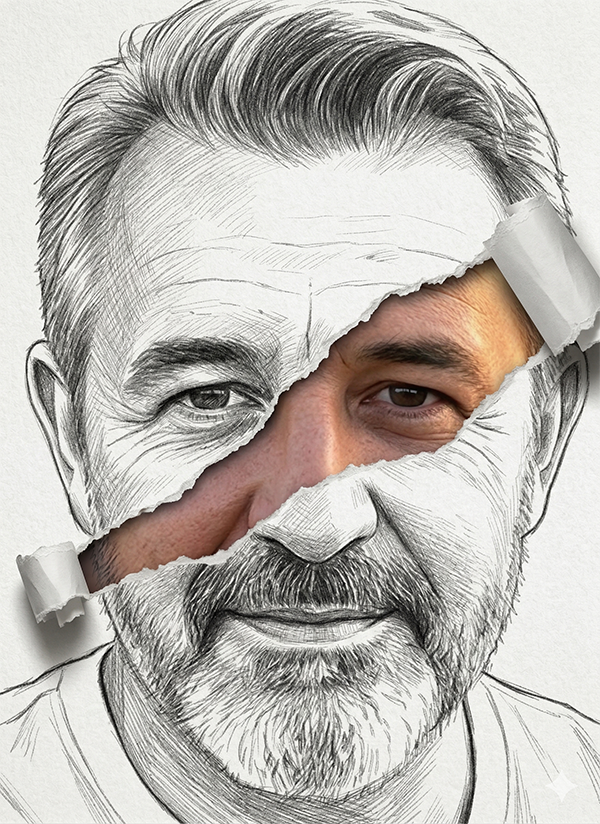
Transform the uploaded portrait into a highly detailed graphite pencil sketch on textured paper, while preserving the original identity and likeness. The entire visible face and hair are rendered as a monochrome graphite drawing: precise pencil line work, smooth tonal shading, cross-hatching, and subtle paper grain visible in lighter areas. Across the face, a jagged torn paper opening reveals the original full-color realistic portrait underneath, as if the pencil drawing layer has been ripped open.
The revealed eye inside the torn opening must align perfectly with the sketched face anatomy, matching the exact eye position, size, and angle from the reference image. Inside the tear, realistic skin and hair are visible in full color, with natural tones and detailed texture, contrasting with the surrounding graphite sketch. Torn paper edges are curled and irregular, with visible thickness, fibers, and cast shadows onto the drawing surface, enhancing the mixed-media illusion.
Pencil shading should include controlled cross‑hatching, soft gradients for cheeks and forehead, sharper strokes for hair and eyebrows, and fine detailing around the nose, lips, and eyelids to keep the face clearly readable. The overall style is a surreal mixed-media portrait: half traditional graphite art, half hidden photographic realism beneath the tear, ultra-detailed, 8K look.
Lighting: soft, directional studio lighting from slightly above and in front, creating gentle shadows on one side of the face and subtle highlights on the graphite strokes and paper texture. Keep contrast high enough to show depth in the shading but avoid harsh blown-out whites. The composition is a tight close-up portrait (head and upper neck), front-facing, with the face centered in the frame and the torn opening placed across one eye or central facial area as the main focal point.
Camera and lens look: frontal portrait, natural perspective with an 85mm portrait-lens feel (mild compression, no wide-angle distortion), sharp focus on the eyes and torn-paper area, slight falloff towards the outer edges of the paper. Ultra-detailed, clean, gallery-quality illustration, as if shot with a high-end camera and then perfectly translated into mixed media.
Negative prompt
blurry, low detail, low resolution, flat lighting, muddy shading, messy or smudged graphite, indistinct facial features, distorted face, misaligned eyes, warped anatomy, changed age, gender swap, feminized or masculinized face compared to the reference, altered facial proportions, different expression.
no colored pencil everywhere, no full-color painting over the whole face, no watercolor wash, no cartoon or anime style, no heavy digital glitch effects, no random textures that obscure the face.
no unrealistic torn edges (no glowing, no fire, no neon), no misaligned torn opening that does not match the underlying anatomy, no extra eyes or duplicated facial features inside the tear.
no heavy noise or grain, no text, logos, watermarks, or UI elements, no extreme wide-angle distortion, no background clutter; keep it as a clean, tight portrait on textured paper.
Main prompt (positive)
Transform the uploaded portrait into a highly detailed graphite pencil sketch on textured paper, while preserving the original identity and likeness. The entire visible face and hair are rendered as a monochrome graphite drawing: precise pencil line work, smooth tonal shading, cross-hatching, and subtle paper grain visible in lighter areas. Across the face, a jagged torn paper opening reveals the original full-color realistic portrait underneath, as if the pencil drawing layer has been ripped open.
The revealed eye inside the torn opening must align perfectly with the sketched face anatomy, matching the exact eye position, size, and angle from the reference image. Inside the tear, realistic skin and hair are visible in full color, with natural tones and detailed texture, contrasting with the surrounding graphite sketch. Torn paper edges are curled and irregular, with visible thickness, fibers, and cast shadows onto the drawing surface, enhancing the mixed-media illusion.
Pencil shading should include controlled cross‑hatching, soft gradients for cheeks and forehead, sharper strokes for hair and eyebrows, and fine detailing around the nose, lips, and eyelids to keep the face clearly readable. The overall style is a surreal mixed-media portrait: half traditional graphite art, half hidden photographic realism beneath the tear, ultra-detailed, 8K look.
Lighting: soft, directional studio lighting from slightly above and in front, creating gentle shadows on one side of the face and subtle highlights on the graphite strokes and paper texture. Keep contrast high enough to show depth in the shading but avoid harsh blown-out whites. The composition is a tight close-up portrait (head and upper neck), front-facing, with the face centered in the frame and the torn opening placed across one eye or central facial area as the main focal point.
Camera and lens look: frontal portrait, natural perspective with an 85mm portrait-lens feel (mild compression, no wide-angle distortion), sharp focus on the eyes and torn-paper area, slight falloff towards the outer edges of the paper. Ultra-detailed, clean, gallery-quality illustration, as if shot with a high-end camera and then perfectly translated into mixed media.
Negative prompt
blurry, low detail, low resolution, flat lighting, muddy shading, messy or smudged graphite, indistinct facial features, distorted face, misaligned eyes, warped anatomy, changed age, gender swap, feminized or masculinized face compared to the reference, altered facial proportions, different expression.
no colored pencil everywhere, no full-color painting over the whole face, no watercolor wash, no cartoon or anime style, no heavy digital glitch effects, no random textures that obscure the face.
no unrealistic torn edges (no glowing, no fire, no neon), no misaligned torn opening that does not match the underlying anatomy, no extra eyes or duplicated facial features inside the tear.
no heavy noise or grain, no text, logos, watermarks, or UI elements, no extreme wide-angle distortion, no background clutter; keep it as a clean, tight portrait on textured paper.