Cda234bbec4e319036fa972a4c646e68
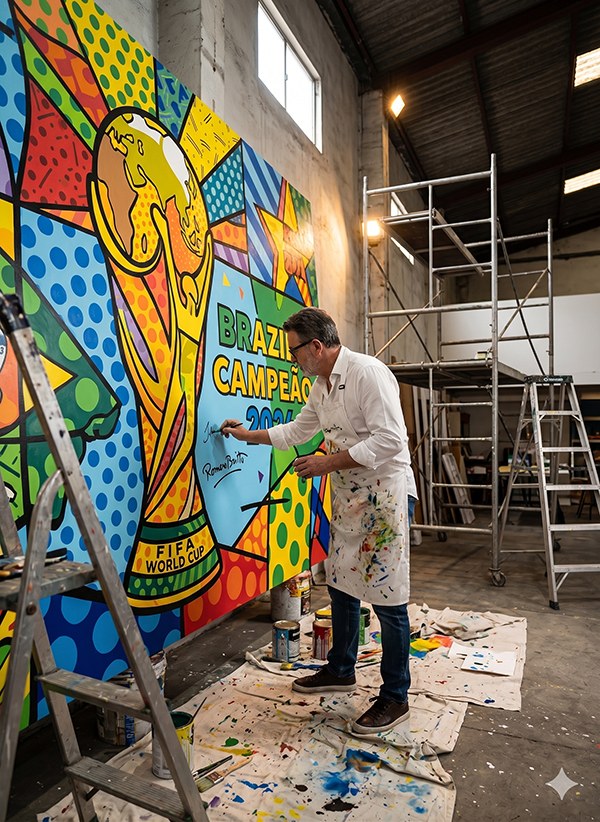
Ultra‑realistic cinematic photography look inside an industrial art studio, in high‑resolution 4K–8K, with sharp details and realistic materials and lighting. The scene shows a large industrial warehouse converted into a monumental painting studio, with very high ceilings, visible metal beams, raw concrete or brick walls, and a 6‑meter‑high wall used as the main painting surface. On this wall, there is a huge painting of the FIFA World Cup 2026 trophy, celebrating Brazil as champions, rendered in a Romero Britto–inspired pop‑cubist style: bold black outlines, fragmented geometric planes, and colorful patches; bright, saturated colors (yellows, greens, blues, reds, pinks, oranges, purples), playful dots, stripes, zigzags and patterns inside each shape; a cheerful, optimistic “happy art” mood and strong graphic impact. The trophy silhouette (globe on top, abstract human figures rising) is simplified into bold shapes with thick black outlines, surfaces divided into vibrant color blocks and geometric patterns, clearly reading as the World Cup trophy but feeling playful and optimistic, with Brazil’s flag colors (canary yellow, vivid green, blue) integrated into the background around the trophy, plus subtle stars, confetti and abstract celebratory shapes radiating from behind it to evoke victory and national pride.
Use the exact identity of the person from the uploaded reference photo only. Keep 100% of the original facial anatomy and proportions: skull and bone structure, eye shape and distance, eyelids, iris details, nose shape, mouth and lips, jawline, cheekbones, chin, ears, eyebrows, hairline. Keep the same hairstyle, hair length, hair volume, hair direction and hair color; do not change haircut or color, only adapt to lighting if needed. Preserve the same gender expression, ethnicity and overall body type, including natural asymmetries and unique features. No beautifying, no slimming, no aging or de‑aging, no anatomical changes. The person from the reference photo is the real painter in the studio, working on and finishing the giant World Cup 2026 trophy mural that celebrates Brazil as champion in a Romero Britto–inspired style. They wear artist clothes: casual outfit plus a white painter’s apron covered in colorful paint stains and splatters.
In front of the mural wall there are metal scaffolding, ladders, paint buckets, open cans of paint, brushes, rollers, rags, drop cloths and paint splashes on the floor, creating a messy, authentic studio atmosphere. Optional elements include tables with palettes, jars of water and small Britto‑style sketches of trophy variations pinned nearby. The person from the reference photo is actively working as the painter of this championship mural: they stand near the bottom area of the 6‑meter wall, holding a brush or marker, as if finishing the last details of the artwork. Their body language shows concentration and pride, as if completing a major celebratory piece; paint stains on their apron and hands reinforce that they have been painting this mural for a long time.
Camera framing is a medium‑wide or wide shot capturing the full body of the painter and the majority of the mural. The painter is the main subject, positioned slightly off‑center, facing the wall, with their side or three‑quarter profile visible to the camera. The giant Romero Britto–inspired World Cup 2026 trophy mural dominates the wall behind them, with the stylized trophy and Brazil‑champion celebration clearly visible above or beside the painter. In the foreground, some paint cans, brushes, scaffolding parts or tools are partially in front of the camera, slightly out of focus, creating depth. In the midground, the painter and the lower portion of the trophy are in sharp focus. In the background, the upper sections of the mural, scaffolding, ceiling beams and far parts of the warehouse become progressively softer and darker, creating layered depth and parallax. The painter’s head and feet must not be cropped; full body and head are clearly visible.
Use a simulated 35–50 mm lens on a full‑frame camera, with natural perspective and no extreme distortion. Give the shot a slight handheld documentary feel, as if a photographer captured a real moment in the studio. Depth of field is moderate, with sharp focus on the painter and the area of the mural they are working on, while foreground objects and distant background are slightly blurred to create clear separation between foreground, midground and background.
Lighting is realistic indoor illumination mixing soft daylight and studio work‑lights. Soft diffused daylight enters from high windows, and warm spotlights are directed at the mural and the painter. The key light mainly comes from one side, shaping the painter’s face and body and preserving all facial details from the reference. Fill light reduces harsh shadows, keeping a cinematic but believable contrast. The environment color palette is natural neutrals, while the mural uses Britto‑style bright, saturated colors and bold black outlines with a strong presence of Brazil’s green, yellow and blue, expressing championship energy; the apron shows multiple paint stains in various hues. Avoid extreme color grading and maintain a realistic cinematic look.
Negative prompt: do not change the person’s face—no morphing, no beautifying, no slimming, no age changes. Do not alter gender, ethnicity, hairstyle or hair color. Do not replace the subject with another person or generic model. The real painter’s face must remain photorealistic and identical to the reference, not cartoon or anime. The mural can be highly stylized in a Romero Britto–inspired pop‑cubist style, but the painter in the scene stays realistic. No low resolution, no noise, no compression artifacts, no blurry main subject. No empty studio; environment must be detailed and plausible, with real scaffolding, paint and tools. No cropping of the painter’s head or body. Do not remove or replace the World Cup trophy theme or the Brazil‑as‑champion celebration in the mural. Absolutely no text or signatures in the image that mention “Romero Britto” or any other real artist name; use only the visual style, never the artist’s name in the artwork.