Clones
Create an image that uses the attached reference photo as a strict identity anchor: both subjects must preserve 100% of the original facial features, face shape, bone structure, proportions, skin tone, hair type and hairstyle, age, body type and gender exactly as in the photo, with no beautification, no slimming or bulking, no change of hairstyle family, no change of gender or ethnicity, so they are instantly recognizable as the same real person.
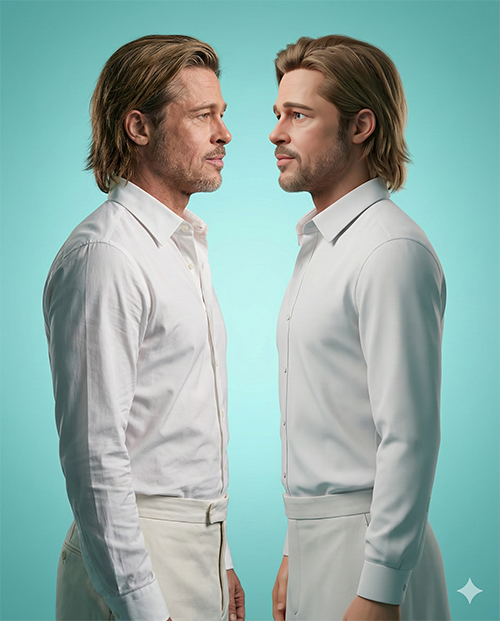
Two versions of the same person stand in a studio facing each other, very close, looking straight into each other’s eyes. On the left: a realistic human portrait version, directly matching the uploaded photo’s face, hair and natural look, with real skin texture, visible pores and a subtle, relaxed expression. On the right: a semi‑realistic stylized 3D character version of the same person, clearly keeping the same facial structure, jawline, nose, mouth, eyes and hairline, just with slightly larger expressive eyes and smoother shading. Both versions have the exact same haircut, length, color, parting and volume as in the reference photo.
Outfit must be naturally adapted to the gender and body of the reference person: a stylish white funky shirt and a short skirt (or equivalent lower garment) designed to fit the real body shape and gender expression of the subject, with believable fabric folds, seams and buttons. The 3D character wears the same outfit design, colors and details, mirroring the real version.
They stand almost toe‑to‑toe, bodies in slight 3/4, faces turned fully toward each other, noses relatively close, creating an intimate mirrored stance. Hands relaxed near the sides or lightly interacting with the shirt hem, posture confident but natural.
Art style: left side high‑end realistic studio portrait; right side semi‑realistic 3D / CGI character with smooth shading and subtle stylization, but identical identity. Overall cinematic, polished, clean rendering.
Lighting: soft, even frontal key lights for each character from slightly opposite sides, creating gentle modeling on both faces; subtle rim light along their outer edges to separate them from the background. Balanced, neutral studio light with clear catchlights in the eyes, no harsh shadows.
Lens and camera: eye‑level camera, 50 mm prime lens look, framed so both figures are visible from mid‑torso up, 4:5 vertical aspect ratio, deep focus so both faces, hair and clothes are tack‑sharp.
Background: smooth aqua gradient studio backdrop, slightly brighter in the center behind the gap between their faces, fading to darker aqua at the edges. No props or text.
Mood: intimate, introspective, almost like the “real self” confronting the “stylized 3D self”, confident but calm.
Technical: ultra‑high resolution, ultra‑clean edges, no noise, consistent rendering across both figures, natural skin tones, perfect facial anatomy, extremely sharp details on face, hair strands, glasses (if present) and fabric textures. Output: 8K, ultra high‑detail, clean, consistent, print‑ready.
Prompt negativo
anime, chibi, cartoon, flat illustration, cel shading, low poly, voxel, grotesque caricature, face not matching the reference, different nose, different jawline, different eye shape, wrong hair color, different hairstyle, bald if the reference has hair, different gender, changed age, changed ethnicity, unrealistic plastic doll skin, over‑smooth skin with no pores, low detail, low resolution, blurry, out of focus, noisy, heavy grain, JPEG artifacts, double face, extra limbs, extra fingers, missing limbs, warped anatomy, extreme wide‑angle or fisheye distortion, fisheye lens, tilted horizon, overexposed highlights, crushed blacks hiding facial detail, neon oversaturated colors, messy background, props or clutter, text, subtitles, logos, watermarks, frames, borders.
Two versions of the same person stand in a studio facing each other, very close, looking straight into each other’s eyes. On the left: a realistic human portrait version, directly matching the uploaded photo’s face, hair and natural look, with real skin texture, visible pores and a subtle, relaxed expression. On the right: a semi‑realistic stylized 3D character version of the same person, clearly keeping the same facial structure, jawline, nose, mouth, eyes and hairline, just with slightly larger expressive eyes and smoother shading. Both versions have the exact same haircut, length, color, parting and volume as in the reference photo.
Outfit must be naturally adapted to the gender and body of the reference person: a stylish white funky shirt and a short skirt (or equivalent lower garment) designed to fit the real body shape and gender expression of the subject, with believable fabric folds, seams and buttons. The 3D character wears the same outfit design, colors and details, mirroring the real version.
They stand almost toe‑to‑toe, bodies in slight 3/4, faces turned fully toward each other, noses relatively close, creating an intimate mirrored stance. Hands relaxed near the sides or lightly interacting with the shirt hem, posture confident but natural.
Art style: left side high‑end realistic studio portrait; right side semi‑realistic 3D / CGI character with smooth shading and subtle stylization, but identical identity. Overall cinematic, polished, clean rendering.
Lighting: soft, even frontal key lights for each character from slightly opposite sides, creating gentle modeling on both faces; subtle rim light along their outer edges to separate them from the background. Balanced, neutral studio light with clear catchlights in the eyes, no harsh shadows.
Lens and camera: eye‑level camera, 50 mm prime lens look, framed so both figures are visible from mid‑torso up, 4:5 vertical aspect ratio, deep focus so both faces, hair and clothes are tack‑sharp.
Background: smooth aqua gradient studio backdrop, slightly brighter in the center behind the gap between their faces, fading to darker aqua at the edges. No props or text.
Mood: intimate, introspective, almost like the “real self” confronting the “stylized 3D self”, confident but calm.
Technical: ultra‑high resolution, ultra‑clean edges, no noise, consistent rendering across both figures, natural skin tones, perfect facial anatomy, extremely sharp details on face, hair strands, glasses (if present) and fabric textures. Output: 8K, ultra high‑detail, clean, consistent, print‑ready.
Prompt negativo
anime, chibi, cartoon, flat illustration, cel shading, low poly, voxel, grotesque caricature, face not matching the reference, different nose, different jawline, different eye shape, wrong hair color, different hairstyle, bald if the reference has hair, different gender, changed age, changed ethnicity, unrealistic plastic doll skin, over‑smooth skin with no pores, low detail, low resolution, blurry, out of focus, noisy, heavy grain, JPEG artifacts, double face, extra limbs, extra fingers, missing limbs, warped anatomy, extreme wide‑angle or fisheye distortion, fisheye lens, tilted horizon, overexposed highlights, crushed blacks hiding facial detail, neon oversaturated colors, messy background, props or clutter, text, subtitles, logos, watermarks, frames, borders.