Colagem_revistas
Main instruction (identity + full-paper character)
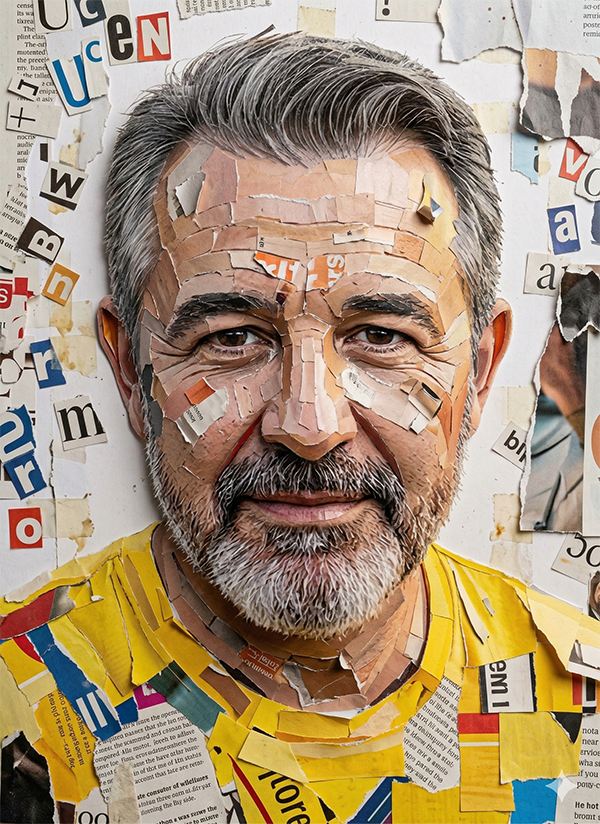
Use the uploaded photo as the identity reference and keep the person 100% recognizable: same facial structure, proportions, expression, gaze direction, and hairstyle silhouette. Do not beautify, do not change age, do not change gender. Transform the entire character and the scene into a handmade paper collage while preserving the original pose and composition.
Positive prompt (what to generate)
Transform the uploaded photo into a handmade paper collage portrait where the entire character is built from hundreds of tiny torn magazine pages and newspaper scraps. Every part of the subject — face, hair, clothing, neck, shoulders, and visible body — is reconstructed only from small irregular paper fragments, not paint or digital shading. Each facial feature (eyes, nose, lips, skin tones, shadows) is assembled using mismatched clippings with clearly visible torn edges, overlaps, wrinkles, and glue seams. Skin must look like layered paper, never like real skin.
Hair is fully created from shredded strips and torn curved paper pieces that follow the natural hair flow and volume, but always as paper fragments. Clothing is made from overlapping text blocks, images, and colored patches from magazine pages and newspapers, forming folds and shapes through layer direction and contrast. Shadows and highlights on the character are made only with darker and lighter paper pieces, never smooth gradients.
Add small physical imperfections across the character: some paper pieces slightly peeled or lifting from the surface, corners curling up, parts partially descoladas (lifting) along the edges of the face, hair, and clothing, visible tape marks, glue stains, and uneven layering that casts tiny shadows. A few fragments on the character may be half-detached, revealing the layer beneath.
The background is also a collage: a messy tabletop or wall covered with scattered collage scraps, cut-out letters, and random clippings, but built from larger torn pieces of magazine and newspaper. Some background papers are also lifting and peeling at the edges, with curled corners and layered depth. Maintain the earlier rule if you quiser: subject in full color and background mostly neutral or desaturated, but everything must still be made of paper fragments. The entire scene should clearly look like a physical analog art project photographed in real life, with real paper texture, shadows, and depth, not a digital illustration.
Lighting and photography: soft, natural or studio-like lighting that emphasizes paper texture and the lifted edges, with sharp focus on the face and upper body, slightly softer focus on background scraps. High-resolution macro-style details of ink, fibers, and tiny tears in the paper.
Negative prompt
smooth skin, airbrushed, digital painting, clean gradients, realistic skin texture, flawless face, perfect symmetry, vector art, CGI, 3D render, plastic skin, rubbery skin, photorealistic portrait, cartoon, anime, purely line-art drawing, flat graphic poster, marble or metal texture, glossy 3D surfaces, perfectly flat paper without texture, no visible edges, no overlaps, beauty retouching, photoshop smoothing, polished illustration style.
Use the uploaded photo as the identity reference and keep the person 100% recognizable: same facial structure, proportions, expression, gaze direction, and hairstyle silhouette. Do not beautify, do not change age, do not change gender. Transform the entire character and the scene into a handmade paper collage while preserving the original pose and composition.
Positive prompt (what to generate)
Transform the uploaded photo into a handmade paper collage portrait where the entire character is built from hundreds of tiny torn magazine pages and newspaper scraps. Every part of the subject — face, hair, clothing, neck, shoulders, and visible body — is reconstructed only from small irregular paper fragments, not paint or digital shading. Each facial feature (eyes, nose, lips, skin tones, shadows) is assembled using mismatched clippings with clearly visible torn edges, overlaps, wrinkles, and glue seams. Skin must look like layered paper, never like real skin.
Hair is fully created from shredded strips and torn curved paper pieces that follow the natural hair flow and volume, but always as paper fragments. Clothing is made from overlapping text blocks, images, and colored patches from magazine pages and newspapers, forming folds and shapes through layer direction and contrast. Shadows and highlights on the character are made only with darker and lighter paper pieces, never smooth gradients.
Add small physical imperfections across the character: some paper pieces slightly peeled or lifting from the surface, corners curling up, parts partially descoladas (lifting) along the edges of the face, hair, and clothing, visible tape marks, glue stains, and uneven layering that casts tiny shadows. A few fragments on the character may be half-detached, revealing the layer beneath.
The background is also a collage: a messy tabletop or wall covered with scattered collage scraps, cut-out letters, and random clippings, but built from larger torn pieces of magazine and newspaper. Some background papers are also lifting and peeling at the edges, with curled corners and layered depth. Maintain the earlier rule if you quiser: subject in full color and background mostly neutral or desaturated, but everything must still be made of paper fragments. The entire scene should clearly look like a physical analog art project photographed in real life, with real paper texture, shadows, and depth, not a digital illustration.
Lighting and photography: soft, natural or studio-like lighting that emphasizes paper texture and the lifted edges, with sharp focus on the face and upper body, slightly softer focus on background scraps. High-resolution macro-style details of ink, fibers, and tiny tears in the paper.
Negative prompt
smooth skin, airbrushed, digital painting, clean gradients, realistic skin texture, flawless face, perfect symmetry, vector art, CGI, 3D render, plastic skin, rubbery skin, photorealistic portrait, cartoon, anime, purely line-art drawing, flat graphic poster, marble or metal texture, glossy 3D surfaces, perfectly flat paper without texture, no visible edges, no overlaps, beauty retouching, photoshop smoothing, polished illustration style.