Desenho_e_pintura
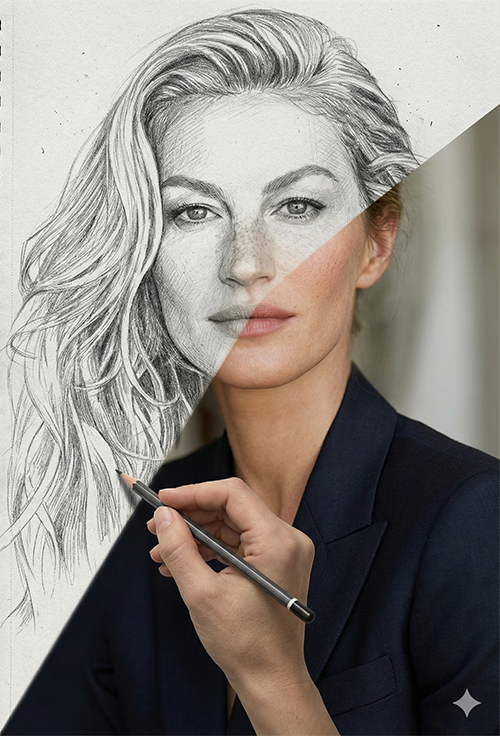
Use this full structured prompt in Nano Banana with your uploaded face photo as the main character reference.
Identity lock (use the uploaded photo)
Use the UPLOADED PHOTO as the ONLY and EXCLUSIVE face and character reference. Keep the person’s identity 100% identical to the uploaded photo: same facial features, bone structure, skin tone, gender, age impression, hairstyle shape and hairline, and the same overall facial proportions. Do not change the person’s gender, do not make the face younger or older, do not beautify, do not slim or stretch the face, do not alter nose, eyes, lips, jawline or cheek volume. Preserve the exact facial expression and any unique details such as moles, freckles, scars or specific skin texture so the viewer instantly recognizes the same real person.
Positive prompt (main scene and concept)
A mixed‑media optical illusion portrait featuring the uploaded person wearing a suit, where their head and upper torso transition from a rough graphite pencil sketch into a hyper‑realistic photograph‑style rendering of the same person. The top‑left region of the image (hair, forehead, upper skull and part of the background) appears as a flat 2D graphite drawing on textured sketchbook paper, with visible pencil hatch marks, cross‑hatching, smudge lines and a subtle paper grain. This sketched portion seamlessly morphs across the diagonal into a fully 3D, photorealistic rendering of the face and suit toward the bottom‑right, where eyes, nose, mouth, jawline, neck and lapels look like a high‑end studio photograph.
The background behind the subject in the realistic region is soft and minimal, slightly blurred, so the focus stays on the transition between paper and real skin. The overall composition should clearly showcase the illusion: one continuous head and suit, partially incomplete as sketch, partially fully rendered and realistic, with the transition line running roughly from upper left (sketch) to lower right (photo).
Lighting block
Lighting should behave as if a real desk lamp or soft studio light is illuminating both the paper and the realistic head at the same time, so shadows and highlights are physically consistent. A soft key light from upper left or upper right creates gentle form on the realistic face (cheekbones, nose, lips) while also casting a believable shadow from the drawing hand and pencil onto the paper surface. Subtle ambient fill light prevents the sketch area from becoming too dark, while still preserving contrast in hatch marks and paper texture. Reflections in the realistic eyes and on any slightly shiny skin areas should be natural and subdued, matching the key‑light direction.
Lens and camera block
Virtual camera set as a portrait‑style lens around 50–85mm equivalent, minimal distortion, focused on the face and the transition area between sketch and reality. Framing is a vertical or near‑vertical portrait from mid‑chest upward, with enough space around the head to show both the sketchbook paper texture and the realistic background region. Slightly shallow depth of field: the face and pencil tip are tack‑sharp, the farther paper edges and background fall off into mild blur, enhancing the mixed‑media illusion.
Detail and rendering block
Hyper‑realistic rendering on the “photo” side: clear pores, natural skin texture, sharp eyelashes, realistic hair strands, detailed fabric texture on the suit (weave, seams, folds), and accurate specular highlights. On the “sketch” side, show authentic graphite behavior: visible grain, hatching and cross‑hatching, gradients built by layered strokes, eraser marks or smudges in some areas, and subtle imperfections in line quality as if drawn by hand. The transition between sketch and reality should be gradual and clever: some facial features (like one eye or part of the nose) may appear half‑drawn, with pencil strokes dissolving into realistic shading and color. The hand and pencil should be anatomically correct, with realistic knuckle creases, fingernails, slight pressure in the grip, and the pencil casting a sharp shadow on the paper near the tip. The texture contrast between rough paper and smooth human skin must be clearly visible when zoomed in: you should see paper fibers and graphite grains on one side, and smooth yet detailed skin on the other.
Negative prompt
No different person, no changed gender, no changed age, no new haircut that does not match the uploaded photo, no altered facial proportions, no face drift or identity change. No full‑illustration style on the realistic half: avoid cartoon, anime, manga, vector flat art, oil painting, watercolor wash or heavy painterly brushstrokes on the photorealistic region. Do not turn the entire image into a sketch; the transformation must clearly go from sketch to realistic rendering, not 100% sketch or 100% photo. No harsh fisheye distortion, no extreme wide‑angle warping, no Dutch angles, no motion blur, no noisy or low‑resolution output, no compression artifacts. no UI elements, no frames or borders. No horror elements, no gore, no surreal dismemberment of the head; keep the illusion artistic and clean, focused on mixed‑media and identity, not on body horror.
Identity lock (use the uploaded photo)
Use the UPLOADED PHOTO as the ONLY and EXCLUSIVE face and character reference. Keep the person’s identity 100% identical to the uploaded photo: same facial features, bone structure, skin tone, gender, age impression, hairstyle shape and hairline, and the same overall facial proportions. Do not change the person’s gender, do not make the face younger or older, do not beautify, do not slim or stretch the face, do not alter nose, eyes, lips, jawline or cheek volume. Preserve the exact facial expression and any unique details such as moles, freckles, scars or specific skin texture so the viewer instantly recognizes the same real person.
Positive prompt (main scene and concept)
A mixed‑media optical illusion portrait featuring the uploaded person wearing a suit, where their head and upper torso transition from a rough graphite pencil sketch into a hyper‑realistic photograph‑style rendering of the same person. The top‑left region of the image (hair, forehead, upper skull and part of the background) appears as a flat 2D graphite drawing on textured sketchbook paper, with visible pencil hatch marks, cross‑hatching, smudge lines and a subtle paper grain. This sketched portion seamlessly morphs across the diagonal into a fully 3D, photorealistic rendering of the face and suit toward the bottom‑right, where eyes, nose, mouth, jawline, neck and lapels look like a high‑end studio photograph.
The background behind the subject in the realistic region is soft and minimal, slightly blurred, so the focus stays on the transition between paper and real skin. The overall composition should clearly showcase the illusion: one continuous head and suit, partially incomplete as sketch, partially fully rendered and realistic, with the transition line running roughly from upper left (sketch) to lower right (photo).
Lighting block
Lighting should behave as if a real desk lamp or soft studio light is illuminating both the paper and the realistic head at the same time, so shadows and highlights are physically consistent. A soft key light from upper left or upper right creates gentle form on the realistic face (cheekbones, nose, lips) while also casting a believable shadow from the drawing hand and pencil onto the paper surface. Subtle ambient fill light prevents the sketch area from becoming too dark, while still preserving contrast in hatch marks and paper texture. Reflections in the realistic eyes and on any slightly shiny skin areas should be natural and subdued, matching the key‑light direction.
Lens and camera block
Virtual camera set as a portrait‑style lens around 50–85mm equivalent, minimal distortion, focused on the face and the transition area between sketch and reality. Framing is a vertical or near‑vertical portrait from mid‑chest upward, with enough space around the head to show both the sketchbook paper texture and the realistic background region. Slightly shallow depth of field: the face and pencil tip are tack‑sharp, the farther paper edges and background fall off into mild blur, enhancing the mixed‑media illusion.
Detail and rendering block
Hyper‑realistic rendering on the “photo” side: clear pores, natural skin texture, sharp eyelashes, realistic hair strands, detailed fabric texture on the suit (weave, seams, folds), and accurate specular highlights. On the “sketch” side, show authentic graphite behavior: visible grain, hatching and cross‑hatching, gradients built by layered strokes, eraser marks or smudges in some areas, and subtle imperfections in line quality as if drawn by hand. The transition between sketch and reality should be gradual and clever: some facial features (like one eye or part of the nose) may appear half‑drawn, with pencil strokes dissolving into realistic shading and color. The hand and pencil should be anatomically correct, with realistic knuckle creases, fingernails, slight pressure in the grip, and the pencil casting a sharp shadow on the paper near the tip. The texture contrast between rough paper and smooth human skin must be clearly visible when zoomed in: you should see paper fibers and graphite grains on one side, and smooth yet detailed skin on the other.
Negative prompt
No different person, no changed gender, no changed age, no new haircut that does not match the uploaded photo, no altered facial proportions, no face drift or identity change. No full‑illustration style on the realistic half: avoid cartoon, anime, manga, vector flat art, oil painting, watercolor wash or heavy painterly brushstrokes on the photorealistic region. Do not turn the entire image into a sketch; the transformation must clearly go from sketch to realistic rendering, not 100% sketch or 100% photo. No harsh fisheye distortion, no extreme wide‑angle warping, no Dutch angles, no motion blur, no noisy or low‑resolution output, no compression artifacts. no UI elements, no frames or borders. No horror elements, no gore, no surreal dismemberment of the head; keep the illusion artistic and clean, focused on mixed‑media and identity, not on body horror.