Diorama_moulin_rouge
Use the UPLOADED PHOTO as the ONLY identity reference. Apply a TOTAL IDENTITY LOCK and keep 100% of the person’s real features: same face shape, facial proportions, nose, mouth, lips, eyes, eyebrows, jawline and cheek volume; same hairstyle, hairline, hair texture and color; same gender expression, age and overall body type. Do NOT beautify, do NOT slim the face or body, do NOT change age, do NOT change hairstyle or hair color, do NOT add or remove makeup, and do NOT swap the face with another person. The artist in the scene must clearly look exactly like the person in the uploaded photo.
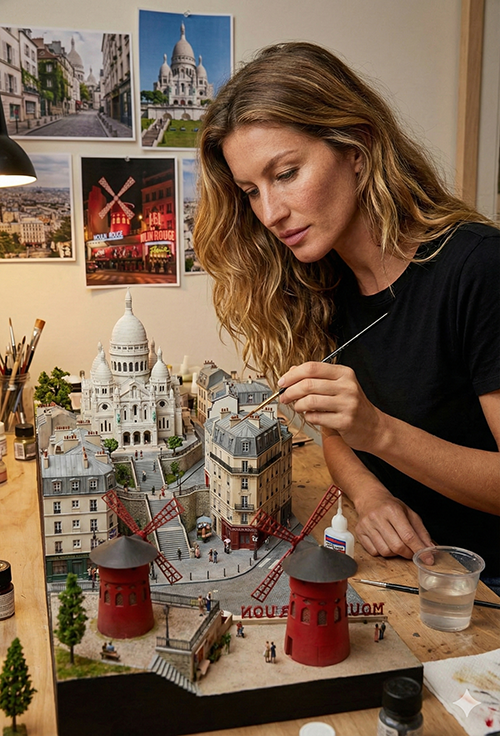
Edit the uploaded photo (face based on the reference photo). Create a highly detailed, realistic miniature diorama of Montmartre in Paris, combining the view of Sacré‑Coeur and Moulin Rouge. In the diorama, show the hilly streets with classic Parisian buildings, stairways and narrow lanes winding up toward the white domes of the Basilica of Sacré‑Coeur on the hill. In another section of the same miniature scene (or in the foreground), include the Moulin Rouge building with its iconic red windmill and façade, scaled down as a detailed miniature. Tiny street lamps, café terraces, trees, cars and small human figures reinforce the sense of a lively Montmartre neighborhood, all crafted at miniature scale with meticulous texture and detailing.
The diorama sits on a wooden worktable under warm, focused workshop lighting. The SAME man from the uploaded photo appears as the miniature artist: he wears a black T‑shirt and is carefully painting and adding tiny details to the Montmartre diorama using a fine brush and modeling tools. Around him on the table are small paint bottles, brushes, glue, scenic materials (miniature trees, flock, tiny people, LED pieces) and a water cup. On the wall or board behind the table, several reference photos of Montmartre, Sacré‑Coeur, Moulin Rouge and Paris street scenes are pinned or taped up, slightly overlapping, clearly visible but not distracting from the main subject. The environment should evoke a calm, focused studio atmosphere combined with the bohemian charm of a handcrafted miniature Montmartre, with realistic depth of field, textures and precise craftsmanship.
Lentes e enquadramento
Lens/look: 35–50 mm equivalent with a light macro/close-up feel, enough to show the artist and the Montmartre diorama clearly while still suggesting a real room environment.
Framing: three-quarter or medium shot: the artist from torso up em um lado do quadro, o diorama de Montmartre ocupando o primeiro plano da mesa, e as fotos de referência de Sacré‑Coeur e Moulin Rouge visíveis ao fundo, levemente desfocadas. Foco no rosto e nas mãos do artista e na superfície do diorama.
Iluminação e cor
Lighting: warm, directional workshop light (como uma luminária de mesa ou spot superior) iluminando a mesa e o diorama, com queda suave de luz para o resto do ambiente; sombras macias sob ferramentas e entre os prédios em miniatura; luz ambiente adicional para manter o rosto do artista bem iluminado, sem contraste extremo.
Color grading: tons naturais, levemente quentes, enfatizando madeira da mesa, fachadas em tons de creme/cinza dos prédios de Montmartre, o branco da Sacré‑Coeur, o vermelho intenso do Moulin Rouge e o verde das árvores; tons de pele realistas no artista; sem filtros de cor pesados. Manter alto micro‑detalhe em calçadas, telhados, janelas, placas e vegetação em miniatura, com paleta agradável e convidativa.
Prompt negativo (Nano Banana)
NEGATIVE PROMPT:
no cartoon, no anime, no flat 2D illustration, no low-poly 3D, no toy-only plastic look; evitar estilo de pintura a óleo pesado ou glitch effects. Não mudar a identidade da pessoa: não alterar maxilar, nariz, formato dos olhos, linha do cabelo, expressão de gênero ou idade; sem embelezar, afinar, rejuvenescer ou trocar o rosto. Não remover o diorama nem substituí-lo por uma paisagem real em escala natural; deve ficar claro que é um modelo em miniatura de Montmartre com Sacré‑Coeur e Moulin Rouge sobre uma bancada. Sem estética sci-fi ou cyberpunk; evitar iluminação de néon ou fitas RGB. Não deixar o fundo vazio—manter algumas fotos de referência na parede—mas sem bagunça que esconda o rosto do artista ou o diorama. Nenhum texto, logos, UI overlays ou marcas d’água na imagem. Sem baixa resolução, ruído pesado, artefatos de compressão ou motion blur excessivo.
Edit the uploaded photo (face based on the reference photo). Create a highly detailed, realistic miniature diorama of Montmartre in Paris, combining the view of Sacré‑Coeur and Moulin Rouge. In the diorama, show the hilly streets with classic Parisian buildings, stairways and narrow lanes winding up toward the white domes of the Basilica of Sacré‑Coeur on the hill. In another section of the same miniature scene (or in the foreground), include the Moulin Rouge building with its iconic red windmill and façade, scaled down as a detailed miniature. Tiny street lamps, café terraces, trees, cars and small human figures reinforce the sense of a lively Montmartre neighborhood, all crafted at miniature scale with meticulous texture and detailing.
The diorama sits on a wooden worktable under warm, focused workshop lighting. The SAME man from the uploaded photo appears as the miniature artist: he wears a black T‑shirt and is carefully painting and adding tiny details to the Montmartre diorama using a fine brush and modeling tools. Around him on the table are small paint bottles, brushes, glue, scenic materials (miniature trees, flock, tiny people, LED pieces) and a water cup. On the wall or board behind the table, several reference photos of Montmartre, Sacré‑Coeur, Moulin Rouge and Paris street scenes are pinned or taped up, slightly overlapping, clearly visible but not distracting from the main subject. The environment should evoke a calm, focused studio atmosphere combined with the bohemian charm of a handcrafted miniature Montmartre, with realistic depth of field, textures and precise craftsmanship.
Lentes e enquadramento
Lens/look: 35–50 mm equivalent with a light macro/close-up feel, enough to show the artist and the Montmartre diorama clearly while still suggesting a real room environment.
Framing: three-quarter or medium shot: the artist from torso up em um lado do quadro, o diorama de Montmartre ocupando o primeiro plano da mesa, e as fotos de referência de Sacré‑Coeur e Moulin Rouge visíveis ao fundo, levemente desfocadas. Foco no rosto e nas mãos do artista e na superfície do diorama.
Iluminação e cor
Lighting: warm, directional workshop light (como uma luminária de mesa ou spot superior) iluminando a mesa e o diorama, com queda suave de luz para o resto do ambiente; sombras macias sob ferramentas e entre os prédios em miniatura; luz ambiente adicional para manter o rosto do artista bem iluminado, sem contraste extremo.
Color grading: tons naturais, levemente quentes, enfatizando madeira da mesa, fachadas em tons de creme/cinza dos prédios de Montmartre, o branco da Sacré‑Coeur, o vermelho intenso do Moulin Rouge e o verde das árvores; tons de pele realistas no artista; sem filtros de cor pesados. Manter alto micro‑detalhe em calçadas, telhados, janelas, placas e vegetação em miniatura, com paleta agradável e convidativa.
Prompt negativo (Nano Banana)
NEGATIVE PROMPT:
no cartoon, no anime, no flat 2D illustration, no low-poly 3D, no toy-only plastic look; evitar estilo de pintura a óleo pesado ou glitch effects. Não mudar a identidade da pessoa: não alterar maxilar, nariz, formato dos olhos, linha do cabelo, expressão de gênero ou idade; sem embelezar, afinar, rejuvenescer ou trocar o rosto. Não remover o diorama nem substituí-lo por uma paisagem real em escala natural; deve ficar claro que é um modelo em miniatura de Montmartre com Sacré‑Coeur e Moulin Rouge sobre uma bancada. Sem estética sci-fi ou cyberpunk; evitar iluminação de néon ou fitas RGB. Não deixar o fundo vazio—manter algumas fotos de referência na parede—mas sem bagunça que esconda o rosto do artista ou o diorama. Nenhum texto, logos, UI overlays ou marcas d’água na imagem. Sem baixa resolução, ruído pesado, artefatos de compressão ou motion blur excessivo.