Fios_eletricos
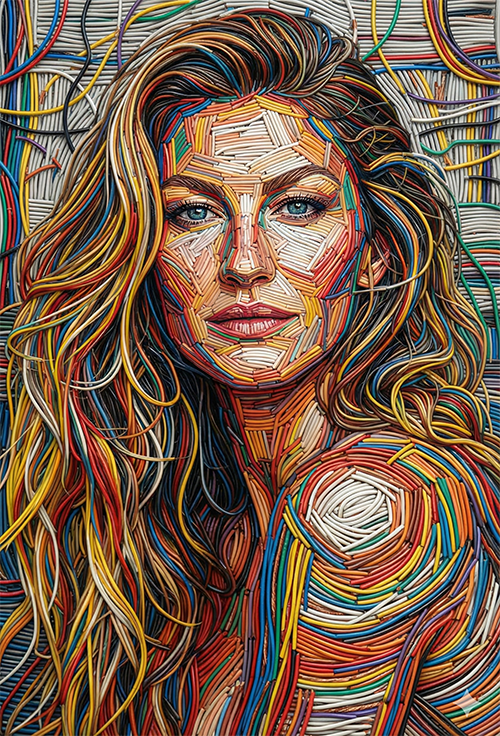
"Use the uploaded photo as the identity reference and keep the same face, hairstyle and gender. The person in the image must look exactly like the person in the photo, with the same facial features, facial proportions, bone structure, skin tone and hair shape. Do not change their gender, apparent age, face shape or ethnic traits. Do not turn them into a different person.
IDENTITY LOCK – 100% FACE, HAIR, GENDER
Preserve 100% of the person’s real appearance from the uploaded photo:
Same facial structure and proportions, head shape, skull geometry, jawline, chin, cheekbones, neck, and real age (no de‑aging or aging).
Same eye shape and spacing, eyelids, eyelashes, eyebrows, nose shape, lips shape and volume, and overall expression character.
Natural skin tone translated into stylized color facets, but still matching the real person.
Hair: keep the exact same hairstyle, hair length, hair volume, hairline and hair color as in the photo, only translated into the mosaic style, never changing the haircut silhouette.
Gender: keep the same gender presentation as in the original photo; do not feminize a masculine face or masculinize a feminine face; do not change ethnic traits.
No beautification, no slimming, no face swap, no mixing with other faces, no averaged features.
The viewer must instantly recognize that this is the same person from the original photo, only rendered as a mosaic made of electrical wires.
CORE STYLE – GEOMETRIC MOSAIC WITH CUBIST INFLUENCE
Transform the portrait into a modern geometric mosaic art style with cubist influence:
Fragmented polygonal shapes arranged in a stained‑glass‑like composition around and across the face and upper body.
Strong emphasis on sharp edges, angular facets and layered geometry, breaking the form into overlapping planes while keeping the identity.
Symmetrical or near‑symmetrical overall balance, with geometry radiating around the head and shoulders.
STYLE VARIATION – FACETED ELECTRICAL WIRE MOSAIC
Turn the geometric mosaic into a handcrafted electrical‑wire portrait:
Every polygonal piece becomes a bundle or loop of electrical wires instead of gemstones.
Use many different types of wires: thin, medium and thick gauges (various bitolas), twisted pairs, multi‑core cables and single insulated conductors.
The wires come in many colors: red, blue, yellow, green, black, white, orange, purple, gray and striped insulation, creating a vivid technical palette.
The wires are tightly packed but not fused into one continuous mass: they must clearly show a three‑dimensional effect with recesses and raised areas. Each wire bundle has its own height and curvature, with visible gaps, overlaps and spaces between cables so the individual groups are clearly separated.
Show realistic wire properties: plastic insulation shine, subtle transparency on some jackets, copper hints where cables are slightly exposed, and sharp specular highlights where light hits the curves.
Mix more matte cables with glossier ones to create depth and variation, while keeping the portrait readable as the same person.
Preserve the cubist, stained‑glass composition and angular geometry, now rendered as a shimmering network of colorful electrical wires, with strong contrast between light and shadow.
The final result should look like a premium art piece: a dense, carefully arranged mosaic of multicolored cables forming a contemporary abstract‑realist portrait.
COLOR PALETTE
Rich, saturated palette dominated by cable colors: deep blues, bright reds, yellows, greens, oranges, violets, plus neutral blacks, whites and grays.
Balance warm and cool wire colors to sculpt the face and features, using lighter cables for highlights and darker cables for shadows.
Maintain overall harmony and avoid neon oversaturation; it should feel like real insulated wires under focused light.
TEXTURE AND SURFACE
Strong emphasis on material tactility: round cable sections, tight bends, overlapping loops and slight irregularities.
Micro‑reflections and glints along the wire curves, especially where insulation catches the light.
Background can also be built from larger, simpler wire bundles or smoother color fields made of cables, but less detailed than the face to keep focus on the portrait.
COMPOSITION AND BALANCE
Portrait or bust composition, centered, with the face as the main focal point.
Decorative illustrative feel, suitable for a modern tech‑inspired art print or gallery installation.
Contemporary abstract realism: the face is stylized into thousands of wire bundles but still readable and emotionally expressive.
LIGHTING AND MOOD
High‑contrast lighting emphasized through light and dark wire colors, creating depth and visual rhythm.
Directional light that makes some cable clusters glow while others fall into deeper shadow, enhancing the sculptural look.
Mood: futuristic, energetic and artistic, like a cybernetic icon or fine‑art wiring diagram turned into a portrait.
QUALITY AND RENDERING
High‑resolution, ultra‑detailed rendering.
Crisp edges on all wire bundles, sharp highlights, no blur, no unintended noise or compression artifacts.
Fine handcrafted finish, as if it could be printed large as a gallery‑quality electrical‑wire mosaic artwork.
NEGATIVE PROMPT (RECOMMENDED)
"photorealistic human skin, realistic photo portrait, fabric or denim texture, leather texture, gemstones, metal plates, clay, flat minimal vector style, low detail, blurry, noise, messy lines, soft airbrushed gradients, plastic 3D CGI look, watercolor wash, simple cartoon, anime style, chibi, generic mosaic without a clear portrait, wrong face, different person, changed gender, changed age, changed ethnicity, pixel art, glitch effects, watermark, logo, text, UI elements."
IDENTITY LOCK – 100% FACE, HAIR, GENDER
Preserve 100% of the person’s real appearance from the uploaded photo:
Same facial structure and proportions, head shape, skull geometry, jawline, chin, cheekbones, neck, and real age (no de‑aging or aging).
Same eye shape and spacing, eyelids, eyelashes, eyebrows, nose shape, lips shape and volume, and overall expression character.
Natural skin tone translated into stylized color facets, but still matching the real person.
Hair: keep the exact same hairstyle, hair length, hair volume, hairline and hair color as in the photo, only translated into the mosaic style, never changing the haircut silhouette.
Gender: keep the same gender presentation as in the original photo; do not feminize a masculine face or masculinize a feminine face; do not change ethnic traits.
No beautification, no slimming, no face swap, no mixing with other faces, no averaged features.
The viewer must instantly recognize that this is the same person from the original photo, only rendered as a mosaic made of electrical wires.
CORE STYLE – GEOMETRIC MOSAIC WITH CUBIST INFLUENCE
Transform the portrait into a modern geometric mosaic art style with cubist influence:
Fragmented polygonal shapes arranged in a stained‑glass‑like composition around and across the face and upper body.
Strong emphasis on sharp edges, angular facets and layered geometry, breaking the form into overlapping planes while keeping the identity.
Symmetrical or near‑symmetrical overall balance, with geometry radiating around the head and shoulders.
STYLE VARIATION – FACETED ELECTRICAL WIRE MOSAIC
Turn the geometric mosaic into a handcrafted electrical‑wire portrait:
Every polygonal piece becomes a bundle or loop of electrical wires instead of gemstones.
Use many different types of wires: thin, medium and thick gauges (various bitolas), twisted pairs, multi‑core cables and single insulated conductors.
The wires come in many colors: red, blue, yellow, green, black, white, orange, purple, gray and striped insulation, creating a vivid technical palette.
The wires are tightly packed but not fused into one continuous mass: they must clearly show a three‑dimensional effect with recesses and raised areas. Each wire bundle has its own height and curvature, with visible gaps, overlaps and spaces between cables so the individual groups are clearly separated.
Show realistic wire properties: plastic insulation shine, subtle transparency on some jackets, copper hints where cables are slightly exposed, and sharp specular highlights where light hits the curves.
Mix more matte cables with glossier ones to create depth and variation, while keeping the portrait readable as the same person.
Preserve the cubist, stained‑glass composition and angular geometry, now rendered as a shimmering network of colorful electrical wires, with strong contrast between light and shadow.
The final result should look like a premium art piece: a dense, carefully arranged mosaic of multicolored cables forming a contemporary abstract‑realist portrait.
COLOR PALETTE
Rich, saturated palette dominated by cable colors: deep blues, bright reds, yellows, greens, oranges, violets, plus neutral blacks, whites and grays.
Balance warm and cool wire colors to sculpt the face and features, using lighter cables for highlights and darker cables for shadows.
Maintain overall harmony and avoid neon oversaturation; it should feel like real insulated wires under focused light.
TEXTURE AND SURFACE
Strong emphasis on material tactility: round cable sections, tight bends, overlapping loops and slight irregularities.
Micro‑reflections and glints along the wire curves, especially where insulation catches the light.
Background can also be built from larger, simpler wire bundles or smoother color fields made of cables, but less detailed than the face to keep focus on the portrait.
COMPOSITION AND BALANCE
Portrait or bust composition, centered, with the face as the main focal point.
Decorative illustrative feel, suitable for a modern tech‑inspired art print or gallery installation.
Contemporary abstract realism: the face is stylized into thousands of wire bundles but still readable and emotionally expressive.
LIGHTING AND MOOD
High‑contrast lighting emphasized through light and dark wire colors, creating depth and visual rhythm.
Directional light that makes some cable clusters glow while others fall into deeper shadow, enhancing the sculptural look.
Mood: futuristic, energetic and artistic, like a cybernetic icon or fine‑art wiring diagram turned into a portrait.
QUALITY AND RENDERING
High‑resolution, ultra‑detailed rendering.
Crisp edges on all wire bundles, sharp highlights, no blur, no unintended noise or compression artifacts.
Fine handcrafted finish, as if it could be printed large as a gallery‑quality electrical‑wire mosaic artwork.
NEGATIVE PROMPT (RECOMMENDED)
"photorealistic human skin, realistic photo portrait, fabric or denim texture, leather texture, gemstones, metal plates, clay, flat minimal vector style, low detail, blurry, noise, messy lines, soft airbrushed gradients, plastic 3D CGI look, watercolor wash, simple cartoon, anime style, chibi, generic mosaic without a clear portrait, wrong face, different person, changed gender, changed age, changed ethnicity, pixel art, glitch effects, watermark, logo, text, UI elements."