Gemini_epic_prompts
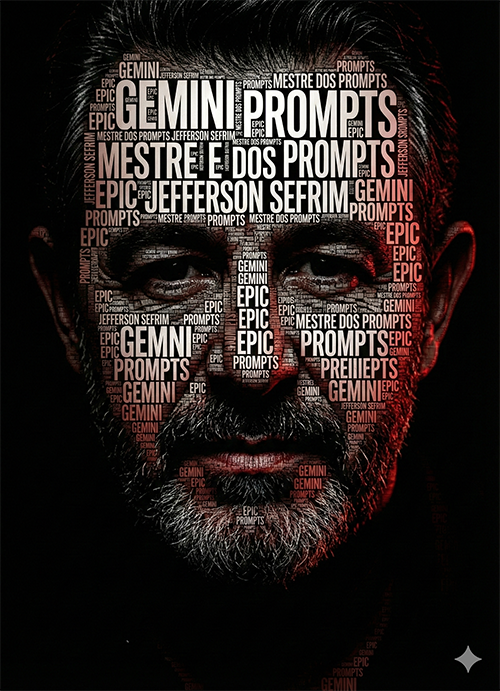
Ultra‑realistic typographic portrait of the person from the uploaded photo, emerging from deep black darkness. Use the uploaded image as the strict facial reference. The face must be 100% identical to the photo: same bone structure, nose, eyes, lips, jawline, cheekbones, forehead, hairstyle shape and hairline, same gender and age impression, with no beautification. Do not change the gender or make the face younger or older. Preserve the exact expression, gaze direction and all unique details such as moles, freckles, scars, wrinkles and skin texture, translated into typographic structure. Match the skin tone from the reference by using dense white and red text to recreate light and shadow exactly where they appear in the original image.
The portrait is constructed entirely out of layered white and red words that form the contours, planes and shading of the face, neck and partial shoulders. Individual letters and words follow the natural curves of the face: tighter, denser clusters in shadow areas and looser spacing in highlights, creating smooth gradients purely through text density. A few key words — “GEMINI”, “EPIC”, “PROMPTS”, “MESTRE DOS PROMPTS”, and “JEFFERSON SEFRIM” — appear repeatedly in varying font sizes and weights, but always integrated into the facial structure, never floating randomly. Deep expressive eyes are partially hidden in shadow; glossy red lips become a strong focal point, rendered with tighter red text and subtle highlights. Background is pure black, with the darkest facial shadows blending into it so parts of the head disappear into darkness. Cinematic, moody red highlights run along cheekbones, nose bridge and lips, created by switching from white to red typography in those regions. Overall look is a dramatic, dark, professional graphic poster, 8K resolution, hyper‑detailed typography art.
Camera, lens and composition
Virtual close‑up portrait shot, 4:5 or 2:3 vertical aspect ratio. Equivalent of an 85mm portrait lens, framing from top of head to just below the collarbone, face slightly turned if that matches the reference photo. Centered composition with the eyes approximately on the upper third line. No distortion; straight, clean perspective mimicking a studio headshot.
Lighting and value structure
High‑contrast studio lighting: a strong key light from one side creating dramatic shadows on the opposite side of the face, with very little fill so the shadows fall off into black. The typography must follow this lighting scheme: dense overlapping text in shadow zones (eye socket, under cheekbone, side of nose, under chin) and sparse text in highlight areas (forehead, top of nose, cheekbones). Red text is used to emphasize lips, some mid‑tones on cheeks, and subtle rim light accents, while white text shapes the main structure and brightest highlights. No visible light sources; the sense of lighting comes entirely from value and color contrast in the text.
Style and technical details
Photorealistic yet clearly typographic: from a distance, it reads as a realistic portrait of the person; up close, each stroke is revealed to be words and letters. Clean, modern sans‑serif fonts, varied sizes, mostly uppercase for graphic impact, always aligned with facial forms rather than random orientation. No extra illustrations, no gradients other than those formed by text density, no color other than black background, white typography and red typography. Crisp edges, razor‑sharp details suitable for large poster printing.
Negative prompt
no different face, no loss of identity, no wrong skin tone simulation, no gender change, no age change, no cartoon or comic style, no hand‑drawn lines, no photo collage, no bitmap halftone dots, no extra colors (only black, white and red), no messy overlapping text that obscures the facial structure, no illegible blurry typography, no background images, no lens flares, no bokeh, no added objects or symbols, no text boxes or UI elements, no watermarks, no logos besides the specified words woven into the portrait, no low resolution or pixelation, no gradient fills, no soft-focus or motion blur.
The portrait is constructed entirely out of layered white and red words that form the contours, planes and shading of the face, neck and partial shoulders. Individual letters and words follow the natural curves of the face: tighter, denser clusters in shadow areas and looser spacing in highlights, creating smooth gradients purely through text density. A few key words — “GEMINI”, “EPIC”, “PROMPTS”, “MESTRE DOS PROMPTS”, and “JEFFERSON SEFRIM” — appear repeatedly in varying font sizes and weights, but always integrated into the facial structure, never floating randomly. Deep expressive eyes are partially hidden in shadow; glossy red lips become a strong focal point, rendered with tighter red text and subtle highlights. Background is pure black, with the darkest facial shadows blending into it so parts of the head disappear into darkness. Cinematic, moody red highlights run along cheekbones, nose bridge and lips, created by switching from white to red typography in those regions. Overall look is a dramatic, dark, professional graphic poster, 8K resolution, hyper‑detailed typography art.
Camera, lens and composition
Virtual close‑up portrait shot, 4:5 or 2:3 vertical aspect ratio. Equivalent of an 85mm portrait lens, framing from top of head to just below the collarbone, face slightly turned if that matches the reference photo. Centered composition with the eyes approximately on the upper third line. No distortion; straight, clean perspective mimicking a studio headshot.
Lighting and value structure
High‑contrast studio lighting: a strong key light from one side creating dramatic shadows on the opposite side of the face, with very little fill so the shadows fall off into black. The typography must follow this lighting scheme: dense overlapping text in shadow zones (eye socket, under cheekbone, side of nose, under chin) and sparse text in highlight areas (forehead, top of nose, cheekbones). Red text is used to emphasize lips, some mid‑tones on cheeks, and subtle rim light accents, while white text shapes the main structure and brightest highlights. No visible light sources; the sense of lighting comes entirely from value and color contrast in the text.
Style and technical details
Photorealistic yet clearly typographic: from a distance, it reads as a realistic portrait of the person; up close, each stroke is revealed to be words and letters. Clean, modern sans‑serif fonts, varied sizes, mostly uppercase for graphic impact, always aligned with facial forms rather than random orientation. No extra illustrations, no gradients other than those formed by text density, no color other than black background, white typography and red typography. Crisp edges, razor‑sharp details suitable for large poster printing.
Negative prompt
no different face, no loss of identity, no wrong skin tone simulation, no gender change, no age change, no cartoon or comic style, no hand‑drawn lines, no photo collage, no bitmap halftone dots, no extra colors (only black, white and red), no messy overlapping text that obscures the facial structure, no illegible blurry typography, no background images, no lens flares, no bokeh, no added objects or symbols, no text boxes or UI elements, no watermarks, no logos besides the specified words woven into the portrait, no low resolution or pixelation, no gradient fills, no soft-focus or motion blur.