Natureza_morta
Use the uploaded photo as the exact identity reference. Maintain the person’s identity 100% identical to the source: same facial features, facial bone structure and proportions, skin tone impression, hairstyle shape, perceived age, and gender presentation. Keep the exact head angle, camera perspective, and expression. Do not rotate, mirror, beautify, de-age or age up, or change the gender; the face must remain instantly recognizable as the same person.
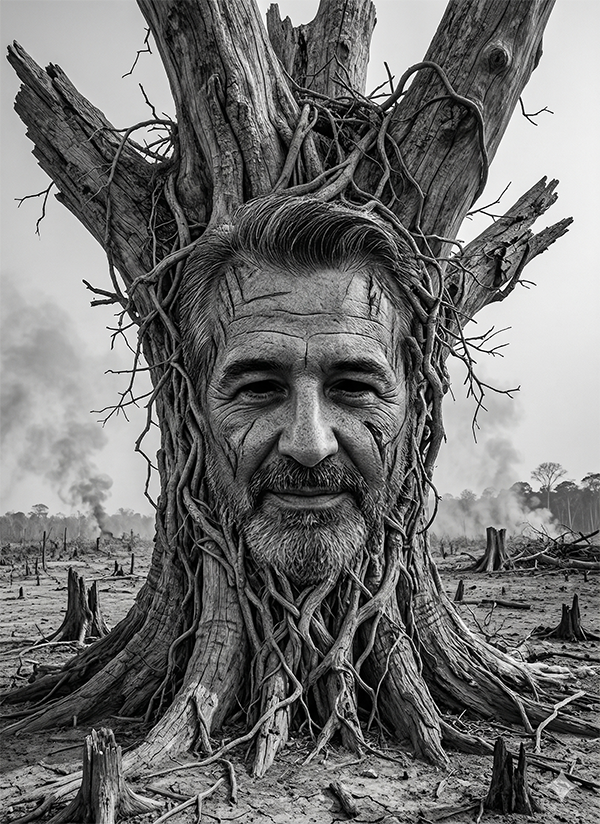
Transform the subject so the entire visible form appears fully constructed from tree wood and intertwined roots, as if naturally grown and carved from a single dead tree. Preserve accurate likeness, bone structure, eye placement, nose shape, lips, and jawline while converting all skin into a dry, lifeless bark surface with deep wood grain flow and rigid growth ridges. Form facial planes using very small, tightly interwoven root strands, fine knotted timber folds, and layered organic trunk textures, built from many tiny wood segments rather than large smooth patches. Sculpt the neck, shoulders, and upper torso entirely from twisting roots, branching wood fibers, and fused tree growth, with thin root filaments wrapping around thicker trunk-like forms. Hair becomes dense root bundles, tangled vine-like strands, and branching woody filaments that rise and spread like a crown of roots, all made from finely detailed, small-scale wood fibers, but clearly dry and without any sign of sap or life. Eyes remain clearly defined in shape and position but appear carved from dead wood or dark hollow cavities, with a dull, lifeless look rather than vivid reflections. Lips, eyelids, and facial contours must feel structurally grown from wood—sharp, chiseled planes and layered bark edges—rather than soft human skin.
Make the central tree’s trunk much wider and more massive, like an ancient, monumental dead tree dominating the landscape. The wooden portrait of the person is not a separate bust on top of the trunk: the face and upper torso are carved directly inside the thick trunk, fully integrated into the wood as if they are part of the tree’s core. The facial structure, chest, and shoulders emerge in shallow relief from the broad trunk surface, with roots, knots, and bark flowing seamlessly into the contours of the face and body, so there is no clear boundary between “statue” and “tree” — it all feels like one single solid organism turned to dead wood. The wide trunk should extend well above and below the carved face, with dry, broken branches reaching out from the upper part, reinforcing the sense that the portrait is embedded within the entire tree rather than sitting on top of it.
Place this monumental tree as the only large vertical form in the middle of a devastated landscape with no living nature. The tree stands alone in a wide, barren area of destruction, with cracked dry soil, dead stumps, fallen logs, broken branches, and scattered debris, but no grass, no leaves, no living plants anywhere. The horizon feels empty and bleak, with distant silhouettes of cut tree trunks, eroded hills, or industrial haze to emphasize environmental loss and desolation.
Render the entire image strictly in black and white, with a Sebastião Salgado–style photographic look: high-contrast monochrome, deep rich blacks, bright whites, and a full range of textured midtones. Emphasize strong chiaroscuro, dramatic tonal contrast, and detailed textures in bark, roots, cracked earth, distant haze, and clouds, echoing large-format documentary photographs with powerful emotional weight. The scene should feel like a melancholic, socially conscious documentary image: stark, timeless, and heavy, capturing the contrast between dead, devastated “nature” and the solitary, lifeless wooden tree-portrait in the middle of a ruined world.
Composition and camera: wide-angle landscape shot with the massive trunk and embedded face placed near the center or slightly off-center, dominating the frame to feel monumental. Low or eye-level camera angle that makes the tree-sculpture feel towering and alone. Foreground shows detailed texture of the dead ground and cut stumps; mid-ground and background fall off into atmospheric haze, smoke, or distant silhouettes. Use only natural-style lighting: overcast or harsh directional sunlight filtered by haze, creating long shadows and emphasizing the dryness and absence of life. No color anywhere; everything is grayscale. Overall style: ultra-detailed, hyper-real black-and-white documentary photography, with a sad, contemplative mood and strong visual contrast between the devastated environment and the single, dead tree-trunk sculpture that carries the human face inside it.
Transform the subject so the entire visible form appears fully constructed from tree wood and intertwined roots, as if naturally grown and carved from a single dead tree. Preserve accurate likeness, bone structure, eye placement, nose shape, lips, and jawline while converting all skin into a dry, lifeless bark surface with deep wood grain flow and rigid growth ridges. Form facial planes using very small, tightly interwoven root strands, fine knotted timber folds, and layered organic trunk textures, built from many tiny wood segments rather than large smooth patches. Sculpt the neck, shoulders, and upper torso entirely from twisting roots, branching wood fibers, and fused tree growth, with thin root filaments wrapping around thicker trunk-like forms. Hair becomes dense root bundles, tangled vine-like strands, and branching woody filaments that rise and spread like a crown of roots, all made from finely detailed, small-scale wood fibers, but clearly dry and without any sign of sap or life. Eyes remain clearly defined in shape and position but appear carved from dead wood or dark hollow cavities, with a dull, lifeless look rather than vivid reflections. Lips, eyelids, and facial contours must feel structurally grown from wood—sharp, chiseled planes and layered bark edges—rather than soft human skin.
Make the central tree’s trunk much wider and more massive, like an ancient, monumental dead tree dominating the landscape. The wooden portrait of the person is not a separate bust on top of the trunk: the face and upper torso are carved directly inside the thick trunk, fully integrated into the wood as if they are part of the tree’s core. The facial structure, chest, and shoulders emerge in shallow relief from the broad trunk surface, with roots, knots, and bark flowing seamlessly into the contours of the face and body, so there is no clear boundary between “statue” and “tree” — it all feels like one single solid organism turned to dead wood. The wide trunk should extend well above and below the carved face, with dry, broken branches reaching out from the upper part, reinforcing the sense that the portrait is embedded within the entire tree rather than sitting on top of it.
Place this monumental tree as the only large vertical form in the middle of a devastated landscape with no living nature. The tree stands alone in a wide, barren area of destruction, with cracked dry soil, dead stumps, fallen logs, broken branches, and scattered debris, but no grass, no leaves, no living plants anywhere. The horizon feels empty and bleak, with distant silhouettes of cut tree trunks, eroded hills, or industrial haze to emphasize environmental loss and desolation.
Render the entire image strictly in black and white, with a Sebastião Salgado–style photographic look: high-contrast monochrome, deep rich blacks, bright whites, and a full range of textured midtones. Emphasize strong chiaroscuro, dramatic tonal contrast, and detailed textures in bark, roots, cracked earth, distant haze, and clouds, echoing large-format documentary photographs with powerful emotional weight. The scene should feel like a melancholic, socially conscious documentary image: stark, timeless, and heavy, capturing the contrast between dead, devastated “nature” and the solitary, lifeless wooden tree-portrait in the middle of a ruined world.
Composition and camera: wide-angle landscape shot with the massive trunk and embedded face placed near the center or slightly off-center, dominating the frame to feel monumental. Low or eye-level camera angle that makes the tree-sculpture feel towering and alone. Foreground shows detailed texture of the dead ground and cut stumps; mid-ground and background fall off into atmospheric haze, smoke, or distant silhouettes. Use only natural-style lighting: overcast or harsh directional sunlight filtered by haze, creating long shadows and emphasizing the dryness and absence of life. No color anywhere; everything is grayscale. Overall style: ultra-detailed, hyper-real black-and-white documentary photography, with a sad, contemplative mood and strong visual contrast between the devastated environment and the single, dead tree-trunk sculpture that carries the human face inside it.