Nevasca
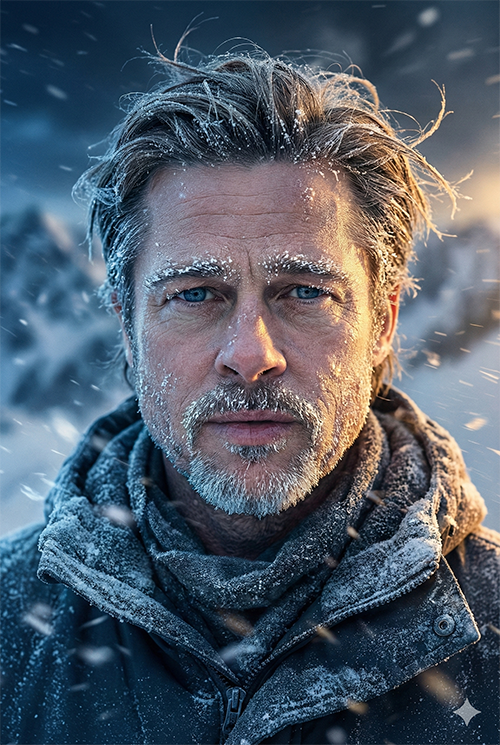
Use the exact face and likeness from the reference/input photo only, keeping 100% of all real physical features unchanged. Preserve precisely the same skull and bone structure, eye shape and eye distance, nose shape and tip, mouth shape and lips, jawline definition, cheekbone height and shape, chin structure, ear shape and size, eyebrow shape and arch, hairline position and hairline shape, skin tone and skin texture. Do not alter, beautify, slim, age, de‑age, feminize, masculinize or change any facial proportions whatsoever. Every facial feature must remain exactly as shown in the reference image.
Preserve the exact hairstyle from the reference photo: same hair length measured precisely, same hair volume and density, same hair direction and flow, same hair color without any recolor or tone shift. Do not cut, layer, restyle, trim or modify the hairline. Only allow natural adaptation to frost and wind effects without structural change. Hair should appear wind-swept and with ice crystals clinging to it, but the fundamental style and shape remain identical to the reference.
Keep the same gender presentation and ethnicity as clearly shown in the reference image. Do not change body type, height, shoulder width, or body proportions. The final result must be unmistakably the same real person from the photograph, rendered in the harsh winter environment with frost and ice effects.
Do not alter eye color, eye size, eye shape, eye spacing, or eye angle. Preserve the exact natural expression and gaze direction from the reference. Keep lips their natural color and shape. The visible eye must be 100% recognizable as belonging to the same individual, even with frost and partial obscuration from icy fabrics.
MAIN PROMPT:
Create a cinematic, ultra-realistic close-up portrait featuring the exact person from the uploaded reference photo, positioned in a harsh winter environment with snow, ice and extreme cold conditions. The subject's face must be rendered with 100% facial and body fidelity, maintaining all natural features, expressions and characteristics from the reference image while being partially obscured by frost-covered fabric and swirling icy fibers.
Compose the portrait as an intense close-up showing primarily the face and upper shoulders. Position the subject so that one piercing eye is sharply in focus, staring directly at the viewer with quiet intensity and emotional depth. The visible eye must be rendered with maximum detail—sharp, clear, reflective and perfectly matched to the reference photo in terms of eye shape, color, and expression.
Partially obscure the face with frost-covered fabric (winter clothing, scarves, or icy material) that drapes across portions of the face and neck, obscuring some features while leaving the primary eye and key facial features visible. The fabric should appear heavily frost-covered with visible crystalline ice formations. Render swirling icy fibers—wind-blown strands of fabric, hair, and ice particles—moving dynamically around the face and shoulders, creating atmospheric movement and depth.
Add fine ice crystals clinging to all exposed skin surfaces: forehead, cheekbones, visible portions of nose and chin. Ice crystals should cover the eyelashes of the visible eye, creating intricate layered textures. Crystals should also be visible clinging to hair strands, creating a sparkling, ethereal effect. The ice coverage should appear natural and organically distributed, as if the subject has been exposed to harsh winter conditions.
Apply harsh, dramatic lighting with cold and warm color contrast: the left side of the face should be dominated by cold, desaturated blue and white tones, suggesting harsh winter light or shadow. The right side of the face should be softly illuminated by warm golden light, creating dramatic contrast and visual interest. The warm light should appear to come from a low, angled direction (perhaps a setting sun or campfire), creating a survival-themed emotional resonance.
Use cold, desaturated color tones on the left side—blues, cyans, cool grays, pale whites. Use warm golden, amber, and orange tones on the right side where warm light illuminates skin. The contrast between cold and warm should be striking but not unrealistic.
Render the background with soft bokeh created through shallow depth of field—atmospheric snow particles, blurred winter landscape, and diffused light. The background should feel distant and slightly out of focus, emphasizing the sharp focus on the visible eye and facial features. Include atmospheric snow particles visible in the air, catching light and creating volumetric depth.
Apply hyper-detailed skin texture to all visible skin surfaces: visible pores, natural freckles or beauty marks if present in reference, subtle skin variations and realistic texture despite the cold conditions. The skin should appear vulnerable and cold—realistic coloration showing the effects of extreme temperature—but maintain photorealistic quality and authentic appearance.
Ensure wind-swept fibers and dynamic movement throughout the composition—icy strands and fabric pieces appearing to move with wind, creating energy and suggesting harsh environmental conditions. The composition should feel cinematic and moody, evoking themes of survival, resilience, and quiet intensity.
Overall style: cinematic dark fantasy or survival-themed aesthetic, photorealistic rendering, 8K resolution quality, professional cinematography, dramatic contrast lighting, ethereal and moody atmosphere, suitable for art poster or fine art exhibition. High dynamic range (HDR) rendering capturing both bright highlights and shadow detail.
FACIAL FEATURE PRESERVATION (100% FIDELITY):
Eye shape: Identical to reference (round, almond, hooded, deepset, etc.) - CRITICAL FOCUS
Eye distance: Exact spacing between pupils as in reference
Eye color: Preserve natural color without alteration
Eye expression: Match the natural gaze direction, intensity and emotional quality - MUST SHOW QUIET INTENSITY
Eyebrow shape: Same arch, thickness, height, position and natural expression
Eyebrow detail: Visible eyelashes with ice crystals clinging to them
Nose: Exact shape, width, tip definition, bridge height, nostril size
Mouth: Identical lip shape, fullness, natural color (affected by cold but recognizable)
Jawline: Match definition level, angle, width and projection (where not obscured)
Cheekbones: Preserve height, width, prominence and natural structure
Chin: Exact shape, size, projection (where visible through fabric)
Ears: Same size, shape, angle and position (if visible)
Face shape: Oval, round, square, heart, oblong—preserve exactly
Skin tone: Natural complexion with cold pallor effect (blue-tinted from cold, but same underlying tone)
Skin texture: All visible pores, freckles, moles, beauty marks preserved and hyper-detailed
Expression: Natural expression with quiet intensity, determination and emotional depth
Facial proportions: All ratios between features remain identical
Frost coverage: Ice crystals distributed naturally across skin without obscuring facial identity
Fabric obscuration: Portions of face obscured by fabric, but primary identifying features remain visible
HAIR PRESERVATION (100% FIDELITY):
Length: Exact length measured from reference, maintained precisely
Volume: Same fullness and density throughout
Direction: Hair flow, wave pattern and movement exactly as reference, adapted for wind
Color: No color shift, recolor, tone change or filter
Style: No cutting, layering, restyling, braiding or modification
Hairline: Preserve exact hairline position and shape
Texture: Natural texture visible in reference maintained
Shine/finish: Match natural hair appearance with ice crystal additions
Parting: Same part placement and direction as reference
Bangs/fringe: Maintain exactly if present in reference
Wind effect: Hair appears wind-swept but fundamental style unchanged
Ice crystals: Crystals clinging to hair strands creating sparkling effect
Wind-swept fibers: Individual hair strands and icy fibers moving dynamically
GENDER & BODY PRESERVATION:
Gender presentation: Maintain exact gender and appearance from reference - CRITICAL
Body type: Preserve natural build and visible proportions
Visible upper body: Shoulders, neck visible where not obscured by clothing/fabric
Posture: Maintain natural posture and body alignment
Musculature: Render natural musculature as visible in reference
Clothing: Render winter clothing authentically (appears to be heavy winter garments, scarves, etc.)
Fabric detail: Frost-covered fabric with visible crystalline formations
Neck exposure: Neck visible where fabric allows, with ice crystals visible
FROST & ICE SPECIFICATIONS:
Ice crystal formation: Fine ice crystals covering all exposed skin surfaces
Crystal size: Varied from fine powder to small visible crystals
Crystal placement: Concentrated on high points (cheekbones, forehead, nose), around eyes and on eyelashes
Eyelash coverage: Ice crystals notably visible on eyelashes of visible eye, creating intricate layered texture
Hair crystal coverage: Crystals clinging to hair strands, creating sparkling effect
Fabric frost coverage: Frost-covered fabric appearing heavily iced with crystalline formations
Crystal appearance: Realistic ice crystalline formations, not uniform or artificial
Transparency: Ice crystals semi-transparent, showing skin beneath
Sparkle/glitter: Subtle sparkle and light reflection on ice crystals
Layering: Multiple layers of ice creating depth and texture
Cold coloration: Skin showing cold pallor with blue and white tones from frost
Moisture: Subtle moisture and condensation effects from cold and breath
Realism: Ice formations appear naturally accumulated from extended cold exposure
FABRIC OBSCURATION SPECIFICATIONS:
Coverage: Frost-covered fabric obscures portions of face (potentially cheeks, portions of jaw, neck)
Type: Winter clothing, scarves, or protective fabric appropriate to harsh winter
Frost detail: Heavy frost coating on fabric with visible crystalline formations
Translucence: Fabric may be partially translucent, showing skin beneath
Texture: Visible fabric texture combined with frost texture
Positioning: Positioned to obscure parts of face while leaving primary eye and key features visible
Movement: Fabric and attached icy fibers appear to move with wind
Integration: Fabric integration appears natural, as if subject is bundled against cold
SWIRLING ICY FIBERS SPECIFICATIONS:
Fiber type: Wind-blown fabric strands, hair strands, and ice particles
Movement: Dynamic swirling motion suggesting wind and harsh conditions
Placement: Distributed around face, neck, and shoulders
Opacity: Varying opacity, some nearly transparent, some more opaque
Detail: Individual fibers visible with ice crystal coating
Atmosphere: Creates atmospheric depth and environmental context
Quantity: Sufficient to create sense of harsh environment without overwhelming face
Direction: Wind direction consistent throughout (suggesting strong directional wind)
Blur: Outer fibers may be slightly blurred to create depth
LIGHTING SETUP (CRITICAL):
Primary key light - COLD SIDE: Harsh cold light from upper left or front-left, creating strong blue and cyan tones. This side of face should be cold, desaturated, harsh and bright. Light appears to come from winter environment (pale winter sun, ice reflection, or distant light source).
Secondary key light - WARM SIDE: Warm golden light from upper right or low angle, creating amber, orange, and golden tones illuminating right side of face. This warm light creates dramatic contrast with cold side. Light source could suggest setting sun, campfire, or warm distant light.
Rim light: Strong rim lighting separating subject from background, outlining the silhouette against dark background. Rim light may contain both warm and cool tones depending on angle.
Fill light: Minimal fill light in shadow areas, maintaining high contrast. Where fill is present, it maintains appropriate color temperature.
Eyelash light: Strategic light specifically illuminating ice crystals on eyelashes and creating sparkle effect.
Volumetric light: Volumetric rays visible through atmosphere, suggesting light passing through snow, ice particles, and moisture.
Shadow characteristics: Deep, defined shadows with color variation. Shadows on cold side appear blue-tinted, shadows in warm side appear warm.
Background light: Diffused light in background suggesting snowy environment and atmospheric depth.
Overall contrast: High contrast between warm and cold, light and shadow, sharp and soft.
Color temperature: Left side approximately 4000-5000K (cool), right side approximately 2500-3000K (warm).
CAMERA SPECIFICATIONS:
Camera model: Professional cinema camera (RED Weapon, ARRI Alexa, Sony Venice)
Lens: 85mm f/1.2 or 100mm f/2.8 macro (classic portrait macro, extreme close-up perspective)
Aperture: f/1.2-f/1.8 (extremely shallow depth of field, tack-sharp eye, softer background)
Shutter speed: 1/500s-1/1000s (fast, crisp detail with dramatic lighting)
ISO: 1600-3200 (appropriate for harsh, dramatic lighting with cold color temperature)
Focus: Tack-sharp on visible eye and primary facial features, softer bokeh background
White balance: Custom white balance, potentially shifted to cool temperature to emphasize cold conditions
Color science: Professional cinema color science with emphasis on dramatic color contrast
Color space: Wide gamut (DCI-P3 or Rec. 2020) for vibrant warm/cool contrast
HDR capability: Full HDR rendering (8K, 10-bit or higher) for maximum dynamic range
Rendering engine: Professional 3D/digital rendering (Unreal Engine 5, V-Ray, Arnold, Octane Render)
Post-processing: Professional color grading emphasizing warm/cold contrast, high contrast curve
COMPOSITION & FRAMING:
Framing: Extreme close-up portrait, head-focused composition
Face position: Centered or slightly off-center, primary focal point
Subject size: Face fills significant portion of frame
Eye position: Visible eye positioned prominently, staring directly at camera
Eye focus: Visible eye in tack-sharp focus, displaying quiet intensity
Background: Soft bokeh background with atmospheric snow and light diffusion
Depth: Extreme shallow depth of field—sharp eye and face, softer background
Lighting composition: Compositional balance between warm and cold sides
Negative space: Balanced negative space around face
Fabric and fibers: Positioned to frame and partially obscure face artistically
Atmospheric particles: Snow particles visible in air and background
Overall aesthetic: Intimate, intense, cinematic portrait composition
Aspect ratio: 1:1 square, 4:5 portrait, or 3:4 (specify preference)
COLOR PALETTE (STRICT):
Face skin (cold side): Cold desaturated tones—pale whites, cool grays, blue-grays, cyans, pale blues
Face skin (warm side): Warm natural skin tone with golden light, amber undertones, warm peachy highlights
Eyes: Natural eye color from reference, potentially enhanced by ice crystal reflections and dramatic lighting
Hair: Natural hair color from reference, with cool lighting effect on cold side, warm on warm side
Frost/ice: White, pale blue, pale cyan, translucent with subtle sparkle
Fabric: Dark colors (blacks, deep grays, dark blues) with white frost coating
Cold side shadows: Deep blues, cyans, cool purples
Warm side shadows: Deep oranges, warm browns, amber-tinted
Highlights: Bright whites, pale yellows, pale golds (in warm area)
Background: Deep dark colors—black, very dark gray, dark blue
Snow/particles: White, pale blue, potentially warm-tinted where lit by warm light
Overall palette: High contrast between cold blues/cyans and warm golds/ambers
Saturation: Moderate to high saturation in neon-like warm/cold contrast
Temperature contrast: Dramatic split between cool and warm sides
ATMOSPHERIC EFFECTS:
Volumetric fog: Subtle volumetric mist suggesting cold air and moisture
Snow particles: Visible snow particles in air and background, catching light
Breath condensation: Subtle condensation effects suggesting cold exposure
Ice sparkle: Subtle sparkle and light reflection on ice crystals
Atmospheric depth: Layered atmospheric effects suggesting distance
Mist/haze: Cold air creating subtle haze and atmospheric effect
Light rays: Volumetric light rays visible through atmosphere
Particle motion: Particles appearing to move with wind
Preserve the exact hairstyle from the reference photo: same hair length measured precisely, same hair volume and density, same hair direction and flow, same hair color without any recolor or tone shift. Do not cut, layer, restyle, trim or modify the hairline. Only allow natural adaptation to frost and wind effects without structural change. Hair should appear wind-swept and with ice crystals clinging to it, but the fundamental style and shape remain identical to the reference.
Keep the same gender presentation and ethnicity as clearly shown in the reference image. Do not change body type, height, shoulder width, or body proportions. The final result must be unmistakably the same real person from the photograph, rendered in the harsh winter environment with frost and ice effects.
Do not alter eye color, eye size, eye shape, eye spacing, or eye angle. Preserve the exact natural expression and gaze direction from the reference. Keep lips their natural color and shape. The visible eye must be 100% recognizable as belonging to the same individual, even with frost and partial obscuration from icy fabrics.
MAIN PROMPT:
Create a cinematic, ultra-realistic close-up portrait featuring the exact person from the uploaded reference photo, positioned in a harsh winter environment with snow, ice and extreme cold conditions. The subject's face must be rendered with 100% facial and body fidelity, maintaining all natural features, expressions and characteristics from the reference image while being partially obscured by frost-covered fabric and swirling icy fibers.
Compose the portrait as an intense close-up showing primarily the face and upper shoulders. Position the subject so that one piercing eye is sharply in focus, staring directly at the viewer with quiet intensity and emotional depth. The visible eye must be rendered with maximum detail—sharp, clear, reflective and perfectly matched to the reference photo in terms of eye shape, color, and expression.
Partially obscure the face with frost-covered fabric (winter clothing, scarves, or icy material) that drapes across portions of the face and neck, obscuring some features while leaving the primary eye and key facial features visible. The fabric should appear heavily frost-covered with visible crystalline ice formations. Render swirling icy fibers—wind-blown strands of fabric, hair, and ice particles—moving dynamically around the face and shoulders, creating atmospheric movement and depth.
Add fine ice crystals clinging to all exposed skin surfaces: forehead, cheekbones, visible portions of nose and chin. Ice crystals should cover the eyelashes of the visible eye, creating intricate layered textures. Crystals should also be visible clinging to hair strands, creating a sparkling, ethereal effect. The ice coverage should appear natural and organically distributed, as if the subject has been exposed to harsh winter conditions.
Apply harsh, dramatic lighting with cold and warm color contrast: the left side of the face should be dominated by cold, desaturated blue and white tones, suggesting harsh winter light or shadow. The right side of the face should be softly illuminated by warm golden light, creating dramatic contrast and visual interest. The warm light should appear to come from a low, angled direction (perhaps a setting sun or campfire), creating a survival-themed emotional resonance.
Use cold, desaturated color tones on the left side—blues, cyans, cool grays, pale whites. Use warm golden, amber, and orange tones on the right side where warm light illuminates skin. The contrast between cold and warm should be striking but not unrealistic.
Render the background with soft bokeh created through shallow depth of field—atmospheric snow particles, blurred winter landscape, and diffused light. The background should feel distant and slightly out of focus, emphasizing the sharp focus on the visible eye and facial features. Include atmospheric snow particles visible in the air, catching light and creating volumetric depth.
Apply hyper-detailed skin texture to all visible skin surfaces: visible pores, natural freckles or beauty marks if present in reference, subtle skin variations and realistic texture despite the cold conditions. The skin should appear vulnerable and cold—realistic coloration showing the effects of extreme temperature—but maintain photorealistic quality and authentic appearance.
Ensure wind-swept fibers and dynamic movement throughout the composition—icy strands and fabric pieces appearing to move with wind, creating energy and suggesting harsh environmental conditions. The composition should feel cinematic and moody, evoking themes of survival, resilience, and quiet intensity.
Overall style: cinematic dark fantasy or survival-themed aesthetic, photorealistic rendering, 8K resolution quality, professional cinematography, dramatic contrast lighting, ethereal and moody atmosphere, suitable for art poster or fine art exhibition. High dynamic range (HDR) rendering capturing both bright highlights and shadow detail.
FACIAL FEATURE PRESERVATION (100% FIDELITY):
Eye shape: Identical to reference (round, almond, hooded, deepset, etc.) - CRITICAL FOCUS
Eye distance: Exact spacing between pupils as in reference
Eye color: Preserve natural color without alteration
Eye expression: Match the natural gaze direction, intensity and emotional quality - MUST SHOW QUIET INTENSITY
Eyebrow shape: Same arch, thickness, height, position and natural expression
Eyebrow detail: Visible eyelashes with ice crystals clinging to them
Nose: Exact shape, width, tip definition, bridge height, nostril size
Mouth: Identical lip shape, fullness, natural color (affected by cold but recognizable)
Jawline: Match definition level, angle, width and projection (where not obscured)
Cheekbones: Preserve height, width, prominence and natural structure
Chin: Exact shape, size, projection (where visible through fabric)
Ears: Same size, shape, angle and position (if visible)
Face shape: Oval, round, square, heart, oblong—preserve exactly
Skin tone: Natural complexion with cold pallor effect (blue-tinted from cold, but same underlying tone)
Skin texture: All visible pores, freckles, moles, beauty marks preserved and hyper-detailed
Expression: Natural expression with quiet intensity, determination and emotional depth
Facial proportions: All ratios between features remain identical
Frost coverage: Ice crystals distributed naturally across skin without obscuring facial identity
Fabric obscuration: Portions of face obscured by fabric, but primary identifying features remain visible
HAIR PRESERVATION (100% FIDELITY):
Length: Exact length measured from reference, maintained precisely
Volume: Same fullness and density throughout
Direction: Hair flow, wave pattern and movement exactly as reference, adapted for wind
Color: No color shift, recolor, tone change or filter
Style: No cutting, layering, restyling, braiding or modification
Hairline: Preserve exact hairline position and shape
Texture: Natural texture visible in reference maintained
Shine/finish: Match natural hair appearance with ice crystal additions
Parting: Same part placement and direction as reference
Bangs/fringe: Maintain exactly if present in reference
Wind effect: Hair appears wind-swept but fundamental style unchanged
Ice crystals: Crystals clinging to hair strands creating sparkling effect
Wind-swept fibers: Individual hair strands and icy fibers moving dynamically
GENDER & BODY PRESERVATION:
Gender presentation: Maintain exact gender and appearance from reference - CRITICAL
Body type: Preserve natural build and visible proportions
Visible upper body: Shoulders, neck visible where not obscured by clothing/fabric
Posture: Maintain natural posture and body alignment
Musculature: Render natural musculature as visible in reference
Clothing: Render winter clothing authentically (appears to be heavy winter garments, scarves, etc.)
Fabric detail: Frost-covered fabric with visible crystalline formations
Neck exposure: Neck visible where fabric allows, with ice crystals visible
FROST & ICE SPECIFICATIONS:
Ice crystal formation: Fine ice crystals covering all exposed skin surfaces
Crystal size: Varied from fine powder to small visible crystals
Crystal placement: Concentrated on high points (cheekbones, forehead, nose), around eyes and on eyelashes
Eyelash coverage: Ice crystals notably visible on eyelashes of visible eye, creating intricate layered texture
Hair crystal coverage: Crystals clinging to hair strands, creating sparkling effect
Fabric frost coverage: Frost-covered fabric appearing heavily iced with crystalline formations
Crystal appearance: Realistic ice crystalline formations, not uniform or artificial
Transparency: Ice crystals semi-transparent, showing skin beneath
Sparkle/glitter: Subtle sparkle and light reflection on ice crystals
Layering: Multiple layers of ice creating depth and texture
Cold coloration: Skin showing cold pallor with blue and white tones from frost
Moisture: Subtle moisture and condensation effects from cold and breath
Realism: Ice formations appear naturally accumulated from extended cold exposure
FABRIC OBSCURATION SPECIFICATIONS:
Coverage: Frost-covered fabric obscures portions of face (potentially cheeks, portions of jaw, neck)
Type: Winter clothing, scarves, or protective fabric appropriate to harsh winter
Frost detail: Heavy frost coating on fabric with visible crystalline formations
Translucence: Fabric may be partially translucent, showing skin beneath
Texture: Visible fabric texture combined with frost texture
Positioning: Positioned to obscure parts of face while leaving primary eye and key features visible
Movement: Fabric and attached icy fibers appear to move with wind
Integration: Fabric integration appears natural, as if subject is bundled against cold
SWIRLING ICY FIBERS SPECIFICATIONS:
Fiber type: Wind-blown fabric strands, hair strands, and ice particles
Movement: Dynamic swirling motion suggesting wind and harsh conditions
Placement: Distributed around face, neck, and shoulders
Opacity: Varying opacity, some nearly transparent, some more opaque
Detail: Individual fibers visible with ice crystal coating
Atmosphere: Creates atmospheric depth and environmental context
Quantity: Sufficient to create sense of harsh environment without overwhelming face
Direction: Wind direction consistent throughout (suggesting strong directional wind)
Blur: Outer fibers may be slightly blurred to create depth
LIGHTING SETUP (CRITICAL):
Primary key light - COLD SIDE: Harsh cold light from upper left or front-left, creating strong blue and cyan tones. This side of face should be cold, desaturated, harsh and bright. Light appears to come from winter environment (pale winter sun, ice reflection, or distant light source).
Secondary key light - WARM SIDE: Warm golden light from upper right or low angle, creating amber, orange, and golden tones illuminating right side of face. This warm light creates dramatic contrast with cold side. Light source could suggest setting sun, campfire, or warm distant light.
Rim light: Strong rim lighting separating subject from background, outlining the silhouette against dark background. Rim light may contain both warm and cool tones depending on angle.
Fill light: Minimal fill light in shadow areas, maintaining high contrast. Where fill is present, it maintains appropriate color temperature.
Eyelash light: Strategic light specifically illuminating ice crystals on eyelashes and creating sparkle effect.
Volumetric light: Volumetric rays visible through atmosphere, suggesting light passing through snow, ice particles, and moisture.
Shadow characteristics: Deep, defined shadows with color variation. Shadows on cold side appear blue-tinted, shadows in warm side appear warm.
Background light: Diffused light in background suggesting snowy environment and atmospheric depth.
Overall contrast: High contrast between warm and cold, light and shadow, sharp and soft.
Color temperature: Left side approximately 4000-5000K (cool), right side approximately 2500-3000K (warm).
CAMERA SPECIFICATIONS:
Camera model: Professional cinema camera (RED Weapon, ARRI Alexa, Sony Venice)
Lens: 85mm f/1.2 or 100mm f/2.8 macro (classic portrait macro, extreme close-up perspective)
Aperture: f/1.2-f/1.8 (extremely shallow depth of field, tack-sharp eye, softer background)
Shutter speed: 1/500s-1/1000s (fast, crisp detail with dramatic lighting)
ISO: 1600-3200 (appropriate for harsh, dramatic lighting with cold color temperature)
Focus: Tack-sharp on visible eye and primary facial features, softer bokeh background
White balance: Custom white balance, potentially shifted to cool temperature to emphasize cold conditions
Color science: Professional cinema color science with emphasis on dramatic color contrast
Color space: Wide gamut (DCI-P3 or Rec. 2020) for vibrant warm/cool contrast
HDR capability: Full HDR rendering (8K, 10-bit or higher) for maximum dynamic range
Rendering engine: Professional 3D/digital rendering (Unreal Engine 5, V-Ray, Arnold, Octane Render)
Post-processing: Professional color grading emphasizing warm/cold contrast, high contrast curve
COMPOSITION & FRAMING:
Framing: Extreme close-up portrait, head-focused composition
Face position: Centered or slightly off-center, primary focal point
Subject size: Face fills significant portion of frame
Eye position: Visible eye positioned prominently, staring directly at camera
Eye focus: Visible eye in tack-sharp focus, displaying quiet intensity
Background: Soft bokeh background with atmospheric snow and light diffusion
Depth: Extreme shallow depth of field—sharp eye and face, softer background
Lighting composition: Compositional balance between warm and cold sides
Negative space: Balanced negative space around face
Fabric and fibers: Positioned to frame and partially obscure face artistically
Atmospheric particles: Snow particles visible in air and background
Overall aesthetic: Intimate, intense, cinematic portrait composition
Aspect ratio: 1:1 square, 4:5 portrait, or 3:4 (specify preference)
COLOR PALETTE (STRICT):
Face skin (cold side): Cold desaturated tones—pale whites, cool grays, blue-grays, cyans, pale blues
Face skin (warm side): Warm natural skin tone with golden light, amber undertones, warm peachy highlights
Eyes: Natural eye color from reference, potentially enhanced by ice crystal reflections and dramatic lighting
Hair: Natural hair color from reference, with cool lighting effect on cold side, warm on warm side
Frost/ice: White, pale blue, pale cyan, translucent with subtle sparkle
Fabric: Dark colors (blacks, deep grays, dark blues) with white frost coating
Cold side shadows: Deep blues, cyans, cool purples
Warm side shadows: Deep oranges, warm browns, amber-tinted
Highlights: Bright whites, pale yellows, pale golds (in warm area)
Background: Deep dark colors—black, very dark gray, dark blue
Snow/particles: White, pale blue, potentially warm-tinted where lit by warm light
Overall palette: High contrast between cold blues/cyans and warm golds/ambers
Saturation: Moderate to high saturation in neon-like warm/cold contrast
Temperature contrast: Dramatic split between cool and warm sides
ATMOSPHERIC EFFECTS:
Volumetric fog: Subtle volumetric mist suggesting cold air and moisture
Snow particles: Visible snow particles in air and background, catching light
Breath condensation: Subtle condensation effects suggesting cold exposure
Ice sparkle: Subtle sparkle and light reflection on ice crystals
Atmospheric depth: Layered atmospheric effects suggesting distance
Mist/haze: Cold air creating subtle haze and atmospheric effect
Light rays: Volumetric light rays visible through atmosphere
Particle motion: Particles appearing to move with wind