Old_hora_da_aventura
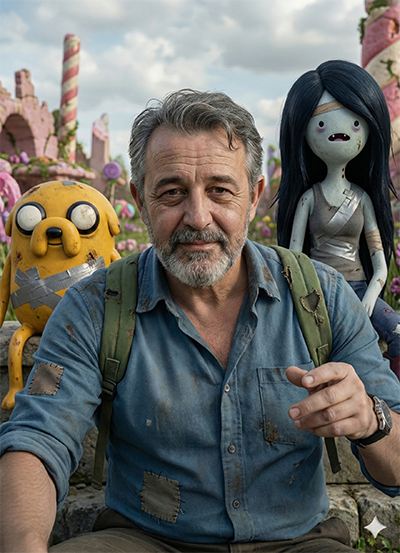
Use the uploaded photo as the main and only reference for the person’s face, hair, gender, body, posture, and natural expression. The generated character must keep the person’s identity 100% identical to the uploaded photo: same facial features, bone structure, skin tone, gender, hairstyle shape, and overall facial proportions. Do not change the person’s gender. Do not beautify or stylize the face in a way that alters its anatomy. Preserve the exact nose, eyes, lips, jawline, hairline, and any unique marks such as moles, freckles, scars, wrinkles, or skin texture. The hairstyle type, volume, and silhouette must be the same as in the photo, only allowing natural motion and interaction.
The person should look older and tired, as if many years have passed, but still clearly recognizable as the same individual from the uploaded photo. Add subtle, respectful signs of age and fatigue: slightly deeper wrinkles, mild eye bags and dark circles, softer skin firmness, a bit more skin shine or oiliness, and a generally weary expression in the eyes. The expression should be a faint, half‑hearted smile toward the camera, like someone who is exhausted but still trying to smile, with heavy eyelids and a tired gaze.
Universe and costume (Adventure Time – Land of Ooo):
Place the person in the Land of Ooo from Adventure Time, in a clearly aged, post‑post‑apocalyptic version of one of its iconic areas (such as the Grass Lands, near the Candy Kingdom, or a generic field with ruined magical structures), keeping the characteristic surreal shapes and colors, but now worn down, cracked, and partially overgrown.
The person must remain fully human, with realistic human body and proportions. Dress the person in clothes that are identical to one Adventure Time character’s outfit (for example, Finn’s blue shirt, shorts, hat, and backpack; Jake‑inspired colors and motifs translated to clothing; Princess Bubblegum’s dress; Marceline’s rock outfit; etc.), but adapted as real clothing worn by a human. The outfit should look like a high‑quality, live‑action costume version of that character’s design: same colors, shapes, and accessories, but fitted naturally on a human body, with realistic fabric, seams, folds, and materials. The clothing should also show age and wear: slightly faded colors, frayed edges, rough visible stitches, patches, scratches, and worn‑out areas, as if repaired many times.
Aged Adventure Time characters (large and heavily worn):
Around the person, place Adventure Time characters that are physically large, almost as big as the person (from chest height up to nearly full human height), so they feel like life‑size companions standing right beside them.
Use iconic characters such as Finn, Jake, Princess Bubblegum, Marceline, BMO, and others, rendered in a semi‑realistic, mixed‑media style, but clearly very old and deteriorated:
Colors desaturated and faded, like old paint or fabric exposed for decades.
Surfaces cracked, scratched, and chipped, with visible stress marks and worn edges.
Limbs, clothing, and accessories roughly repaired with silver duct tape, thick rope, adhesive tape, and visible chunky stitches.
Parts tied or bandaged together, with cords and tape holding joints, arms, or accessories in place.
Screws or fasteners half loose and sticking out, pieces slightly separated or misaligned, some panels or decorative elements peeling away.
Stickers, emblems, and symbols peeling off or half detached, edges curling, and prints partially erased.
Dents, crushed sections, and visibly warped shapes that show long use and neglect.
They must interact physically with the person in a gentle, melancholic way: one character leaning on the person for support, another resting a taped‑up arm on their shoulder, another loosely hugging them from the side. All of them stand close, touching or almost touching, forming a worn‑out group of old friends. Everyone (the person and the characters) looks toward the camera with a weak, tired smile, sharing the same sense of exhaustion and long history.
Environment (aged Land of Ooo setting):
Set the scene in a decayed, abandoned version of the Land of Ooo:
– Familiar Ooo landscape elements (rolling hills, weird trees, candy‑like structures, floating or twisted architecture) now cracked, faded, overgrown with vines, mushrooms, and strange post‑apocalyptic plants.
– Ruined pieces of modern and magical technology scattered around, half buried, rusted, and covered in dirt, reinforcing the post‑apocalyptic nature of Ooo.
– Broken signposts, crumbling candy buildings, and collapsed towers with gaps, exposed beams, and debris.
Add dust in the air, cobweb‑like growths, and litter on the ground to create a sense of total neglect, as if this corner of Ooo has not been maintained for a very long time.
Camera, framing, and cinematic quality:
Use a slightly high or elevated camera angle (a large, slightly top‑down cinematic shot) that shows the person and the large, aged Adventure Time characters together, all looking toward the camera.
The image must have a cinematic film look with rich but subdued colors: slightly desaturated palette with hints of the original vibrant Adventure Time color scheme, now aged and muted. Add fine film grain, soft halation around bright areas, strong depth of field, and extremely detailed textures in skin, clothing, and the worn characters, as if this were an ultra‑high‑resolution scan of a film frame.
Lighting:
Atmospheric, directional outdoor lighting, like a late‑afternoon or overcast sky over Ooo: soft but directional light that casts gentle, elongated shadows from the characters and the person.
Use color contrast between warm highlights and cooler shadows to keep a cinematic feel. The lighting should emphasize wrinkles, eye bags, worn fabrics, cracks, tape, and patches, but keep the scene emotional and melancholic rather than horror‑like. Maintain the person’s natural skin tone from the original photo, only subtly aged.
Artistic style and mood:
Ultra‑detailed, cinematic interpretation of Adventure Time’s art style: simple shapes and whimsical designs translated into textured, semi‑realistic materials (cloth, rubber, plastic, stone, candy‑like surfaces), still recognizable as the Land of Ooo but aged and decayed.
The mood is “tired, surreal nostalgia and end‑of‑the‑journey friendship”: the real human and the almost life‑size, worn Adventure Time characters stand together, obviously weathered by time, yet still side by side. Their small, awkward, tired smiles toward the camera suggest a long shared history, more bittersweet than playful.
Hard constraints for identity and body:
The person must remain clearly the same individual from the uploaded photo: same facial structure, same gender, same hairstyle type (only subtly aged if desired), same core features and marks. Aging should be believable and moderate, not grotesque or caricatured. The body must remain a realistic human body, with human proportions; do not turn the person into a cartoon body or stylized Adventure Time anatomy. Clothes are Adventure Time–inspired, but the person stays human. No extreme distortion, no cruel exaggeration of age‑related traits.
Unified negative prompt:
grotesque aging, body horror, extreme facial deformation, melted skin, missing facial features, extra limbs, duplicated arms, duplicated faces, overlapping limbs, multiple torsos, duplicated characters, distorted anatomy, unrealistic proportions, tiny toy‑sized characters (characters must be large, almost human‑sized), floating characters not grounded, flat low‑effort 2D rendering, low texture detail, muddy or noisy surfaces, overly harsh HDR, blurry edges, flat lighting, overexposed highlights, crushed shadows, unrealistic skin tones, AI artifacts, wrong perspective, missing or incorrect shadows, bad composition, poor blending between the person and Adventure Time characters, pixelation, low resolution look, unrecognizable face, changed gender, turning the person into a cartoon body.
The person should look older and tired, as if many years have passed, but still clearly recognizable as the same individual from the uploaded photo. Add subtle, respectful signs of age and fatigue: slightly deeper wrinkles, mild eye bags and dark circles, softer skin firmness, a bit more skin shine or oiliness, and a generally weary expression in the eyes. The expression should be a faint, half‑hearted smile toward the camera, like someone who is exhausted but still trying to smile, with heavy eyelids and a tired gaze.
Universe and costume (Adventure Time – Land of Ooo):
Place the person in the Land of Ooo from Adventure Time, in a clearly aged, post‑post‑apocalyptic version of one of its iconic areas (such as the Grass Lands, near the Candy Kingdom, or a generic field with ruined magical structures), keeping the characteristic surreal shapes and colors, but now worn down, cracked, and partially overgrown.
The person must remain fully human, with realistic human body and proportions. Dress the person in clothes that are identical to one Adventure Time character’s outfit (for example, Finn’s blue shirt, shorts, hat, and backpack; Jake‑inspired colors and motifs translated to clothing; Princess Bubblegum’s dress; Marceline’s rock outfit; etc.), but adapted as real clothing worn by a human. The outfit should look like a high‑quality, live‑action costume version of that character’s design: same colors, shapes, and accessories, but fitted naturally on a human body, with realistic fabric, seams, folds, and materials. The clothing should also show age and wear: slightly faded colors, frayed edges, rough visible stitches, patches, scratches, and worn‑out areas, as if repaired many times.
Aged Adventure Time characters (large and heavily worn):
Around the person, place Adventure Time characters that are physically large, almost as big as the person (from chest height up to nearly full human height), so they feel like life‑size companions standing right beside them.
Use iconic characters such as Finn, Jake, Princess Bubblegum, Marceline, BMO, and others, rendered in a semi‑realistic, mixed‑media style, but clearly very old and deteriorated:
Colors desaturated and faded, like old paint or fabric exposed for decades.
Surfaces cracked, scratched, and chipped, with visible stress marks and worn edges.
Limbs, clothing, and accessories roughly repaired with silver duct tape, thick rope, adhesive tape, and visible chunky stitches.
Parts tied or bandaged together, with cords and tape holding joints, arms, or accessories in place.
Screws or fasteners half loose and sticking out, pieces slightly separated or misaligned, some panels or decorative elements peeling away.
Stickers, emblems, and symbols peeling off or half detached, edges curling, and prints partially erased.
Dents, crushed sections, and visibly warped shapes that show long use and neglect.
They must interact physically with the person in a gentle, melancholic way: one character leaning on the person for support, another resting a taped‑up arm on their shoulder, another loosely hugging them from the side. All of them stand close, touching or almost touching, forming a worn‑out group of old friends. Everyone (the person and the characters) looks toward the camera with a weak, tired smile, sharing the same sense of exhaustion and long history.
Environment (aged Land of Ooo setting):
Set the scene in a decayed, abandoned version of the Land of Ooo:
– Familiar Ooo landscape elements (rolling hills, weird trees, candy‑like structures, floating or twisted architecture) now cracked, faded, overgrown with vines, mushrooms, and strange post‑apocalyptic plants.
– Ruined pieces of modern and magical technology scattered around, half buried, rusted, and covered in dirt, reinforcing the post‑apocalyptic nature of Ooo.
– Broken signposts, crumbling candy buildings, and collapsed towers with gaps, exposed beams, and debris.
Add dust in the air, cobweb‑like growths, and litter on the ground to create a sense of total neglect, as if this corner of Ooo has not been maintained for a very long time.
Camera, framing, and cinematic quality:
Use a slightly high or elevated camera angle (a large, slightly top‑down cinematic shot) that shows the person and the large, aged Adventure Time characters together, all looking toward the camera.
The image must have a cinematic film look with rich but subdued colors: slightly desaturated palette with hints of the original vibrant Adventure Time color scheme, now aged and muted. Add fine film grain, soft halation around bright areas, strong depth of field, and extremely detailed textures in skin, clothing, and the worn characters, as if this were an ultra‑high‑resolution scan of a film frame.
Lighting:
Atmospheric, directional outdoor lighting, like a late‑afternoon or overcast sky over Ooo: soft but directional light that casts gentle, elongated shadows from the characters and the person.
Use color contrast between warm highlights and cooler shadows to keep a cinematic feel. The lighting should emphasize wrinkles, eye bags, worn fabrics, cracks, tape, and patches, but keep the scene emotional and melancholic rather than horror‑like. Maintain the person’s natural skin tone from the original photo, only subtly aged.
Artistic style and mood:
Ultra‑detailed, cinematic interpretation of Adventure Time’s art style: simple shapes and whimsical designs translated into textured, semi‑realistic materials (cloth, rubber, plastic, stone, candy‑like surfaces), still recognizable as the Land of Ooo but aged and decayed.
The mood is “tired, surreal nostalgia and end‑of‑the‑journey friendship”: the real human and the almost life‑size, worn Adventure Time characters stand together, obviously weathered by time, yet still side by side. Their small, awkward, tired smiles toward the camera suggest a long shared history, more bittersweet than playful.
Hard constraints for identity and body:
The person must remain clearly the same individual from the uploaded photo: same facial structure, same gender, same hairstyle type (only subtly aged if desired), same core features and marks. Aging should be believable and moderate, not grotesque or caricatured. The body must remain a realistic human body, with human proportions; do not turn the person into a cartoon body or stylized Adventure Time anatomy. Clothes are Adventure Time–inspired, but the person stays human. No extreme distortion, no cruel exaggeration of age‑related traits.
Unified negative prompt:
grotesque aging, body horror, extreme facial deformation, melted skin, missing facial features, extra limbs, duplicated arms, duplicated faces, overlapping limbs, multiple torsos, duplicated characters, distorted anatomy, unrealistic proportions, tiny toy‑sized characters (characters must be large, almost human‑sized), floating characters not grounded, flat low‑effort 2D rendering, low texture detail, muddy or noisy surfaces, overly harsh HDR, blurry edges, flat lighting, overexposed highlights, crushed shadows, unrealistic skin tones, AI artifacts, wrong perspective, missing or incorrect shadows, bad composition, poor blending between the person and Adventure Time characters, pixelation, low resolution look, unrecognizable face, changed gender, turning the person into a cartoon body.