Old_toy
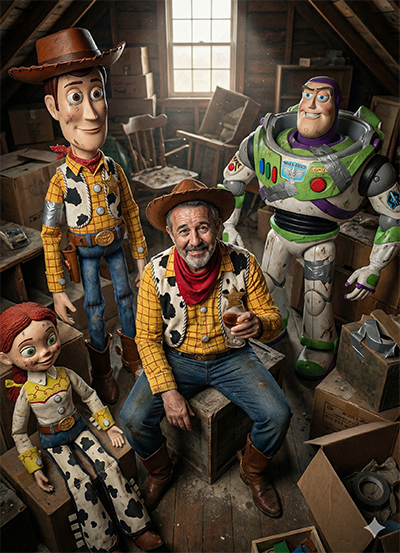
Use the uploaded photo as the main and only reference for the person’s face, hair, gender, body, posture, and natural expression. The generated character must keep the person’s identity 100% identical to the uploaded photo: same facial features, bone structure, skin tone, gender, hairstyle shape, and overall facial proportions. Do not change the person’s gender. Do not beautify or stylize the face in a way that alters its anatomy. Preserve the exact nose, eyes, lips, jawline, hairline, and any unique marks such as moles, freckles, scars, wrinkles, or skin texture. The hairstyle type, volume, and silhouette must be the same as in the photo, only allowing natural motion and interaction.
The person should look older and tired, as if many years have passed, but still clearly recognizable as the same individual from the uploaded photo. Add subtle, respectful signs of age and fatigue: slightly deeper wrinkles, mild eye bags and dark circles, softer skin firmness, a bit more skin shine or oiliness, and a generally weary expression in the eyes. The expression should be a faint, half‑hearted smile toward the camera, like someone who is exhausted but still trying to smile, with heavy eyelids and a tired gaze.
Universe and costume (Toy Story):
Place the person inside the Toy Story universe, in an older, time‑worn version of the familiar Toy Story environment (such as Andy’s old room, a dusty attic, or a forgotten toy storage area), clearly belonging to that world but now aged and slightly decayed.
The person must remain fully human, with realistic human body and proportions. Dress the person in clothes that are identical to one Toy Story character’s outfit (for example, Woody’s cowboy shirt, vest, jeans, boots, and hat; Buzz Lightyear’s suit colors and patterns interpreted as clothing; Jessie’s cowgirl outfit; Bo Peep’s pastel dress; etc.), but adapted as real clothing worn by a human. The outfit should look like a high‑quality, live‑action costume version of that character’s design: same colors, patterns, and accessories, but fitted naturally on a human body, with realistic fabric, seams, folds, and materials. The clothing should also show age and wear: slightly faded colors, small rips, patches, visible thick stitches, worn edges, and some scratches, as if repaired many times over the years.
Aged Toy Story characters (large and heavily worn):
Surrounding the person are Toy Story characters that are physically large, almost as big as the person, reaching from waist height up to nearly full human height, so they feel like imposing, life‑size toys standing right beside them.
Woody, Buzz, Jessie, Bo Peep, and other toys appear as 3D, semi‑realistic toys that are clearly very old and heavily deteriorated:
Colors desaturated and faded, with paint worn off in many areas.
Plastic and painted parts cracked, chipped, and scratched.
Limbs, joints, and body panels held together with silver duct tape, cloth strips, and thick visible stitches.
Some parts roughly tied with string, rope, or adhesive tape to keep them from falling apart.
Loose screws partially unscrewed and sticking out, small metal parts rusting or about to fall, plates and armor pieces slightly detached or hanging.
Stickers and decals peeling off, half‑detached labels, torn logos, and wrinkled surface graphics.
Dents, crushed areas, flattened edges, and clear deformation from impacts and time.
They must interact physically with the person in a gentle, melancholic way: one toy leaning on the person for support, another with an arm around their shoulders, another resting a worn hand on their arm, all close and touching, as if they are old, fragile friends. All look toward the camera with a faint, tired smile, sharing the same sense of exhaustion and age as the person.
Environment (aged Toy Story setting):
Set the scene in a nostalgic, decayed Toy Story environment:
– Old room, attic, or storage space with wooden floor or shelves covered in dust, scratches, and stains.
– Faded posters, broken furniture, and cardboard boxes with toy labels, all showing dust, cobwebs, and signs of abandonment.
– Classic Toy Story props (blocks, drawings, toy chests, old boxes with “TOYS” written on them) still present but dirty, dented, bent, and sometimes held together with tape or rope, with torn edges and faded colors.
Add cobwebs in corners, layers of dust on surfaces, small debris on the floor, and a general feeling that the place has not been cleaned or used for many years.
Camera, framing, and cinematic quality:
Use a slightly high or elevated camera angle (a large, slightly top‑down cinematic shot) that shows the person and the large, aged Toy Story characters together, all looking toward the camera.
The image must have a cinematic film look with rich but subdued colors: slightly desaturated and warm, with deeper shadows, subtle film grain, soft halation around highlights, and strong depth. Details in the person’s aged skin, costume fabric, cracked plastic, duct tape, stitches, screws, and peeling stickers on the toys must be extremely sharp and visible, as if this were an ultra‑high‑resolution scan of a film frame.
Lighting:
Soft, directional indoor lighting with a nostalgic, melancholic tone: a warm key light from a window or lamp, creating gentle shadows and emphasizing texture on skin, fabric, and toy surfaces.
Use a mix of warm highlights and cooler shadows to create cinematic contrast. The lighting should reveal wrinkles, eye bags, material wear, cracks, tape, stitching, and dust, but without turning the scene into horror. Keep the person’s skin tone faithful to the original, only subtly aged.
Artistic style and mood:
Ultra‑detailed, cinematic 3D Toy Story style, with Pixar‑like materials and rendering quality, but pushed toward a more grounded, realistic treatment of aging and wear.
The mood is “tired nostalgia and long‑lasting friendship at the end of the journey”: the person and the almost life‑size toys look exhausted, deteriorated, and patched up, yet still together. They all face the camera with a small, uncomfortable, tired smile, like they know time has passed and everything is falling apart, but they are still there for each other.
Hard constraints for identity and body:
The person must remain clearly the same individual from the uploaded photo: same facial structure, same gender, same hairstyle type (only subtly aged if desired), same core features and marks. Aging should be believable and moderate, not grotesque or caricatured. The body must remain a realistic human body, with human proportions; do not turn the person into a toy body or plastic figure. Clothes are Toy Story–inspired, but the person stays human. No extreme distortion, no cruel exaggeration of age‑related traits.
Unified negative prompt:
grotesque aging, body horror, extreme facial deformation, melted skin, missing facial features, extra limbs, duplicated arms, duplicated faces, overlapping limbs, multiple torsos, duplicated characters, distorted anatomy, unrealistic proportions, tiny toy‑sized characters (characters must be large, almost human‑sized), floating characters not grounded, flat low‑effort 2D rendering, low texture detail, muddy or noisy surfaces, overly harsh HDR, blurry edges, flat lighting, overexposed highlights, crushed shadows, unrealistic skin tones, AI artifacts, wrong perspective, missing or incorrect shadows, bad composition, poor blending between the person and Toy Story characters, pixelation, low resolution look, unrecognizable face, changed gender, turning the person into a toy body.
The person should look older and tired, as if many years have passed, but still clearly recognizable as the same individual from the uploaded photo. Add subtle, respectful signs of age and fatigue: slightly deeper wrinkles, mild eye bags and dark circles, softer skin firmness, a bit more skin shine or oiliness, and a generally weary expression in the eyes. The expression should be a faint, half‑hearted smile toward the camera, like someone who is exhausted but still trying to smile, with heavy eyelids and a tired gaze.
Universe and costume (Toy Story):
Place the person inside the Toy Story universe, in an older, time‑worn version of the familiar Toy Story environment (such as Andy’s old room, a dusty attic, or a forgotten toy storage area), clearly belonging to that world but now aged and slightly decayed.
The person must remain fully human, with realistic human body and proportions. Dress the person in clothes that are identical to one Toy Story character’s outfit (for example, Woody’s cowboy shirt, vest, jeans, boots, and hat; Buzz Lightyear’s suit colors and patterns interpreted as clothing; Jessie’s cowgirl outfit; Bo Peep’s pastel dress; etc.), but adapted as real clothing worn by a human. The outfit should look like a high‑quality, live‑action costume version of that character’s design: same colors, patterns, and accessories, but fitted naturally on a human body, with realistic fabric, seams, folds, and materials. The clothing should also show age and wear: slightly faded colors, small rips, patches, visible thick stitches, worn edges, and some scratches, as if repaired many times over the years.
Aged Toy Story characters (large and heavily worn):
Surrounding the person are Toy Story characters that are physically large, almost as big as the person, reaching from waist height up to nearly full human height, so they feel like imposing, life‑size toys standing right beside them.
Woody, Buzz, Jessie, Bo Peep, and other toys appear as 3D, semi‑realistic toys that are clearly very old and heavily deteriorated:
Colors desaturated and faded, with paint worn off in many areas.
Plastic and painted parts cracked, chipped, and scratched.
Limbs, joints, and body panels held together with silver duct tape, cloth strips, and thick visible stitches.
Some parts roughly tied with string, rope, or adhesive tape to keep them from falling apart.
Loose screws partially unscrewed and sticking out, small metal parts rusting or about to fall, plates and armor pieces slightly detached or hanging.
Stickers and decals peeling off, half‑detached labels, torn logos, and wrinkled surface graphics.
Dents, crushed areas, flattened edges, and clear deformation from impacts and time.
They must interact physically with the person in a gentle, melancholic way: one toy leaning on the person for support, another with an arm around their shoulders, another resting a worn hand on their arm, all close and touching, as if they are old, fragile friends. All look toward the camera with a faint, tired smile, sharing the same sense of exhaustion and age as the person.
Environment (aged Toy Story setting):
Set the scene in a nostalgic, decayed Toy Story environment:
– Old room, attic, or storage space with wooden floor or shelves covered in dust, scratches, and stains.
– Faded posters, broken furniture, and cardboard boxes with toy labels, all showing dust, cobwebs, and signs of abandonment.
– Classic Toy Story props (blocks, drawings, toy chests, old boxes with “TOYS” written on them) still present but dirty, dented, bent, and sometimes held together with tape or rope, with torn edges and faded colors.
Add cobwebs in corners, layers of dust on surfaces, small debris on the floor, and a general feeling that the place has not been cleaned or used for many years.
Camera, framing, and cinematic quality:
Use a slightly high or elevated camera angle (a large, slightly top‑down cinematic shot) that shows the person and the large, aged Toy Story characters together, all looking toward the camera.
The image must have a cinematic film look with rich but subdued colors: slightly desaturated and warm, with deeper shadows, subtle film grain, soft halation around highlights, and strong depth. Details in the person’s aged skin, costume fabric, cracked plastic, duct tape, stitches, screws, and peeling stickers on the toys must be extremely sharp and visible, as if this were an ultra‑high‑resolution scan of a film frame.
Lighting:
Soft, directional indoor lighting with a nostalgic, melancholic tone: a warm key light from a window or lamp, creating gentle shadows and emphasizing texture on skin, fabric, and toy surfaces.
Use a mix of warm highlights and cooler shadows to create cinematic contrast. The lighting should reveal wrinkles, eye bags, material wear, cracks, tape, stitching, and dust, but without turning the scene into horror. Keep the person’s skin tone faithful to the original, only subtly aged.
Artistic style and mood:
Ultra‑detailed, cinematic 3D Toy Story style, with Pixar‑like materials and rendering quality, but pushed toward a more grounded, realistic treatment of aging and wear.
The mood is “tired nostalgia and long‑lasting friendship at the end of the journey”: the person and the almost life‑size toys look exhausted, deteriorated, and patched up, yet still together. They all face the camera with a small, uncomfortable, tired smile, like they know time has passed and everything is falling apart, but they are still there for each other.
Hard constraints for identity and body:
The person must remain clearly the same individual from the uploaded photo: same facial structure, same gender, same hairstyle type (only subtly aged if desired), same core features and marks. Aging should be believable and moderate, not grotesque or caricatured. The body must remain a realistic human body, with human proportions; do not turn the person into a toy body or plastic figure. Clothes are Toy Story–inspired, but the person stays human. No extreme distortion, no cruel exaggeration of age‑related traits.
Unified negative prompt:
grotesque aging, body horror, extreme facial deformation, melted skin, missing facial features, extra limbs, duplicated arms, duplicated faces, overlapping limbs, multiple torsos, duplicated characters, distorted anatomy, unrealistic proportions, tiny toy‑sized characters (characters must be large, almost human‑sized), floating characters not grounded, flat low‑effort 2D rendering, low texture detail, muddy or noisy surfaces, overly harsh HDR, blurry edges, flat lighting, overexposed highlights, crushed shadows, unrealistic skin tones, AI artifacts, wrong perspective, missing or incorrect shadows, bad composition, poor blending between the person and Toy Story characters, pixelation, low resolution look, unrecognizable face, changed gender, turning the person into a toy body.