Papelao_cena
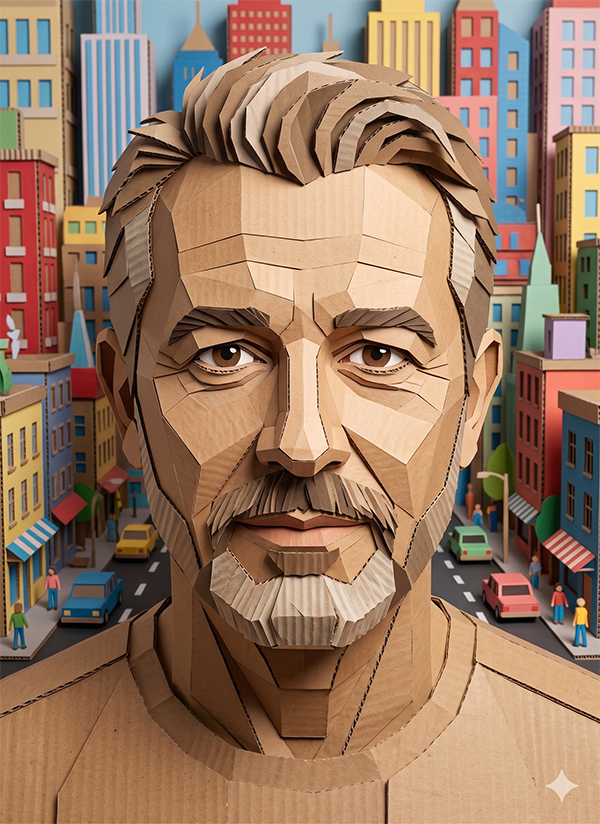
Using the provided input photo as the primary face and character reference, recreate the exact same person as a three-dimensional relief-style art piece built entirely from layered brown cardboard. Maintain the person’s identity 100% identical to the uploaded photo: same facial features, bone structure, skin tone, gender, perceived age, hairstyle shape, and overall facial proportions. Preserve the exact facial expression, nose, eyes, lips, jawline, and any unique marks such as moles, freckles, scars, and skin texture. Do not change the gender or make the person look younger or older.
Render a photorealistic yet clearly hand-crafted cardboard sculpture of this person, as if an artisan created a layered 3D portrait by meticulously cutting and assembling multiple cardboard pieces. The portrait is built up in successive planes of cut-out cardboard to create strong layering and depth, with clearly separated planes for the face, hair, neck, and clothing. Use geometric faceting everywhere: facial features, hair, clothing, and background are all formed from interlocking, distinct, clean-cut polygonal cardboard shapes instead of smooth curves.
The eyes themselves are also constructed entirely from cardboard, not real eyes: iris, pupils, sclera, eyelids, and eyelashes are all made from layered, cut, and shaped cardboard pieces, with subtle color variation created by different tones of painted cardboard while still clearly showing cardboard texture and edges.
Show full material authenticity of recycled cardboard: all surfaces must have the natural brown color of cardboard, visible paper grain, occasional imperfections, and the ‘wavy’ corrugated pattern where the inner flutes are exposed. Alternate flute directions (some horizontal, some vertical, some diagonal) to define muscle structure, planes of the face, and contours, especially around the cheeks, forehead, jaw, and neck.
Faithfully recreate the original pose, gaze, and composition from the input photo, including details like eyewear, mustache or beard, hairstyle, and clothing (for example, a suit jacket and turtleneck), all constructed from cut cardboard pieces. Suggest the turtleneck collar using layered rings or spiral-cut cardboard bands to emphasize its cylindrical form.
Behind the portrait, place a full 3D city scene made entirely from cardboard: streets, cars, buildings, traffic lights, sidewalks, and street details are all sculpted from cut and layered cardboard. Every element in the background city is built as a miniature three-dimensional cardboard model, then painted with a wide range of vivid, saturated colors (reds, blues, yellows, greens, pastel tones), while always preserving visible cardboard texture, edges, and occasional exposed corrugated flutes. The city should feel lively and full of depth, with overlapping buildings and cars, but still clearly handcrafted from cardboard.
The background is composed of these colorful cardboard buildings and streets arranged as overlapping shapes and depth steps, forming a coherent cardboard cityscape diorama behind the subject. Maintain a clear separation between foreground portrait and background city using depth, scale, and shadows, while ensuring they feel part of the same physical cardboard world.
Use professional studio lighting: soft, directional key light from one side, with gentle fill on the opposite side, to cast defined but soft-edged shadows that emphasize the depth between layers and the faceted, three-dimensional construction. Subtle rim light can separate the silhouette from the background. Color grading is neutral and warm, matching the natural tone of brown cardboard and the painted colors of the city. Maintain the same studio lighting on both the character and the cardboard city: soft, directional key light with gentle shadows that emphasize the 3D layering, and consistent perspective so the portrait and the colorful cardboard city background feel like a single, coherent physical diorama.
Camera settings: high-resolution close-up or medium-close portrait, straight-on or very slight three-quarter angle that matches the original photo, shot with a 50mm–85mm portrait lens equivalent. Shallow to moderate depth of field that keeps the entire face and main cardboard structure in sharp focus while allowing the background layers to be slightly softer. Ultra-detailed, crisp focus on the eyes and central facial planes, with visible micro-details in the cardboard edges and cut lines.
No overlaid text, no watermarks, no logos.
Negative prompt:
blurry, out of focus, low resolution, low detail, low quality, oversharpened halos, distorted face, changed identity, altered age, de-aged, aged up, different person, wrong gender, incorrect skin tone, plastic texture, metal texture, rubber texture, clay render, 3D CGI look, glossy plastic, smooth digital gradients, painterly brushstrokes, oil painting, watercolor, sketch, pencil drawing, anime, cartoon, comic style, pixel art, glitch, artifacts, extra limbs, extra eyes, missing facial features, warped anatomy, asymmetrical eyes, mismatched earrings, broken glasses, melted cardboard, unrealistic lighting, harsh flash, extreme fisheye distortion, Dutch angle, tilted horizon, text, subtitles, captions, UI elements, watermarks, logos, signatures.
Render a photorealistic yet clearly hand-crafted cardboard sculpture of this person, as if an artisan created a layered 3D portrait by meticulously cutting and assembling multiple cardboard pieces. The portrait is built up in successive planes of cut-out cardboard to create strong layering and depth, with clearly separated planes for the face, hair, neck, and clothing. Use geometric faceting everywhere: facial features, hair, clothing, and background are all formed from interlocking, distinct, clean-cut polygonal cardboard shapes instead of smooth curves.
The eyes themselves are also constructed entirely from cardboard, not real eyes: iris, pupils, sclera, eyelids, and eyelashes are all made from layered, cut, and shaped cardboard pieces, with subtle color variation created by different tones of painted cardboard while still clearly showing cardboard texture and edges.
Show full material authenticity of recycled cardboard: all surfaces must have the natural brown color of cardboard, visible paper grain, occasional imperfections, and the ‘wavy’ corrugated pattern where the inner flutes are exposed. Alternate flute directions (some horizontal, some vertical, some diagonal) to define muscle structure, planes of the face, and contours, especially around the cheeks, forehead, jaw, and neck.
Faithfully recreate the original pose, gaze, and composition from the input photo, including details like eyewear, mustache or beard, hairstyle, and clothing (for example, a suit jacket and turtleneck), all constructed from cut cardboard pieces. Suggest the turtleneck collar using layered rings or spiral-cut cardboard bands to emphasize its cylindrical form.
Behind the portrait, place a full 3D city scene made entirely from cardboard: streets, cars, buildings, traffic lights, sidewalks, and street details are all sculpted from cut and layered cardboard. Every element in the background city is built as a miniature three-dimensional cardboard model, then painted with a wide range of vivid, saturated colors (reds, blues, yellows, greens, pastel tones), while always preserving visible cardboard texture, edges, and occasional exposed corrugated flutes. The city should feel lively and full of depth, with overlapping buildings and cars, but still clearly handcrafted from cardboard.
The background is composed of these colorful cardboard buildings and streets arranged as overlapping shapes and depth steps, forming a coherent cardboard cityscape diorama behind the subject. Maintain a clear separation between foreground portrait and background city using depth, scale, and shadows, while ensuring they feel part of the same physical cardboard world.
Use professional studio lighting: soft, directional key light from one side, with gentle fill on the opposite side, to cast defined but soft-edged shadows that emphasize the depth between layers and the faceted, three-dimensional construction. Subtle rim light can separate the silhouette from the background. Color grading is neutral and warm, matching the natural tone of brown cardboard and the painted colors of the city. Maintain the same studio lighting on both the character and the cardboard city: soft, directional key light with gentle shadows that emphasize the 3D layering, and consistent perspective so the portrait and the colorful cardboard city background feel like a single, coherent physical diorama.
Camera settings: high-resolution close-up or medium-close portrait, straight-on or very slight three-quarter angle that matches the original photo, shot with a 50mm–85mm portrait lens equivalent. Shallow to moderate depth of field that keeps the entire face and main cardboard structure in sharp focus while allowing the background layers to be slightly softer. Ultra-detailed, crisp focus on the eyes and central facial planes, with visible micro-details in the cardboard edges and cut lines.
No overlaid text, no watermarks, no logos.
Negative prompt:
blurry, out of focus, low resolution, low detail, low quality, oversharpened halos, distorted face, changed identity, altered age, de-aged, aged up, different person, wrong gender, incorrect skin tone, plastic texture, metal texture, rubber texture, clay render, 3D CGI look, glossy plastic, smooth digital gradients, painterly brushstrokes, oil painting, watercolor, sketch, pencil drawing, anime, cartoon, comic style, pixel art, glitch, artifacts, extra limbs, extra eyes, missing facial features, warped anatomy, asymmetrical eyes, mismatched earrings, broken glasses, melted cardboard, unrealistic lighting, harsh flash, extreme fisheye distortion, Dutch angle, tilted horizon, text, subtitles, captions, UI elements, watermarks, logos, signatures.