Pb_hiper_realista
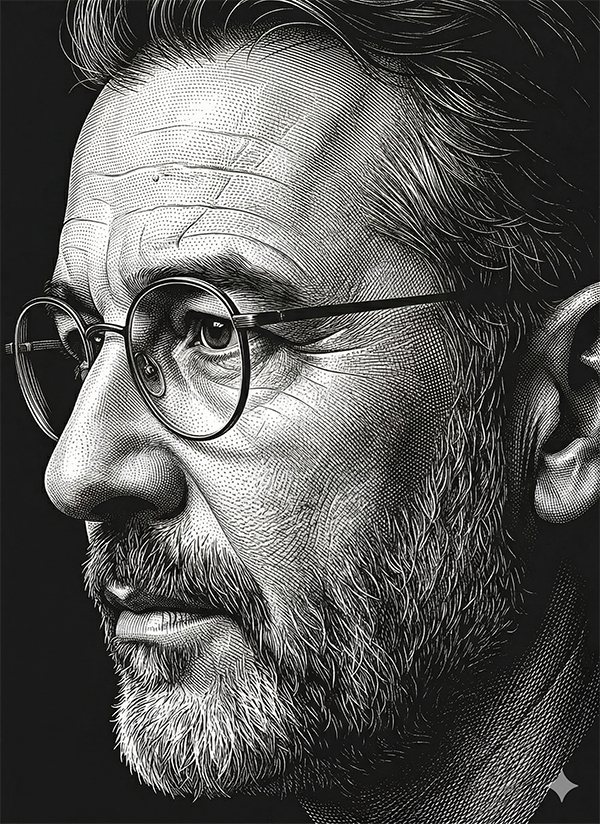
Using my uploaded reference photo as the primary face reference, keep the person’s identity 100% identical to the original image: same facial features, bone structure, skin tone, gender, perceived age, hairstyle shape and overall facial proportions, with no age‑regression or aging. Preserve the exact nose, eyes, lips, jawline and any unique marks such as moles, freckles, scars or skin texture, as if it were the same person captured again. Transform this into an ultra‑detailed black and white portrait in strict profile view, with the head turned sideways, wearing round glasses, and an intense, focused expression. The style should mimic a hyper‑realistic engraving or woodcut etching: extreme close‑up on the face, with clearly visible skin texture, wrinkles, beard stubble and hair rendered entirely through dense linework.
Lighting
Use dramatic studio lighting with deep shadows and high contrast: a strong key light from one side to carve out the forehead, nose, cheekbone and chin, leaving the far side of the head in rich shadow. The lighting should emphasize the three‑dimensional structure of the profile—nose bridge, lips and jawline—creating a cinematic chiaroscuro effect against a dark background. No color; keep everything monochrome in pure black ink and white paper.
Camera, lens and composition
Frame an extreme close‑up portrait in profile: the head and neck fill most of the image, with the ear roughly centered vertically, and the glasses clearly visible. Use a portrait‑style focal length equivalent around 85–105 mm to keep facial proportions natural, as if this were a studio headshot later converted into engraving. Keep the composition minimalist like a poster: clean margins, the face positioned slightly off‑center, and a solid dark background with no distracting elements.
Style and detail
Apply classical engraving and cross‑hatching techniques: sharp black linework, fine parallel hatching and cross‑hatching that follow the contours of the face to build form, texture and value. Avoid soft airbrushed shading; all tones should be created by layered lines and etched marks. Show hyper‑detailed wrinkles on the forehead and around the eyes, subtle pores, beard stubble and hair strands, all in monochrome. The overall feel should be that of a high‑end, 8K‑resolution, highly textured engraving or etching print suitable for a minimalist poster.
Negative prompt
different person, altered identity, changed gender, younger or older face, changed nose, eyes, lips or jawline, different skin tone, different hairstyle, missing or altered moles, freckles or scars, front‑facing or three‑quarter angle (not profile), cartoon style, anime, sketchy loose doodle, painterly oil or watercolor look, grayscale photo without linework, soft airbrushed shading, halftone comic dots, colored ink, busy background, text, logos, decorative borders, low resolution, blurry lines, pixelation, noisy artifacts.
Lighting
Use dramatic studio lighting with deep shadows and high contrast: a strong key light from one side to carve out the forehead, nose, cheekbone and chin, leaving the far side of the head in rich shadow. The lighting should emphasize the three‑dimensional structure of the profile—nose bridge, lips and jawline—creating a cinematic chiaroscuro effect against a dark background. No color; keep everything monochrome in pure black ink and white paper.
Camera, lens and composition
Frame an extreme close‑up portrait in profile: the head and neck fill most of the image, with the ear roughly centered vertically, and the glasses clearly visible. Use a portrait‑style focal length equivalent around 85–105 mm to keep facial proportions natural, as if this were a studio headshot later converted into engraving. Keep the composition minimalist like a poster: clean margins, the face positioned slightly off‑center, and a solid dark background with no distracting elements.
Style and detail
Apply classical engraving and cross‑hatching techniques: sharp black linework, fine parallel hatching and cross‑hatching that follow the contours of the face to build form, texture and value. Avoid soft airbrushed shading; all tones should be created by layered lines and etched marks. Show hyper‑detailed wrinkles on the forehead and around the eyes, subtle pores, beard stubble and hair strands, all in monochrome. The overall feel should be that of a high‑end, 8K‑resolution, highly textured engraving or etching print suitable for a minimalist poster.
Negative prompt
different person, altered identity, changed gender, younger or older face, changed nose, eyes, lips or jawline, different skin tone, different hairstyle, missing or altered moles, freckles or scars, front‑facing or three‑quarter angle (not profile), cartoon style, anime, sketchy loose doodle, painterly oil or watercolor look, grayscale photo without linework, soft airbrushed shading, halftone comic dots, colored ink, busy background, text, logos, decorative borders, low resolution, blurry lines, pixelation, noisy artifacts.