Rachando
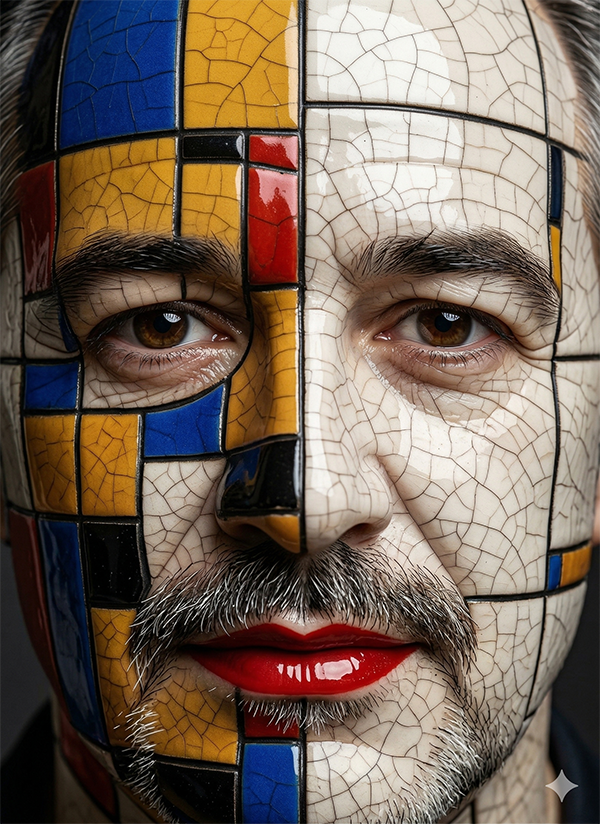
Main prompt (positive)
Use the uploaded image as the exact identity reference. Maintain the person’s identity 100% identical to the source photo: same facial bone structure, facial proportions, skin tone, gender, perceived age, hairstyle shape, and overall likeness. Preserve the original expression, nose, eyes, lips, jawline, cheekbones, chin, and any unique marks such as moles, freckles, scars, or skin texture. The face must remain instantly recognizable.
IDENTITY LOCK — ABSOLUTE (NON-NEGOTIABLE)
Preserve exactly: facial bone structure and proportions; eye shape, eyelids, iris size, and gaze direction; nose bridge, tip, nostril shape, and alignment; lip shape, fullness, edges, and natural asymmetry; skin plane transitions (cheek to nose to lips); exact head angle and camera perspective; original neutral expression with no reinterpretation. Do not rotate, mirror, beautify, stylize anatomy, or alter proportions.
COMPOSITION — SYMMETRICAL SPLIT FACE (CRITICAL)
Tight close-up portrait from eyes to lips, with minimal forehead and chin crop. The face fills the entire frame. A perfect vertical split runs down the exact center of the face. Left and right halves remain anatomically aligned and continuous, with no offset or duplication. Both eyes are fully visible and unobstructed. The central seam is clean, straight, and razor sharp. No perspective shift between halves; this is one single face, divided stylistically, not two separate faces.
CORE STYLE — CRACKED MOSAIC SURFACE RECONSTRUCTION
Transform the entire face into a high-detail cracked ceramic / enamel mosaic surface. Skin becomes a fine, irregular crackle texture (crazed glaze effect) with thin, organic, vein-like networks of cracks across all surfaces. Maintain full 3D facial volume underneath the texture so the face still feels sculpted, not flat. Cracks must follow the curvature of the facial forms (nose bridge, lips, orbital area, cheeks, chin) instead of being randomly flat.
GEOMETRIC OVERLAY — LEFT SIDE
On the left half of the face, overlay bold abstract geometric shapes inspired by Mondrian / cubist segmentation. Use thick, slightly raised black dividing lines that define the segments. Fill these segments with solid saturated colors: cobalt blue, deep yellow / ochre, red accents, and occasional black blocks. Shapes must wrap naturally over the facial contours and volumes, not behave like flat stickers. Geometry should intersect the eye area, cheek planes, and forehead cleanly while preserving anatomy.
MINIMAL MOSAIC FIELD — RIGHT SIDE
On the right half of the face, keep the overall look mostly monochrome in off-white / ivory ceramic. Use the same fine crackle texture as the left side but without heavy color blocking. Introduce subtle geometric segmentation using thin black lines, but much less dense than on the left. Small accent shapes in yellow or black are allowed, but must remain restrained so this side reads calmer and more minimal.
FACIAL FEATURE TREATMENT (CRITICAL)
Eyes: hyper-realistic, glossy, and sharply detailed, with bright, clear irises and natural reflections. Eyelashes must remain crisp and intact, not broken into mosaic tiles. The crack texture and geometric overlays can pass near the eyes but must not distort or misplace their anatomy.
Lips: smooth, glossy, bold saturated red, with slightly fewer cracks than the surrounding skin (semi-preserved surface). Maintain natural lip volume, edges, and highlight reflections.
Nose: fully integrated with the crack pattern, with subtle shading preserved under the mosaic surface to maintain form and depth.
MATERIAL & DEPTH RULES
The overall surface should resemble glazed ceramic or enamel with micro-cracking. Skin areas have a matte-to-semi-gloss finish, while lips and eyes show stronger specular highlights. Cracks have visible depth variation rather than flat drawn lines, and black geometric lines feel slightly embossed or inset in the surface. The result should feel like a physical, tactile ceramic portrait tile.
COLOR & CONTRAST SYSTEM
Left side: bold, high-saturation geometric color blocking (cobalt blue, ochre yellow, red, black blocks) with strong graphic contrast.
Right side: restrained, pale ceramic neutrality (off-white / ivory) with subtle black lines and small accent shapes.
Maintain a strong contrast between the two halves while preserving a continuous identity across the split.
LIGHTING & FINISH
Use clean studio lighting, front-facing and soft but defined, to keep all micro-texture and cracks clearly visible. Emphasize the micro-texture of the crackle glaze and the depth of geometric lines with precise highlights and shadows. No background distractions: the face dominates the entire frame; any remaining negative space should be neutral and unobtrusive. Output must feel ultra-detailed, gallery-quality, with crisp edges and clean segmentation.
Camera look: tight close-up portrait framing, neutral focal length around 50–85mm, straight-on view, no wide-angle distortion, sharp focus on eyes and lips.
Negative prompt (strict)
no face distortion, no misaligned halves, no vertical seam offset, no shifted or duplicated facial elements, no perspective mismatch between left and right sides.
no blurred or low-detail cracks, no muddy textures, no painterly brush strokes, no soft airbrushed skin, no watercolor or sketch effects.
no cartoon or anime stylization, no exaggerated proportions, no melted or warped geometry, no broken eye shape, no loss of realistic eye detail.
no extra eyes, no extra nose, no extra mouth, no duplicated lips, no second face, no split personality effect with different expressions.
no busy background, no text, no logos, no watermarks.
Output must be ultra-detailed, high-resolution (8K look), hyper-realistic texture fidelity, with crisp edges and clean, precise segmentation.
Use the uploaded image as the exact identity reference. Maintain the person’s identity 100% identical to the source photo: same facial bone structure, facial proportions, skin tone, gender, perceived age, hairstyle shape, and overall likeness. Preserve the original expression, nose, eyes, lips, jawline, cheekbones, chin, and any unique marks such as moles, freckles, scars, or skin texture. The face must remain instantly recognizable.
IDENTITY LOCK — ABSOLUTE (NON-NEGOTIABLE)
Preserve exactly: facial bone structure and proportions; eye shape, eyelids, iris size, and gaze direction; nose bridge, tip, nostril shape, and alignment; lip shape, fullness, edges, and natural asymmetry; skin plane transitions (cheek to nose to lips); exact head angle and camera perspective; original neutral expression with no reinterpretation. Do not rotate, mirror, beautify, stylize anatomy, or alter proportions.
COMPOSITION — SYMMETRICAL SPLIT FACE (CRITICAL)
Tight close-up portrait from eyes to lips, with minimal forehead and chin crop. The face fills the entire frame. A perfect vertical split runs down the exact center of the face. Left and right halves remain anatomically aligned and continuous, with no offset or duplication. Both eyes are fully visible and unobstructed. The central seam is clean, straight, and razor sharp. No perspective shift between halves; this is one single face, divided stylistically, not two separate faces.
CORE STYLE — CRACKED MOSAIC SURFACE RECONSTRUCTION
Transform the entire face into a high-detail cracked ceramic / enamel mosaic surface. Skin becomes a fine, irregular crackle texture (crazed glaze effect) with thin, organic, vein-like networks of cracks across all surfaces. Maintain full 3D facial volume underneath the texture so the face still feels sculpted, not flat. Cracks must follow the curvature of the facial forms (nose bridge, lips, orbital area, cheeks, chin) instead of being randomly flat.
GEOMETRIC OVERLAY — LEFT SIDE
On the left half of the face, overlay bold abstract geometric shapes inspired by Mondrian / cubist segmentation. Use thick, slightly raised black dividing lines that define the segments. Fill these segments with solid saturated colors: cobalt blue, deep yellow / ochre, red accents, and occasional black blocks. Shapes must wrap naturally over the facial contours and volumes, not behave like flat stickers. Geometry should intersect the eye area, cheek planes, and forehead cleanly while preserving anatomy.
MINIMAL MOSAIC FIELD — RIGHT SIDE
On the right half of the face, keep the overall look mostly monochrome in off-white / ivory ceramic. Use the same fine crackle texture as the left side but without heavy color blocking. Introduce subtle geometric segmentation using thin black lines, but much less dense than on the left. Small accent shapes in yellow or black are allowed, but must remain restrained so this side reads calmer and more minimal.
FACIAL FEATURE TREATMENT (CRITICAL)
Eyes: hyper-realistic, glossy, and sharply detailed, with bright, clear irises and natural reflections. Eyelashes must remain crisp and intact, not broken into mosaic tiles. The crack texture and geometric overlays can pass near the eyes but must not distort or misplace their anatomy.
Lips: smooth, glossy, bold saturated red, with slightly fewer cracks than the surrounding skin (semi-preserved surface). Maintain natural lip volume, edges, and highlight reflections.
Nose: fully integrated with the crack pattern, with subtle shading preserved under the mosaic surface to maintain form and depth.
MATERIAL & DEPTH RULES
The overall surface should resemble glazed ceramic or enamel with micro-cracking. Skin areas have a matte-to-semi-gloss finish, while lips and eyes show stronger specular highlights. Cracks have visible depth variation rather than flat drawn lines, and black geometric lines feel slightly embossed or inset in the surface. The result should feel like a physical, tactile ceramic portrait tile.
COLOR & CONTRAST SYSTEM
Left side: bold, high-saturation geometric color blocking (cobalt blue, ochre yellow, red, black blocks) with strong graphic contrast.
Right side: restrained, pale ceramic neutrality (off-white / ivory) with subtle black lines and small accent shapes.
Maintain a strong contrast between the two halves while preserving a continuous identity across the split.
LIGHTING & FINISH
Use clean studio lighting, front-facing and soft but defined, to keep all micro-texture and cracks clearly visible. Emphasize the micro-texture of the crackle glaze and the depth of geometric lines with precise highlights and shadows. No background distractions: the face dominates the entire frame; any remaining negative space should be neutral and unobtrusive. Output must feel ultra-detailed, gallery-quality, with crisp edges and clean segmentation.
Camera look: tight close-up portrait framing, neutral focal length around 50–85mm, straight-on view, no wide-angle distortion, sharp focus on eyes and lips.
Negative prompt (strict)
no face distortion, no misaligned halves, no vertical seam offset, no shifted or duplicated facial elements, no perspective mismatch between left and right sides.
no blurred or low-detail cracks, no muddy textures, no painterly brush strokes, no soft airbrushed skin, no watercolor or sketch effects.
no cartoon or anime stylization, no exaggerated proportions, no melted or warped geometry, no broken eye shape, no loss of realistic eye detail.
no extra eyes, no extra nose, no extra mouth, no duplicated lips, no second face, no split personality effect with different expressions.
no busy background, no text, no logos, no watermarks.
Output must be ultra-detailed, high-resolution (8K look), hyper-realistic texture fidelity, with crisp edges and clean, precise segmentation.