Reflexo_quente
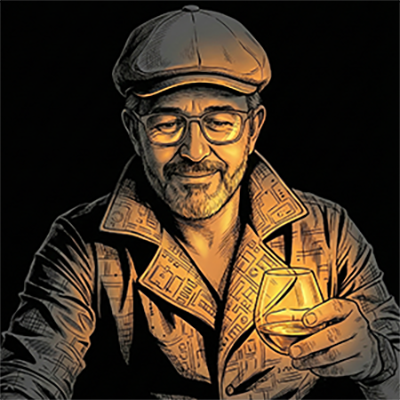
Stylized portrait of the same person from the uploaded image, using that image as the strict identity reference. The character must look 100% identical to the uploaded cartoon portrait, translated into a high‑contrast line‑art style: same hairstyle silhouette and hair color, same facial structure and jawline, same ears, same glasses shape and position, same facial hair pattern and density, same skin‑tone impression, same gender expression, and same perceived age. Do not change any identity traits; keep head and face proportions exactly the same.
Medium‑shot vertical portrait. The upper body is slightly turned, with the torso rotated a bit away from the viewer while the head is angled downward and gently toward the viewer’s left. The character’s eyes gaze intensely at a small glowing object held between the fingers of one hand, positioned near the chest, while wearing a subtle, relaxed smile that feels friendly and thoughtful rather than serious. The character wears a structured flat cap that follows the same dark hair color and integrates with the existing hairstyle silhouette, and a collared jacket with wide lapels over a visible shirt collar, replacing the hoodie while keeping the same overall slim build. The jacket is covered with intricate schematic‑like patterns: abstract symbols, thin technical lines, and fragmented, illegible micro‑text, arranged like a futuristic blueprint or diagram.
A warm golden‑orange light emanates from the glowing object in the hand, casting dramatic illumination upward onto the face, glasses, and underside of the flat cap, creating strong rim lighting and bright highlights, while the rest of the figure falls into rich shadows. Background is a deep pure black with no visible environment, emphasizing the graphic silhouette.
Rendering style: graphic, high‑contrast digital line‑art with a modern illustration aesthetic. Forms and shadows are defined with fine, parallel hatching lines, cross‑hatching, and clean contour lines; large shadow areas are built from dense linework rather than smooth gradients. Limited color: mostly black, white, and warm golden‑orange from the glow, plus subtle skin‑tone indication. The overall look is cinematic and dramatic, like a noir graphic novel cover, but with a slightly softer, more approachable mood due to the character’s gentle smile.
(2) Negative prompt – avoid
blurry, low‑resolution, pixelated, noisy, out of focus, soft painterly shading, watercolor, oil painting, full‑color rendered skin, 3D render, photorealistic photo, anime or manga style, flat vector emoji style, thick messy lines, sketchy unfinished doodle, no hatching, smooth airbrushed shadows, bright or colored background, gradients or textures in the background, visible environment, street or room background, front‑facing neutral pose, head looking straight at the viewer, no glowing object, no upward lighting, jacket without patterns, realistic readable text blocks on the jacket, birds or extra props, missing flat cap, different type of hat, different clothing style (hoodie, t‑shirt only), different glasses shape or color, missing glasses, missing facial hair, different hairstyle, visible long hair, cigarette, smoking, smoke, wisps of smoke, serious or angry expression, wide open grin, changed jawline, changed nose, changed eyes, changed lips, changed age (younger or older), changed gender expression, wrong skin‑tone impression, extra characters, hands covering the face, cool blue light instead of warm orange glow, logos, watermarks, or UI elements other than any text you explicitly add elsewhere.
(3) Identity‑preservation instructions – 100% same person
The portrait must depict exactly the same person as in the uploaded image, with zero deviation in identity.
Use the uploaded character as the single source of truth for:
Head shape and proportions, including forehead, cheeks, jawline, and chin.
Facial features: identical eye shape and spacing, eyebrow thickness and curve, nose shape, lip shape and thickness, ear shape and size.
Skin‑tone impression (even though rendered graphically and minimally colored).
Hairstyle: same dark, tousled, upward‑swept style and silhouette, adapted under the flat cap but not changed in structure; hair must remain consistent where visible.
Facial hair: same stubble/mustache pattern, coverage, and density, translated into line‑art.
Glasses: same black rectangular frame, same size, position, and style on the face.
Gender expression and perceived age: do not make the character younger, older, or change how masculine/feminine they appear.
You may change the outfit from hoodie to flat cap plus collared jacket with wide lapels and shirt collar, but you must not change the face or head proportions.
The system is not allowed to invent a different character; it must always re‑render this exact person in the new pose and style.
(4) Technical details – aspect ratio, “lens”, lighting, resolution
Aspect ratio: vertical portrait, approximately 2:3 or 3:4.
Framing: medium shot from mid‑torso upward, with the head close to the upper third of the frame and the glowing object clearly visible in the lower central area.
Camera angle: slight 3/4 body turn with the head tilted down and toward viewer’s left; eye‑level camera relative to the face, no extreme perspective.
“Lens” feel: equivalent to a 50–85mm portrait lens – natural perspective, no wide‑angle distortion.
Depth of field: illustration‑style (everything important—face, hand, glowing object, jacket details and any text—is sharp), background completely black with no detail.
Lighting: single dominant warm golden‑orange light source emitted from the small glowing object in the hand, casting strong upward illumination on the lower face, nose, glasses, and underside of the cap; subtle rim light along the edges of the head and shoulders; ambient darkness elsewhere.
Contrast: very high‑contrast graphic look – deep blacks, sharp bright highlights, most midtones expressed through line density rather than soft gradients.
Resolution: high resolution (4K or similar), crisp linework and clean edges, no banding or artifacts.
Style: digital high‑contrast line‑art illustration with fine parallel hatching and cross‑hatching, limited warm accent color, cinematic and moody but with a friendly, softly smiling expression.
Medium‑shot vertical portrait. The upper body is slightly turned, with the torso rotated a bit away from the viewer while the head is angled downward and gently toward the viewer’s left. The character’s eyes gaze intensely at a small glowing object held between the fingers of one hand, positioned near the chest, while wearing a subtle, relaxed smile that feels friendly and thoughtful rather than serious. The character wears a structured flat cap that follows the same dark hair color and integrates with the existing hairstyle silhouette, and a collared jacket with wide lapels over a visible shirt collar, replacing the hoodie while keeping the same overall slim build. The jacket is covered with intricate schematic‑like patterns: abstract symbols, thin technical lines, and fragmented, illegible micro‑text, arranged like a futuristic blueprint or diagram.
A warm golden‑orange light emanates from the glowing object in the hand, casting dramatic illumination upward onto the face, glasses, and underside of the flat cap, creating strong rim lighting and bright highlights, while the rest of the figure falls into rich shadows. Background is a deep pure black with no visible environment, emphasizing the graphic silhouette.
Rendering style: graphic, high‑contrast digital line‑art with a modern illustration aesthetic. Forms and shadows are defined with fine, parallel hatching lines, cross‑hatching, and clean contour lines; large shadow areas are built from dense linework rather than smooth gradients. Limited color: mostly black, white, and warm golden‑orange from the glow, plus subtle skin‑tone indication. The overall look is cinematic and dramatic, like a noir graphic novel cover, but with a slightly softer, more approachable mood due to the character’s gentle smile.
(2) Negative prompt – avoid
blurry, low‑resolution, pixelated, noisy, out of focus, soft painterly shading, watercolor, oil painting, full‑color rendered skin, 3D render, photorealistic photo, anime or manga style, flat vector emoji style, thick messy lines, sketchy unfinished doodle, no hatching, smooth airbrushed shadows, bright or colored background, gradients or textures in the background, visible environment, street or room background, front‑facing neutral pose, head looking straight at the viewer, no glowing object, no upward lighting, jacket without patterns, realistic readable text blocks on the jacket, birds or extra props, missing flat cap, different type of hat, different clothing style (hoodie, t‑shirt only), different glasses shape or color, missing glasses, missing facial hair, different hairstyle, visible long hair, cigarette, smoking, smoke, wisps of smoke, serious or angry expression, wide open grin, changed jawline, changed nose, changed eyes, changed lips, changed age (younger or older), changed gender expression, wrong skin‑tone impression, extra characters, hands covering the face, cool blue light instead of warm orange glow, logos, watermarks, or UI elements other than any text you explicitly add elsewhere.
(3) Identity‑preservation instructions – 100% same person
The portrait must depict exactly the same person as in the uploaded image, with zero deviation in identity.
Use the uploaded character as the single source of truth for:
Head shape and proportions, including forehead, cheeks, jawline, and chin.
Facial features: identical eye shape and spacing, eyebrow thickness and curve, nose shape, lip shape and thickness, ear shape and size.
Skin‑tone impression (even though rendered graphically and minimally colored).
Hairstyle: same dark, tousled, upward‑swept style and silhouette, adapted under the flat cap but not changed in structure; hair must remain consistent where visible.
Facial hair: same stubble/mustache pattern, coverage, and density, translated into line‑art.
Glasses: same black rectangular frame, same size, position, and style on the face.
Gender expression and perceived age: do not make the character younger, older, or change how masculine/feminine they appear.
You may change the outfit from hoodie to flat cap plus collared jacket with wide lapels and shirt collar, but you must not change the face or head proportions.
The system is not allowed to invent a different character; it must always re‑render this exact person in the new pose and style.
(4) Technical details – aspect ratio, “lens”, lighting, resolution
Aspect ratio: vertical portrait, approximately 2:3 or 3:4.
Framing: medium shot from mid‑torso upward, with the head close to the upper third of the frame and the glowing object clearly visible in the lower central area.
Camera angle: slight 3/4 body turn with the head tilted down and toward viewer’s left; eye‑level camera relative to the face, no extreme perspective.
“Lens” feel: equivalent to a 50–85mm portrait lens – natural perspective, no wide‑angle distortion.
Depth of field: illustration‑style (everything important—face, hand, glowing object, jacket details and any text—is sharp), background completely black with no detail.
Lighting: single dominant warm golden‑orange light source emitted from the small glowing object in the hand, casting strong upward illumination on the lower face, nose, glasses, and underside of the cap; subtle rim light along the edges of the head and shoulders; ambient darkness elsewhere.
Contrast: very high‑contrast graphic look – deep blacks, sharp bright highlights, most midtones expressed through line density rather than soft gradients.
Resolution: high resolution (4K or similar), crisp linework and clean edges, no banding or artifacts.
Style: digital high‑contrast line‑art illustration with fine parallel hatching and cross‑hatching, limited warm accent color, cinematic and moody but with a friendly, softly smiling expression.