Rosto_da_natureza_com_insetos
Use the uploaded photo as the exact identity reference. Maintain the person’s identity 100% identical to the source: same facial features, facial bone structure and proportions, skin tone impression, hairstyle shape, perceived age, and gender presentation. Keep the exact head angle, camera perspective, and expression. Do not rotate, mirror, beautify, de-age or age up, or change the gender; the face must remain instantly recognizable as the same person.
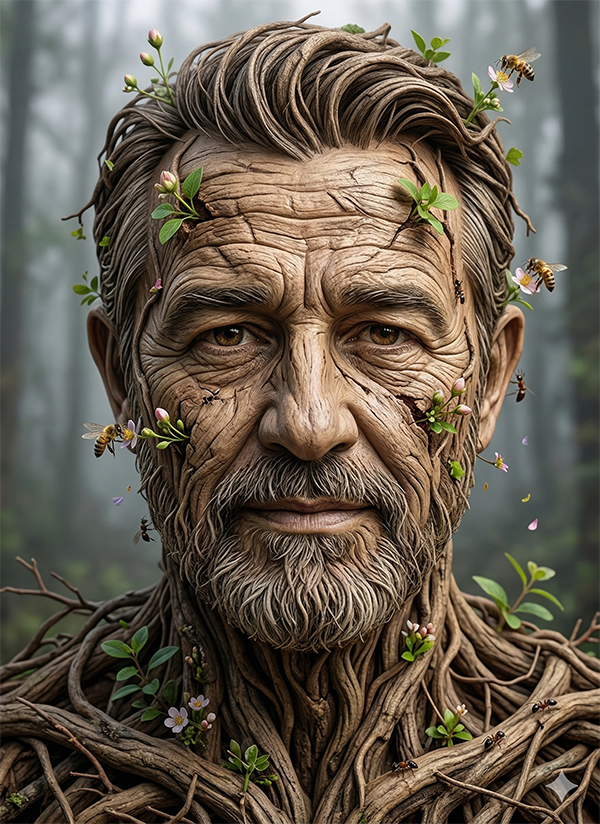
Transform the subject so the entire visible form appears fully constructed from tree wood and intertwined roots, as if naturally grown and carved from a living tree. Preserve accurate likeness, bone structure, eye placement, nose shape, lips, and jawline while converting all skin into a realistic bark surface with deep wood grain flow and natural growth ridges. Form facial planes using very small, tightly interwoven root strands, fine knotted timber folds, and layered organic trunk textures, built from many tiny wood segments rather than large smooth patches. Sculpt the neck, shoulders, and upper torso entirely from twisting roots, branching wood fibers, and fused tree growth, with thin root filaments wrapping around thicker trunk-like forms. Hair becomes dense root bundles, tangled vine-like strands, and branching woody filaments that rise and spread like a crown of roots, all made from finely detailed, small-scale wood fibers.
Along some of these roots and wooden strands, have small areas where life is emerging: tiny fresh green leaves and delicate small flowers sprouting from cracks, knots, and junctions in the wood. These flowers should appear in selective spots only, as if the wood is slowly coming to life, with small buds, tiny blossoms, and clusters of bright green leaves growing from thin twigs and root tips around the head, shoulders, and chest. Subtly integrate small realistic insects into the scene: a few bees hovering near the flowers or landing on petals, and several ants walking along the wooden branches and root surfaces, following the lines of the grain and moving over raised ridges. The insects must stay small and naturalistic, enhancing the sense of scale and organic life without overpowering the portrait.
Eyes remain clearly defined and expressive but appear carved within wood cavities or framed by root arches, with realistic reflections and iris detail preserved from the reference. Lips, eyelids, and facial contours must feel structurally grown from wood—sharp, chiseled planes and layered bark edges—rather than soft human skin. Include natural cracks, weathered splits, hollow root pockets, and aged timber erosion details across the surface, with micro-cracks and small chips enhancing realism. Maintain a monumental sculptural bust composition with upper chest and shoulders visible, as if this is a life-sized ancient tree statue. Use a natural earthy wood palette: deep walnut brown, dry oak beige, burnt sienna, and dark root umber, with subtle tonal variation following the grain direction, plus fresh, saturated greens for the small leaves and natural flower colors in soft accents. The surface finish should feel matte, dry, fibrous, and tactile like ancient tree sculpture, not glossy or wet.
Place the figure against a neutral, soft studio or forest-tone background (muted greens, foggy grays, or dark earthy tones) that does not distract from the wooden bust and the subtle flowers and insects. Use cinematic directional lighting from one side to reveal depth of grain and root structure, casting strong, clean shadows into crevices and hollow root pockets while highlighting raised ridges, facial planes, leaf edges, and tiny flower petals. Overall style: ultra-detailed, hyper-real organic fantasy realism with the mood of an ancient tree spirit, root-grown sculpture, and primal natural metamorphosis, with small blossoms of life (flowers, leaves, insects) emerging from the wooden form.
Transform the subject so the entire visible form appears fully constructed from tree wood and intertwined roots, as if naturally grown and carved from a living tree. Preserve accurate likeness, bone structure, eye placement, nose shape, lips, and jawline while converting all skin into a realistic bark surface with deep wood grain flow and natural growth ridges. Form facial planes using very small, tightly interwoven root strands, fine knotted timber folds, and layered organic trunk textures, built from many tiny wood segments rather than large smooth patches. Sculpt the neck, shoulders, and upper torso entirely from twisting roots, branching wood fibers, and fused tree growth, with thin root filaments wrapping around thicker trunk-like forms. Hair becomes dense root bundles, tangled vine-like strands, and branching woody filaments that rise and spread like a crown of roots, all made from finely detailed, small-scale wood fibers.
Along some of these roots and wooden strands, have small areas where life is emerging: tiny fresh green leaves and delicate small flowers sprouting from cracks, knots, and junctions in the wood. These flowers should appear in selective spots only, as if the wood is slowly coming to life, with small buds, tiny blossoms, and clusters of bright green leaves growing from thin twigs and root tips around the head, shoulders, and chest. Subtly integrate small realistic insects into the scene: a few bees hovering near the flowers or landing on petals, and several ants walking along the wooden branches and root surfaces, following the lines of the grain and moving over raised ridges. The insects must stay small and naturalistic, enhancing the sense of scale and organic life without overpowering the portrait.
Eyes remain clearly defined and expressive but appear carved within wood cavities or framed by root arches, with realistic reflections and iris detail preserved from the reference. Lips, eyelids, and facial contours must feel structurally grown from wood—sharp, chiseled planes and layered bark edges—rather than soft human skin. Include natural cracks, weathered splits, hollow root pockets, and aged timber erosion details across the surface, with micro-cracks and small chips enhancing realism. Maintain a monumental sculptural bust composition with upper chest and shoulders visible, as if this is a life-sized ancient tree statue. Use a natural earthy wood palette: deep walnut brown, dry oak beige, burnt sienna, and dark root umber, with subtle tonal variation following the grain direction, plus fresh, saturated greens for the small leaves and natural flower colors in soft accents. The surface finish should feel matte, dry, fibrous, and tactile like ancient tree sculpture, not glossy or wet.
Place the figure against a neutral, soft studio or forest-tone background (muted greens, foggy grays, or dark earthy tones) that does not distract from the wooden bust and the subtle flowers and insects. Use cinematic directional lighting from one side to reveal depth of grain and root structure, casting strong, clean shadows into crevices and hollow root pockets while highlighting raised ridges, facial planes, leaf edges, and tiny flower petals. Overall style: ultra-detailed, hyper-real organic fantasy realism with the mood of an ancient tree spirit, root-grown sculpture, and primal natural metamorphosis, with small blossoms of life (flowers, leaves, insects) emerging from the wooden form.