Selfie_monstros
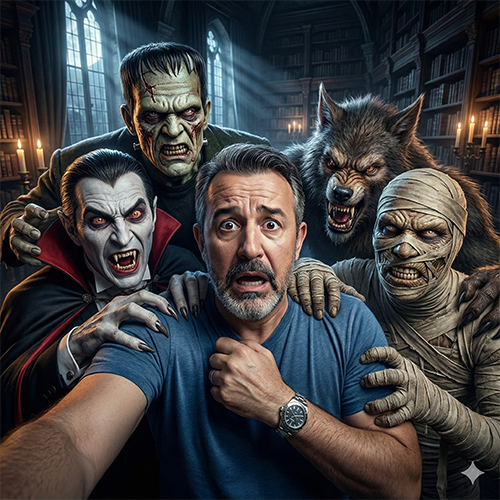
Hyper‑realistic 8K cinematic wide‑angle selfie using the uploaded face as the primary identity reference. The overall realism of all characters and the environment must be absolutely insane, with extremely realistic skin, materials, lighting, and micro‑details, indistinguishable from a high‑end live‑action movie frame.
The main subject wears a blue T‑shirt and looks extremely scared, with a terrified facial expression: wide eyes, tense brows, slightly open mouth, and visible fear in the gaze. The person’s identity must remain 100% identical to the uploaded photo: same facial features, bone structure, skin tone, gender, perceived age, hairstyle shape, and overall facial proportions, preserving the exact nose, eyes, lips, jawline, ears, and any unique marks or skin texture; keep the skin tone exactly matching the reference with ultra‑realistic pore detail, subtle imperfections, and natural subsurface scattering.
In the extreme foreground, the left hand reaches toward the camera to hold the phone for the selfie; a detailed silver wristwatch on the left wrist is large and prominent, with razor‑sharp reflections, tiny scratches, brushed metal texture, engraved details, and physically accurate highlights.
Surrounding the terrified subject, four legendary monsters are physically interacting with him, all crowded tightly into the selfie frame for a chaotic “family photo”. Their realism must be pushed to the absolute limit: every pore, hair, fabric thread, and material behaves like real‑world physics and photography. All four monsters have extremely realistic, enraged faces, with intense, furious expressions that contrast with the subject’s fear—bared teeth or fangs, wrinkled brows, flared nostrils, and tense facial muscles.
Frankenstein’s monster stands directly behind him, one huge stitched arm wrapped gently but firmly around his shoulders in a side hug, towering over him. His ultra‑realistic enraged face shows deep furrowed brows, clenched jaw, stretched scars, veins bulging at the temples, and bloodshot eyes; skin shows detailed scars, stitches pulling slightly at the flesh, subtle color variations, veins beneath the surface, tiny beads of sweat, and realistic roughness.
Dracula is on one side, one elegant hand resting on the subject’s opposite shoulder while the other hand makes a tense, claw‑like peace sign close to the lens, velvet cape partially wrapping around the group. His enraged aristocratic face shows pale porcelain skin with fine pores and faint veins, eyes blazing with anger, sharply arched brows, slightly bared fangs, and a velvet cape with clearly defined fibers, soft specular sheen, and weighty folds.
The werewolf leans in from the other side, one furry arm draped over the subject’s upper back, claws clearly visible and slightly gripping, his snout and wet nose very close to the subject’s head. His hyper‑realistic furious expression features snarling lips, exposed sharp teeth, wrinkled muzzle, flared nostrils, and glowing eyes; every strand of fur is individually rendered with depth and clumping, slight moisture around the mouth and nose, realistic wet specular highlights on the nose, and sharp yet believable claws with subtle translucency at the tips.
The Mummy is slightly in front and to the side, one bandaged hand gripping the subject’s forearm near the watch and the other hand pressing against his chest or shoulder, pulling him even closer into the group. The Mummy’s enraged face peers through gaps in the bandages: sunken eyes burning with anger, tightly clenched jaw, desiccated skin stretched over bone. The bandages show insanely detailed frayed fibers, dust, centuries‑old stains, slight translucency where skin presses beneath, and glimpses of ultra‑realistic dried skin and bone structure under torn areas.
All four monsters are touching or embracing the subject, making it feel like an intense, uncomfortable “group hug” selfie in which the monsters seem dangerously furious, amplifying the subject’s terrified expression. Their faces and hands are close to the camera, showing microscopic detail: pores, texture, micro‑wrinkles, fine hair, and physically accurate specular highlights.
The setting is a vast, dimly lit Gothic library with towering dark wooden bookshelves packed with ancient leather‑bound books, each spine with readable texture, embossed details, and subtle wear. Tall arched windows let in moonlight that cuts through the dust‑filled air, creating visible beams and soft bokeh highlights between the shelves. Stone floors, carved railings, and iron details are rendered with photorealistic surface imperfections, scratches, and subtle reflections. The aspect ratio must be a perfect square, 1:1, framing the entire group tightly in the center of the scene.
Lighting and Mood
Cinematic low‑key lighting with physically accurate rendering: cool moonlight from the tall windows mixed with warm candlelight and sconces.
Multiple candles placed on tables, railings, and wall sconces cast warm, flickering highlights on faces, armor, fur, bandages, wood, and stone, creating moving reflections and soft dancing shadows that graze the enraged monster faces.
Soft blue‑white rim light from the moon outlines the monsters and the subject’s hair and shoulders, while warm interior candlelight and sconces illuminate parts of their faces, clothing, fur, bandages, and the silver watch with natural color falloff.
A layer of subtle ground‑hugging fog and thin atmospheric mist fills the lower part of the library and swirls through the moonbeams, catching both candlelight and moonlight for dramatic volumetric effects.
Dust motes and haze in the air are rendered with volumetric light scattering, giving a three‑dimensional sense of atmosphere.
Strong but controlled contrast: deep shadows in the library corners and between shelves, yet all important textures on skin, fur, bandages, leather, velvet, metal, and wood remain clearly visible with realistic dynamic range and smooth highlight roll‑off.
Camera, Lens, and Framing
Square 1:1 image, perfectly centered composition for social‑media style framing.
Wide‑angle selfie perspective, as if taken with a modern smartphone held at arm’s length.
Simulated full‑frame camera with a 20–24 mm lens at around f/2.8–f/3.5, exaggerating the foreground hand and watch slightly while keeping all characters recognizable and proportionally correct.
Camera slightly below eye level, tilted slightly upward toward the group, enhancing the looming, imposing size of the enraged monsters surrounding the subject.
Tight composition: the subject’s terrified face near the center of the square frame, hyper‑detailed hand and watch dominating the lower foreground, four furious monsters filling the sides and top of the frame, some features partially cut by the edges for a spontaneous candid selfie feeling. Realistic lens characteristics: slight barrel distortion and subtle chromatic aberration at the frame edges, gentle depth of field blur in the far background.
Style and Technical Quality
Photorealistic, ultra‑cinematic style with an absurd, extreme level of realism—every surface and material looks like high‑end VFX rendered for a blockbuster film. The monsters in particular must look shockingly real, as if they are real creatures standing in front of the camera.
8K resolution or higher, ultra‑sharp focus on the subject’s face and wristwatch, with slightly softer but still richly detailed depth on the monsters and library background.
Cinematic color grading: cool blues and teals from moonlight contrasted with warm golden candle and sconce highlights, subtle film‑style grain, rich blacks, and carefully tuned midtones for maximum depth. Reflections, subsurface scattering, volumetric fog, depth of field, and still‑frame clarity must all feel like a real photographed moment.
Environment Details
Dark wooden shelves reaching toward the ceiling, full of old books with worn leather, cracked spines, and faded gold lettering, all rendered with microscopic realism.
Stone or tiled floor with realistic reflections of moonlight and candlelight, small chips and imperfections, slight dirt buildup in grout lines, and low‑lying fog drifting across the ground.
Windows with mullions casting complex light and shadow patterns onto the floor and nearby shelves; occasional drifting dust motes sharply defined in the beams.
Subtle props such as ladders, iron railings, candles, and candleholders add richness without distracting from the group in the foreground.
Negative Prompt
Do not change the subject’s identity, age, gender, face shape, hairstyle, or skin tone from the uploaded photo; no beautification, skin‑smoothing, de‑aging, or aging.
Do not give the subject a happy or relaxed expression; avoid smiles or laughter—the face must clearly communicate intense fear and terror.
Do not make the monsters cute, cartoonish, or friendly; their faces must remain enraged, threatening, and extremely realistic.
No cartoon, anime, comic, painterly, 2D vector, cel‑shaded, or low‑poly styles; avoid flat shading, stylization, or simplified details.
No extra characters beyond the main subject, Frankenstein’s monster, Dracula, the werewolf, and the Mummy.
No modern bright rooms, daytime scenes, or non‑Gothic environments; do not include city skylines, outdoor daylight, or casual interiors.
No anatomical distortions: avoid extra limbs or fingers, missing fingers, melted faces, warped hands or watch, misaligned eyes, or unnatural body proportions.
Avoid low resolution, pixelation, heavy digital noise, excessive lens flares, blown‑out highlights, washed‑out colors, excessive motion blur, over‑sharpening artifacts, or anything that reduces the extreme, photorealistic quality of the scene.
The main subject wears a blue T‑shirt and looks extremely scared, with a terrified facial expression: wide eyes, tense brows, slightly open mouth, and visible fear in the gaze. The person’s identity must remain 100% identical to the uploaded photo: same facial features, bone structure, skin tone, gender, perceived age, hairstyle shape, and overall facial proportions, preserving the exact nose, eyes, lips, jawline, ears, and any unique marks or skin texture; keep the skin tone exactly matching the reference with ultra‑realistic pore detail, subtle imperfections, and natural subsurface scattering.
In the extreme foreground, the left hand reaches toward the camera to hold the phone for the selfie; a detailed silver wristwatch on the left wrist is large and prominent, with razor‑sharp reflections, tiny scratches, brushed metal texture, engraved details, and physically accurate highlights.
Surrounding the terrified subject, four legendary monsters are physically interacting with him, all crowded tightly into the selfie frame for a chaotic “family photo”. Their realism must be pushed to the absolute limit: every pore, hair, fabric thread, and material behaves like real‑world physics and photography. All four monsters have extremely realistic, enraged faces, with intense, furious expressions that contrast with the subject’s fear—bared teeth or fangs, wrinkled brows, flared nostrils, and tense facial muscles.
Frankenstein’s monster stands directly behind him, one huge stitched arm wrapped gently but firmly around his shoulders in a side hug, towering over him. His ultra‑realistic enraged face shows deep furrowed brows, clenched jaw, stretched scars, veins bulging at the temples, and bloodshot eyes; skin shows detailed scars, stitches pulling slightly at the flesh, subtle color variations, veins beneath the surface, tiny beads of sweat, and realistic roughness.
Dracula is on one side, one elegant hand resting on the subject’s opposite shoulder while the other hand makes a tense, claw‑like peace sign close to the lens, velvet cape partially wrapping around the group. His enraged aristocratic face shows pale porcelain skin with fine pores and faint veins, eyes blazing with anger, sharply arched brows, slightly bared fangs, and a velvet cape with clearly defined fibers, soft specular sheen, and weighty folds.
The werewolf leans in from the other side, one furry arm draped over the subject’s upper back, claws clearly visible and slightly gripping, his snout and wet nose very close to the subject’s head. His hyper‑realistic furious expression features snarling lips, exposed sharp teeth, wrinkled muzzle, flared nostrils, and glowing eyes; every strand of fur is individually rendered with depth and clumping, slight moisture around the mouth and nose, realistic wet specular highlights on the nose, and sharp yet believable claws with subtle translucency at the tips.
The Mummy is slightly in front and to the side, one bandaged hand gripping the subject’s forearm near the watch and the other hand pressing against his chest or shoulder, pulling him even closer into the group. The Mummy’s enraged face peers through gaps in the bandages: sunken eyes burning with anger, tightly clenched jaw, desiccated skin stretched over bone. The bandages show insanely detailed frayed fibers, dust, centuries‑old stains, slight translucency where skin presses beneath, and glimpses of ultra‑realistic dried skin and bone structure under torn areas.
All four monsters are touching or embracing the subject, making it feel like an intense, uncomfortable “group hug” selfie in which the monsters seem dangerously furious, amplifying the subject’s terrified expression. Their faces and hands are close to the camera, showing microscopic detail: pores, texture, micro‑wrinkles, fine hair, and physically accurate specular highlights.
The setting is a vast, dimly lit Gothic library with towering dark wooden bookshelves packed with ancient leather‑bound books, each spine with readable texture, embossed details, and subtle wear. Tall arched windows let in moonlight that cuts through the dust‑filled air, creating visible beams and soft bokeh highlights between the shelves. Stone floors, carved railings, and iron details are rendered with photorealistic surface imperfections, scratches, and subtle reflections. The aspect ratio must be a perfect square, 1:1, framing the entire group tightly in the center of the scene.
Lighting and Mood
Cinematic low‑key lighting with physically accurate rendering: cool moonlight from the tall windows mixed with warm candlelight and sconces.
Multiple candles placed on tables, railings, and wall sconces cast warm, flickering highlights on faces, armor, fur, bandages, wood, and stone, creating moving reflections and soft dancing shadows that graze the enraged monster faces.
Soft blue‑white rim light from the moon outlines the monsters and the subject’s hair and shoulders, while warm interior candlelight and sconces illuminate parts of their faces, clothing, fur, bandages, and the silver watch with natural color falloff.
A layer of subtle ground‑hugging fog and thin atmospheric mist fills the lower part of the library and swirls through the moonbeams, catching both candlelight and moonlight for dramatic volumetric effects.
Dust motes and haze in the air are rendered with volumetric light scattering, giving a three‑dimensional sense of atmosphere.
Strong but controlled contrast: deep shadows in the library corners and between shelves, yet all important textures on skin, fur, bandages, leather, velvet, metal, and wood remain clearly visible with realistic dynamic range and smooth highlight roll‑off.
Camera, Lens, and Framing
Square 1:1 image, perfectly centered composition for social‑media style framing.
Wide‑angle selfie perspective, as if taken with a modern smartphone held at arm’s length.
Simulated full‑frame camera with a 20–24 mm lens at around f/2.8–f/3.5, exaggerating the foreground hand and watch slightly while keeping all characters recognizable and proportionally correct.
Camera slightly below eye level, tilted slightly upward toward the group, enhancing the looming, imposing size of the enraged monsters surrounding the subject.
Tight composition: the subject’s terrified face near the center of the square frame, hyper‑detailed hand and watch dominating the lower foreground, four furious monsters filling the sides and top of the frame, some features partially cut by the edges for a spontaneous candid selfie feeling. Realistic lens characteristics: slight barrel distortion and subtle chromatic aberration at the frame edges, gentle depth of field blur in the far background.
Style and Technical Quality
Photorealistic, ultra‑cinematic style with an absurd, extreme level of realism—every surface and material looks like high‑end VFX rendered for a blockbuster film. The monsters in particular must look shockingly real, as if they are real creatures standing in front of the camera.
8K resolution or higher, ultra‑sharp focus on the subject’s face and wristwatch, with slightly softer but still richly detailed depth on the monsters and library background.
Cinematic color grading: cool blues and teals from moonlight contrasted with warm golden candle and sconce highlights, subtle film‑style grain, rich blacks, and carefully tuned midtones for maximum depth. Reflections, subsurface scattering, volumetric fog, depth of field, and still‑frame clarity must all feel like a real photographed moment.
Environment Details
Dark wooden shelves reaching toward the ceiling, full of old books with worn leather, cracked spines, and faded gold lettering, all rendered with microscopic realism.
Stone or tiled floor with realistic reflections of moonlight and candlelight, small chips and imperfections, slight dirt buildup in grout lines, and low‑lying fog drifting across the ground.
Windows with mullions casting complex light and shadow patterns onto the floor and nearby shelves; occasional drifting dust motes sharply defined in the beams.
Subtle props such as ladders, iron railings, candles, and candleholders add richness without distracting from the group in the foreground.
Negative Prompt
Do not change the subject’s identity, age, gender, face shape, hairstyle, or skin tone from the uploaded photo; no beautification, skin‑smoothing, de‑aging, or aging.
Do not give the subject a happy or relaxed expression; avoid smiles or laughter—the face must clearly communicate intense fear and terror.
Do not make the monsters cute, cartoonish, or friendly; their faces must remain enraged, threatening, and extremely realistic.
No cartoon, anime, comic, painterly, 2D vector, cel‑shaded, or low‑poly styles; avoid flat shading, stylization, or simplified details.
No extra characters beyond the main subject, Frankenstein’s monster, Dracula, the werewolf, and the Mummy.
No modern bright rooms, daytime scenes, or non‑Gothic environments; do not include city skylines, outdoor daylight, or casual interiors.
No anatomical distortions: avoid extra limbs or fingers, missing fingers, melted faces, warped hands or watch, misaligned eyes, or unnatural body proportions.
Avoid low resolution, pixelation, heavy digital noise, excessive lens flares, blown‑out highlights, washed‑out colors, excessive motion blur, over‑sharpening artifacts, or anything that reduces the extreme, photorealistic quality of the scene.