Surreal_quebracabeca
Use the uploaded photo as the only and exclusive face and character reference. Keep the person’s identity 100% identical to the uploaded photo: same facial features, bone structure, skin tone, gender, age impression, hairstyle shape, and overall facial proportions. Do not change the person’s gender or make the face younger or older. Preserve the exact facial expression, nose, eyes, lips, jawline, chin, ears, and any unique marks such as moles, freckles, scars, pores, or skin texture so the face looks exactly like the person in the photo, only integrated into the puzzle‑duality concept below.
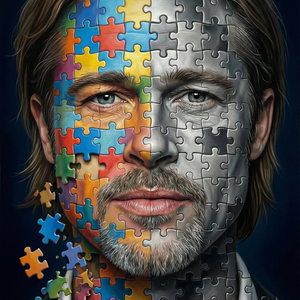
Create a hyperrealistic close‑up portrait of the person from the uploaded photo, with an introspective expression and a direct, piercing gaze toward the viewer. The face is shown as a centered headshot, vertically bisected down the middle into two contrasting halves, symbolizing fragmentation, duality, identity, and the puzzle of human consciousness. Maintain perfect symmetry in the cut while keeping all facial proportions and alignment true to the reference.
On the left half of the face (from the viewer’s perspective), construct the visage entirely from interlocking jigsaw puzzle pieces in a riot of vivid colors. Use deep blues, bright yellows, fiery reds, earthy greens, oranges, and purples, with individual pieces clearly defined, edges visible, and slight depth where they overlap. Some of these colorful pieces should appear to disintegrate, drift, or cascade downward along the cheek and toward the shoulder, suggesting unraveling, emotional complexity, or the breakdown of identity.
On the right half of the face, build the features from similar puzzle pieces, but in a uniform metallic grayscale palette of silvers, charcoals, gunmetal, and muted whites. This side should feel more cohesive, ordered, and structurally “complete,” with pieces fitting together tightly and fewer gaps. The contrast between the colorful, fragmenting left side and the cool, ordered right side should visually express the tension between emotional richness and detached rationality.
Hair and facial details: keep the person’s long, wavy (or original) hairstyle flowing symmetrically down both sides, with strands realistically blending into and behind the puzzle pieces. Where the real skin is still visible (such as along the central seam or at the neck), maintain photorealistic texture, pores, and subtle color variations matching the reference photo. On the colorful side, let the lips retain a soft, natural pink tone with gentle reflections; on the grayscale side, render the lips in desaturated gray tones that still preserve volume and form.
Eyes and expression: both eyes must remain perfectly aligned and true to the uploaded reference, with hyperrealistic detail, reflections, and depth. The irises should read as piercing blue‑gray (or match the real color if different), with subtle variations in hue and a sharp, introspective stare that anchors the composition. Allow the puzzle textures to frame the eyes without obscuring them, so the gaze remains the central emotional focus.
Background, lighting, and style: use a deep navy‑black gradient background fading into near‑black at the edges, enhancing the dramatic, contemplative mood. Light the face with strong, directional, slightly top‑down dramatic lighting that carves out planes, highlights puzzle edges, and creates soft but defined shadows under the jaw, nose, and puzzle pieces. Render the entire image in a hyperrealistic oil painting style with meticulous attention to texture: glossy and matte variations on the puzzle surfaces, subtle specular highlights on metallic pieces, rich skin detail where visible, and smooth transitions between light and shadow. High detail, cinematic composition, masterpiece quality, 8K resolution.
Negative / avoid (add this as a final block in the prompt):
“no different person, no generic model face, no changed gender, no de‑aged or beautified skin, no cartoon, no anime, no flat illustration, no low‑detail puzzle shapes, no low contrast, no cluttered background, no extra objects, no text, no logos, no watermarks, no glitch effects, no heavy blur, no distortion of facial proportions, no mismatched eye positions or asymmetrical split line.”
Create a hyperrealistic close‑up portrait of the person from the uploaded photo, with an introspective expression and a direct, piercing gaze toward the viewer. The face is shown as a centered headshot, vertically bisected down the middle into two contrasting halves, symbolizing fragmentation, duality, identity, and the puzzle of human consciousness. Maintain perfect symmetry in the cut while keeping all facial proportions and alignment true to the reference.
On the left half of the face (from the viewer’s perspective), construct the visage entirely from interlocking jigsaw puzzle pieces in a riot of vivid colors. Use deep blues, bright yellows, fiery reds, earthy greens, oranges, and purples, with individual pieces clearly defined, edges visible, and slight depth where they overlap. Some of these colorful pieces should appear to disintegrate, drift, or cascade downward along the cheek and toward the shoulder, suggesting unraveling, emotional complexity, or the breakdown of identity.
On the right half of the face, build the features from similar puzzle pieces, but in a uniform metallic grayscale palette of silvers, charcoals, gunmetal, and muted whites. This side should feel more cohesive, ordered, and structurally “complete,” with pieces fitting together tightly and fewer gaps. The contrast between the colorful, fragmenting left side and the cool, ordered right side should visually express the tension between emotional richness and detached rationality.
Hair and facial details: keep the person’s long, wavy (or original) hairstyle flowing symmetrically down both sides, with strands realistically blending into and behind the puzzle pieces. Where the real skin is still visible (such as along the central seam or at the neck), maintain photorealistic texture, pores, and subtle color variations matching the reference photo. On the colorful side, let the lips retain a soft, natural pink tone with gentle reflections; on the grayscale side, render the lips in desaturated gray tones that still preserve volume and form.
Eyes and expression: both eyes must remain perfectly aligned and true to the uploaded reference, with hyperrealistic detail, reflections, and depth. The irises should read as piercing blue‑gray (or match the real color if different), with subtle variations in hue and a sharp, introspective stare that anchors the composition. Allow the puzzle textures to frame the eyes without obscuring them, so the gaze remains the central emotional focus.
Background, lighting, and style: use a deep navy‑black gradient background fading into near‑black at the edges, enhancing the dramatic, contemplative mood. Light the face with strong, directional, slightly top‑down dramatic lighting that carves out planes, highlights puzzle edges, and creates soft but defined shadows under the jaw, nose, and puzzle pieces. Render the entire image in a hyperrealistic oil painting style with meticulous attention to texture: glossy and matte variations on the puzzle surfaces, subtle specular highlights on metallic pieces, rich skin detail where visible, and smooth transitions between light and shadow. High detail, cinematic composition, masterpiece quality, 8K resolution.
Negative / avoid (add this as a final block in the prompt):
“no different person, no generic model face, no changed gender, no de‑aged or beautified skin, no cartoon, no anime, no flat illustration, no low‑detail puzzle shapes, no low contrast, no cluttered background, no extra objects, no text, no logos, no watermarks, no glitch effects, no heavy blur, no distortion of facial proportions, no mismatched eye positions or asymmetrical split line.”