Wallpaper_capitao_america
Positive Prompt
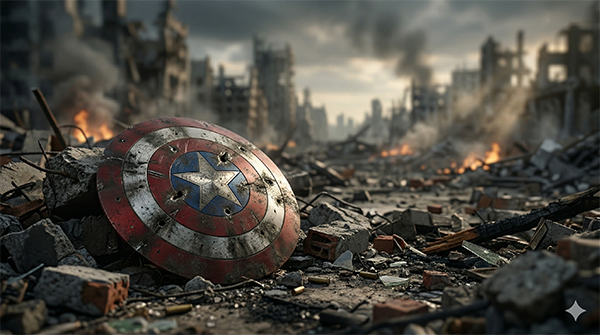
Cinematic ultra‑realistic 16:9 horizontal wallpaper (1920×1080), maximum resolution, post‑war devastation scene. The camera is very close to the ground, using macro focus on Captain America’s circular shield lying on the rubble in the foreground. The shield is extremely battle‑damaged: deep, severe scratches, bullet holes, heavy scrapes, chipped and peeled paint, dents, and even broken pieces along the rim, all covered with dirt, soot, dried mud, and dust from the battle. The vibranium metal still shows subtle reflections through the filth, with micro‑detail on every scar.
Around the shield, the ground is filled with war debris: chunks of broken concrete, twisted metal beams, scattered bricks, shattered glass, and burnt fragments of vehicles or structures. The mid‑ground and background show a vast destroyed cityscape, collapsed buildings, smoking craters, and distant fires. The entire background strip across the horizontal frame is blurred with a tilt‑shift, miniature‑style depth of field, creating a sharp band of focus around the shield and immediate rubble, while the upper and distant parts of the scene fade into soft blur.
The overall mood is somber and epic, as if the camera captured the aftermath of an enormous final battle where the shield was left behind.
Lighting
Use dramatic, cinematic late‑afternoon or overcast lighting. Soft directional light from one side grazes the shield and rubble, revealing texture, scratches, and dust with strong but controlled specular highlights. Smoke and dust in the air catch the light, creating volumetric rays and hazy glows over distant ruins. Color palette: desaturated grays and browns for rubble, with muted reds, whites, and blues on the shield, plus warm orange embers or small fires to add contrast.
Camera & Lens
Aspect ratio: 16:9 horizontal wallpaper, 1920×1080.
Camera position: very low, almost touching the ground, close to the shield for a macro‑style foreground.
Lens: wide‑to‑normal cinematic lens (approximately 24–35 mm full‑frame) combined with a tilt‑shift effect so that the sharp focus plane runs across the shield and nearby rubble, while the rest of the scene gradually blurs above and beyond it.
Depth of field: shallow and tilt‑shifted — shield and immediate foreground debris in razor‑sharp focus; middle and background city ruins softly blurred along the top and back of the frame.
Environment & Atmosphere
Post‑war, post‑apocalyptic urban battlefield:
Collapsed buildings, broken facades, exposed rebar, and half‑destroyed skyscrapers in the blurred background.
Thick smoke and haze hanging in the air, drifting across the scene; floating ash and dust particles visible around small light beams.
Scattered fires, glowing embers, faint sparks rising from wreckage.
Ground covered with layers of ash, spent shell casings, torn fabric, and other battlefield remnants, reinforcing the sense of a massive, recent conflict.
Negative Prompt
No clean or pristine shield; avoid smooth, undamaged metal or toy‑like plastic.
No visible superheroes or human figures; focus only on the shield and environment.
No bright, colorful, untouched buildings; no intact modern city or cheerful sky.
No cartoon, no anime, no cel‑shading, no comic‑panel halftone, no 2D illustration, no painterly look — keep photorealistic.
No low resolution, no pixelation, no strong noise, no motion blur on the shield, no compression artifacts, no warped shapes.
No text overlays, UI, logos, watermarks, borders, or split screens anywhere in the wallpaper.
Cinematic ultra‑realistic 16:9 horizontal wallpaper (1920×1080), maximum resolution, post‑war devastation scene. The camera is very close to the ground, using macro focus on Captain America’s circular shield lying on the rubble in the foreground. The shield is extremely battle‑damaged: deep, severe scratches, bullet holes, heavy scrapes, chipped and peeled paint, dents, and even broken pieces along the rim, all covered with dirt, soot, dried mud, and dust from the battle. The vibranium metal still shows subtle reflections through the filth, with micro‑detail on every scar.
Around the shield, the ground is filled with war debris: chunks of broken concrete, twisted metal beams, scattered bricks, shattered glass, and burnt fragments of vehicles or structures. The mid‑ground and background show a vast destroyed cityscape, collapsed buildings, smoking craters, and distant fires. The entire background strip across the horizontal frame is blurred with a tilt‑shift, miniature‑style depth of field, creating a sharp band of focus around the shield and immediate rubble, while the upper and distant parts of the scene fade into soft blur.
The overall mood is somber and epic, as if the camera captured the aftermath of an enormous final battle where the shield was left behind.
Lighting
Use dramatic, cinematic late‑afternoon or overcast lighting. Soft directional light from one side grazes the shield and rubble, revealing texture, scratches, and dust with strong but controlled specular highlights. Smoke and dust in the air catch the light, creating volumetric rays and hazy glows over distant ruins. Color palette: desaturated grays and browns for rubble, with muted reds, whites, and blues on the shield, plus warm orange embers or small fires to add contrast.
Camera & Lens
Aspect ratio: 16:9 horizontal wallpaper, 1920×1080.
Camera position: very low, almost touching the ground, close to the shield for a macro‑style foreground.
Lens: wide‑to‑normal cinematic lens (approximately 24–35 mm full‑frame) combined with a tilt‑shift effect so that the sharp focus plane runs across the shield and nearby rubble, while the rest of the scene gradually blurs above and beyond it.
Depth of field: shallow and tilt‑shifted — shield and immediate foreground debris in razor‑sharp focus; middle and background city ruins softly blurred along the top and back of the frame.
Environment & Atmosphere
Post‑war, post‑apocalyptic urban battlefield:
Collapsed buildings, broken facades, exposed rebar, and half‑destroyed skyscrapers in the blurred background.
Thick smoke and haze hanging in the air, drifting across the scene; floating ash and dust particles visible around small light beams.
Scattered fires, glowing embers, faint sparks rising from wreckage.
Ground covered with layers of ash, spent shell casings, torn fabric, and other battlefield remnants, reinforcing the sense of a massive, recent conflict.
Negative Prompt
No clean or pristine shield; avoid smooth, undamaged metal or toy‑like plastic.
No visible superheroes or human figures; focus only on the shield and environment.
No bright, colorful, untouched buildings; no intact modern city or cheerful sky.
No cartoon, no anime, no cel‑shading, no comic‑panel halftone, no 2D illustration, no painterly look — keep photorealistic.
No low resolution, no pixelation, no strong noise, no motion blur on the shield, no compression artifacts, no warped shapes.
No text overlays, UI, logos, watermarks, borders, or split screens anywhere in the wallpaper.