Wallpaper_v_cap_america
Positive Prompt
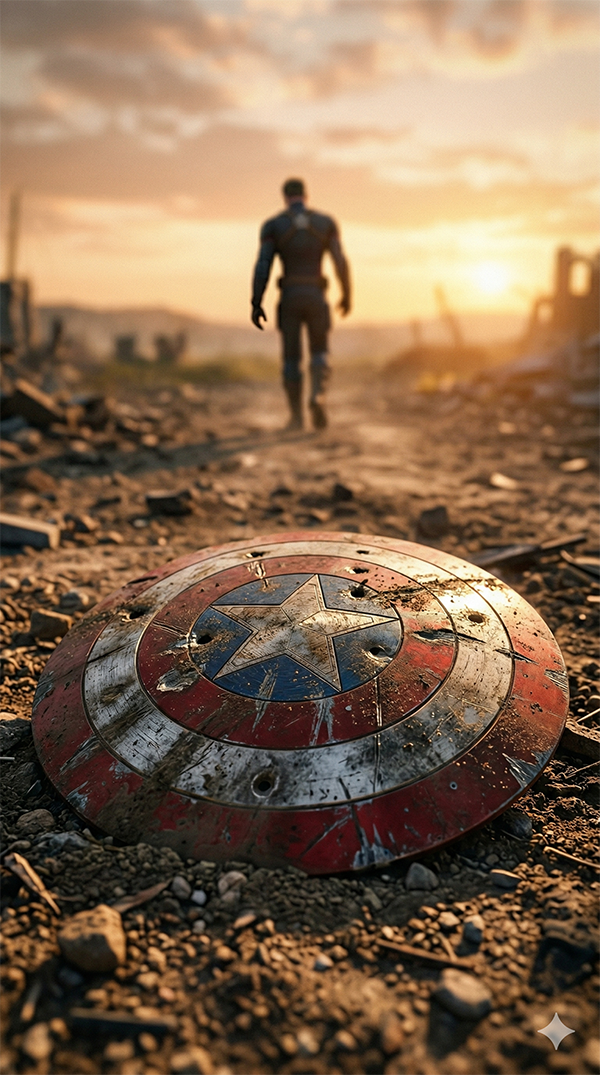
Create a cinematic ultra‑realistic scene in 9:16 vertical format. The camera is on the ground in a macro, extreme close‑up of Captain America’s shield lying in the dirt, right in front of the lens. The shield almost fills the foreground frame: circular red, white, and blue vibranium shield rendered with hyper‑detailed metal textures, heavily damaged by battle — deep scratches, long scrapes, bullet holes, dents, chipped paint, muddy stains, dried dust, and bent edges, with tiny reflections glinting along the worn metal surface.
In the distance, in the same scene, Captain America appears from behind, walking away toward a soft, golden late‑afternoon sunset. He is small in scale compared to the shield, silhouette slightly slumped from exhaustion, shield hand empty, heading toward the warm horizon. He is intentionally out of focus with a strong Gaussian‑blur style background blur, so his figure and the sunset are soft and dreamy, while the shield in the foreground remains razor‑sharp and detailed, emphasizing the end of a battle and a quiet, melancholic mood.
The environment is a war‑torn field or ruined street: broken asphalt or dirt, small stones, dust, and scattered debris around the shield. The sunset sky is painted with warm amber, orange, and soft pink tones, low sun near the horizon, with subtle light rays and haze.
Lighting
Use warm, late‑afternoon golden hour lighting. The low sun backlights Captain America and creates a glowing rim around his blurred silhouette. Soft, directional light grazes the shield’s surface from the side, revealing every scratch, dent, and texture, with small specular highlights on metal edges. Shadows on the ground are long and soft; overall contrast is cinematic but gentle, with warm golden tones dominating and a hint of cooler shadows in the foreground.
Camera, Lens & Depth of Field
Aspect ratio: 9:16 vertical.
Camera position: placed on the ground, at shield level, in front of the shield.
Lens: macro‑style close‑focus lens (around 85–100 mm macro equivalent) for an extreme close‑up of the shield.
Depth of field: very shallow — the shield and immediate ground in perfect sharpness, everything behind it (including Captain America and the sunset) rendered with smooth, Gaussian‑like bokeh blur.
Composition: shield dominates the lower and central part of the frame; Captain America’s blurred back‑view figure is placed in the upper third walking toward the horizon.
Visual Details
Render at 8K ultra‑high resolution, photorealistic. Emphasize:
Micro‑scratches, chipped paint layers, metal grain, rust hints, dirt clumps, and mud splatter on the shield.
Small pebbles, dust, and texture of the ground around the shield.
Soft, glowing sunset gradient in the sky, with hazy atmosphere and light scattering.
Smooth, cinematic background blur on Captain America and distant environment, like a high‑quality Gaussian blur simulating shallow depth of field.
Negative Prompt
No clean or pristine shield; avoid smooth undamaged metal. No front‑facing Captain America close‑up; he must appear far in the background, from behind, and noticeably blurred.
No anime, no cartoon, no cel‑shading, no comic‑panel halftone, no 2D illustration, no stylized painting.
No low resolution, no noise, no pixelation, no motion blur on the shield, no compression artifacts, no warped shapes.
No indoor studio, no bright midday light, no sci‑fi interiors; it must be an outdoor battlefield or ruined field at sunset.
No text overlays, no HUD, no logos, no watermarks, no borders, no split screens.
Create a cinematic ultra‑realistic scene in 9:16 vertical format. The camera is on the ground in a macro, extreme close‑up of Captain America’s shield lying in the dirt, right in front of the lens. The shield almost fills the foreground frame: circular red, white, and blue vibranium shield rendered with hyper‑detailed metal textures, heavily damaged by battle — deep scratches, long scrapes, bullet holes, dents, chipped paint, muddy stains, dried dust, and bent edges, with tiny reflections glinting along the worn metal surface.
In the distance, in the same scene, Captain America appears from behind, walking away toward a soft, golden late‑afternoon sunset. He is small in scale compared to the shield, silhouette slightly slumped from exhaustion, shield hand empty, heading toward the warm horizon. He is intentionally out of focus with a strong Gaussian‑blur style background blur, so his figure and the sunset are soft and dreamy, while the shield in the foreground remains razor‑sharp and detailed, emphasizing the end of a battle and a quiet, melancholic mood.
The environment is a war‑torn field or ruined street: broken asphalt or dirt, small stones, dust, and scattered debris around the shield. The sunset sky is painted with warm amber, orange, and soft pink tones, low sun near the horizon, with subtle light rays and haze.
Lighting
Use warm, late‑afternoon golden hour lighting. The low sun backlights Captain America and creates a glowing rim around his blurred silhouette. Soft, directional light grazes the shield’s surface from the side, revealing every scratch, dent, and texture, with small specular highlights on metal edges. Shadows on the ground are long and soft; overall contrast is cinematic but gentle, with warm golden tones dominating and a hint of cooler shadows in the foreground.
Camera, Lens & Depth of Field
Aspect ratio: 9:16 vertical.
Camera position: placed on the ground, at shield level, in front of the shield.
Lens: macro‑style close‑focus lens (around 85–100 mm macro equivalent) for an extreme close‑up of the shield.
Depth of field: very shallow — the shield and immediate ground in perfect sharpness, everything behind it (including Captain America and the sunset) rendered with smooth, Gaussian‑like bokeh blur.
Composition: shield dominates the lower and central part of the frame; Captain America’s blurred back‑view figure is placed in the upper third walking toward the horizon.
Visual Details
Render at 8K ultra‑high resolution, photorealistic. Emphasize:
Micro‑scratches, chipped paint layers, metal grain, rust hints, dirt clumps, and mud splatter on the shield.
Small pebbles, dust, and texture of the ground around the shield.
Soft, glowing sunset gradient in the sky, with hazy atmosphere and light scattering.
Smooth, cinematic background blur on Captain America and distant environment, like a high‑quality Gaussian blur simulating shallow depth of field.
Negative Prompt
No clean or pristine shield; avoid smooth undamaged metal. No front‑facing Captain America close‑up; he must appear far in the background, from behind, and noticeably blurred.
No anime, no cartoon, no cel‑shading, no comic‑panel halftone, no 2D illustration, no stylized painting.
No low resolution, no noise, no pixelation, no motion blur on the shield, no compression artifacts, no warped shapes.
No indoor studio, no bright midday light, no sci‑fi interiors; it must be an outdoor battlefield or ruined field at sunset.
No text overlays, no HUD, no logos, no watermarks, no borders, no split screens.